

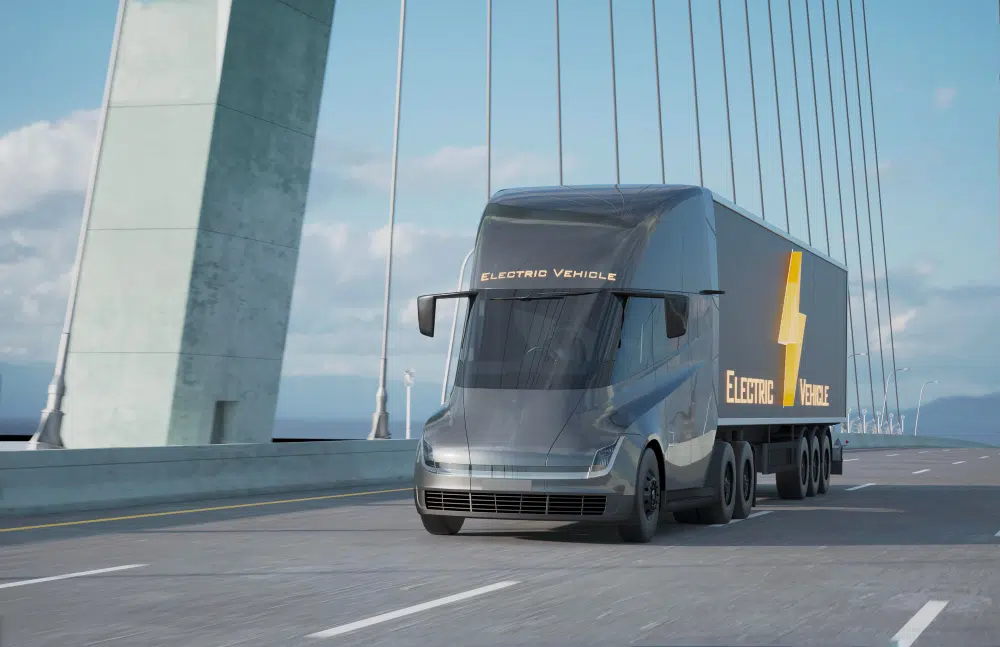
Tesla’s long-delayed electric Semi is no longer just a flashy promise. It’s rolling, and the early reaction from the people who actually drive big rigs for a living is unexpectedly positive.
Test drivers and fleet operators say the truck feels easier to handle than a traditional diesel, delivers instant power under load, and rethinks the cab in a way that matters on long days. That matters in an industry that doesn’t buy new tractors like consumers buy phones, and that’s currently dealing with softer freight demand, rising labor costs, and tariff-driven uncertainty.
Tesla is betting the Semi’s headline numbers, up to 500 miles of range and a fast-charge pitch built around a 30-minute stop, can break through the skepticism. The company is also pointing to a production ramp targeted for summer 2026.
A center-seat cab that truckers actually like
The feature drivers keep coming back to isn’t a touchscreen or a gimmick. It’s the seat, dead center.
In the Tesla Semi, the driver sits on the truck’s centerline instead of the left side. Testers say that changes how you judge the rig’s size and angles, especially when maneuvering. With camera-based mirrors and better sightlines, some drivers report feeling more “planted” in the lane, no small thing when you’re hauling a 40-foot trailer.
Several drivers also describe the Semi as less tiring to operate than a diesel. No 18-speed shifting. Less pedal work in stop-and-go traffic. The electric power delivery is smoother and more linear, they say, which can reduce fatigue over a long shift, and could help fleets recruit in a job market where experienced drivers are hard to find.
One story from testing stuck: a driver took a wrong turn into a tight corner, exactly the kind of mistake that can burn time and spike stress. He said he was able to recover without much drama, thanks in part to visibility and camera assistance. For fleets, that’s not “tech.” That’s fewer delays and fewer costly incidents.
These are still controlled tests, often with motivated drivers and planned routes. Real-world adoption will depend on day-to-day operations, yards, schedules, charging access, and habits. But the blunt takeaway is hard to ignore: some veteran truckers say they don’t want to go back to diesel.
Big power numbers, aimed at hills, not drag races
Tesla is touting a tri-motor setup rated at 800 kW, roughly the kind of output people associate with 1,000-plus horsepower. The point isn’t to win a highway sprint. It’s to avoid bogging down on grades with a heavy load.
One widely repeated claim: 0 to 60 mph in about 20 seconds while fully loaded. Comparable diesel rigs can take closer to 45 to 60 seconds depending on configuration. In practical terms, that could mean less white-knuckle climbing and fewer moments crawling up a ramp at 30 mph while traffic stacks up behind you.
On efficiency, published estimates cited in the report put the Semi at about 1.7 kWh per mile at a gross combined weight of 82,000 pounds. That’s a serious-duty number, not a last-mile delivery van metric, though it will vary with weather, terrain, wind, and driving style.
Tesla is also pitching an ePTO (electric power take-off) rated at 25 kW to run equipment like refrigerated trailers without a separate diesel auxiliary unit. If it works as advertised, that could cut fuel burn, maintenance, and noise for cold-chain fleets.
Two range options: 325 miles or 500 miles
Tesla says it will offer two versions: a 325-mile “Standard Range” and a 500-mile “Long Range.” That’s a clear play for regional hauling, runs between ports, warehouses, and distribution hubs, rather than coast-to-coast routes with unpredictable stops.
For fleets, the choice will come down to operations math. The 325-mile version could work if trucks return to a depot with charging and have predictable windows to plug in. The 500-mile version offers more flexibility, but likely comes with a bigger battery, higher upfront cost, and potential weight tradeoffs.
Rivals’ electric trucks have sometimes been boxed into shorter real-world routes, around 225 miles in one example cited, because infrastructure and operational buffers weren’t there. Tesla’s bet is that enough range reduces the constant anxiety of detours, traffic jams, bad weather, and long waits at crowded docks.
fleets will judge the Semi on utilization: payload, stops, downtime, and whether real-world range holds up when conditions get ugly.
Tesla says 30 minutes can add 60% charge, if the chargers exist
Charging is the make-or-break issue for electric trucking, and Tesla is leaning hard on fast charging via the Megawatt Charging System (MCS 3.2). The company claims the Semi can recover 60% of its battery in 30 minutes.
That matters because a 30-minute stop fits into the rhythm of trucking in the U.S., where drivers already take breaks under hours-of-service rules. But only if chargers are available, reliable, and located where freight actually moves.
Building a heavy-duty charging network isn’t like sprinkling a few car chargers in a parking lot. It requires massive electrical capacity, real estate, transformers, permits, and ongoing maintenance. Fleets won’t tolerate trucks sitting idle because a station is down or backed up.
On operating costs, estimates cited put electricity at roughly $0.17 per mile versus about $0.50 to $0.70 per mile for diesel, depending on fuel prices and duty cycle. Even if those numbers swing, the gap explains the interest, over tens of thousands of miles a year, pennies add up fast. But fleets also have to factor in infrastructure costs, demand charges, and service contracts.
Maintenance could be another selling point. One fleet anecdote cited suggests an electric operation might need one mechanic where a diesel shop might need five for a 40-truck fleet. That’s a powerful claim in a market short on skilled technicians, though fleets will want multi-year reliability data and clarity on parts availability and repair times.
California money is accelerating orders, 1,002 Semis backed by $195 million
The strongest signal that this isn’t just hype may be the money already committed. In California, a zero-emission truck incentive program reportedly sold out quickly after reopening. Over the past six months, companies secured about $195 million in subsidies tied to 1,002 Tesla Semis.
For American readers: California isn’t just another state in this story. It sets some of the country’s toughest air-quality rules, and its ports, especially Los Angeles and Long Beach, are under heavy political and public-health pressure to cut diesel pollution. Short-haul “drayage” routes from port to warehouse are also among the easiest trucking jobs to electrify because they’re predictable and can be supported with dedicated charging.
Price remains the sticking point. Reports cited peg the Semi at under $300,000, roughly double the cost of a comparable diesel tractor, though also about $100,000 cheaper than some competing electric semis. Subsidies help soften the upfront hit, but fleets will still demand proof that total cost of ownership wins on energy, maintenance, and uptime.
Tesla says production will ramp starting in summer 2026, with manufacturing tied to Nevada and outside estimates suggesting deployments could reach as many as 15,000 units in 2026. That’s an ambitious target for a program that’s been delayed for years. The real test won’t be the demo runs, it’ll be whether Tesla can build them at scale, keep them on the road, and support fleets when something breaks at 2 a.m. on a worknight.
Key Takeaways
- Test drivers say they like the centered driving position and the visibility cameras.
- Tesla highlights 800 kW, 1.7 kWh/mile, and two range options: 325 and 500 miles.
- MCS 3.2 charging, announced as 60% in 30 minutes, aims to make stops compatible with fleet operations.
- In California, $195 million in grants have been secured for 1,002 Semis.
- The production ramp-up is slated for summer 2026, with major challenges around infrastructure and service.
Frequently Asked Questions
What do truck drivers like most about the Tesla Semi?
Test feedback mainly highlights the centered driving position, driving that’s considered easier than some diesel trucks, the power available under load, and the added visibility from the cameras when maneuvering.
What range does Tesla claim for the Semi?
Tesla offers two versions: a Standard Range rated at 325 miles and a Long Range rated at 500 miles, with a primary focus on regional freight and regular routes.
Is Tesla Semi charging really fast?
The manufacturer points to charging via the MCS 3.2 standard, which can add 60% capacity in 30 minutes. Real-world results will mainly depend on station availability, grid power, and charger reliability.
How much does the Tesla Semi cost compared with a diesel truck?
Reported estimates put the Semi under $300,000—about twice the price of an equivalent diesel truck. Tesla is also described as about $100,000 cheaper than some competing electric trucks, with incentives making it more attractive.
Why does California play a central role in the rollout?
A zero-emission vehicle incentive program there quickly filled up, and over the past six months companies secured $195 million for 1,002 Semis. Port and regional operations around Los Angeles and Long Beach fit planned routes and dedicated charging.
Sources
- Tesla Finally Has Its First Semi-Truck and It's Already a Hit … – calstart
- Truckers stunned by bizarre feature of Tesla's new semi-truck
- Tesla Semi Finally Hits the Road – And Truckers Are Actually …
- Truckers love Tesla's electric semi-truck. Here's why. – Yahoo Finance
- Tesla Semi earns strong reviews veteran truckers