

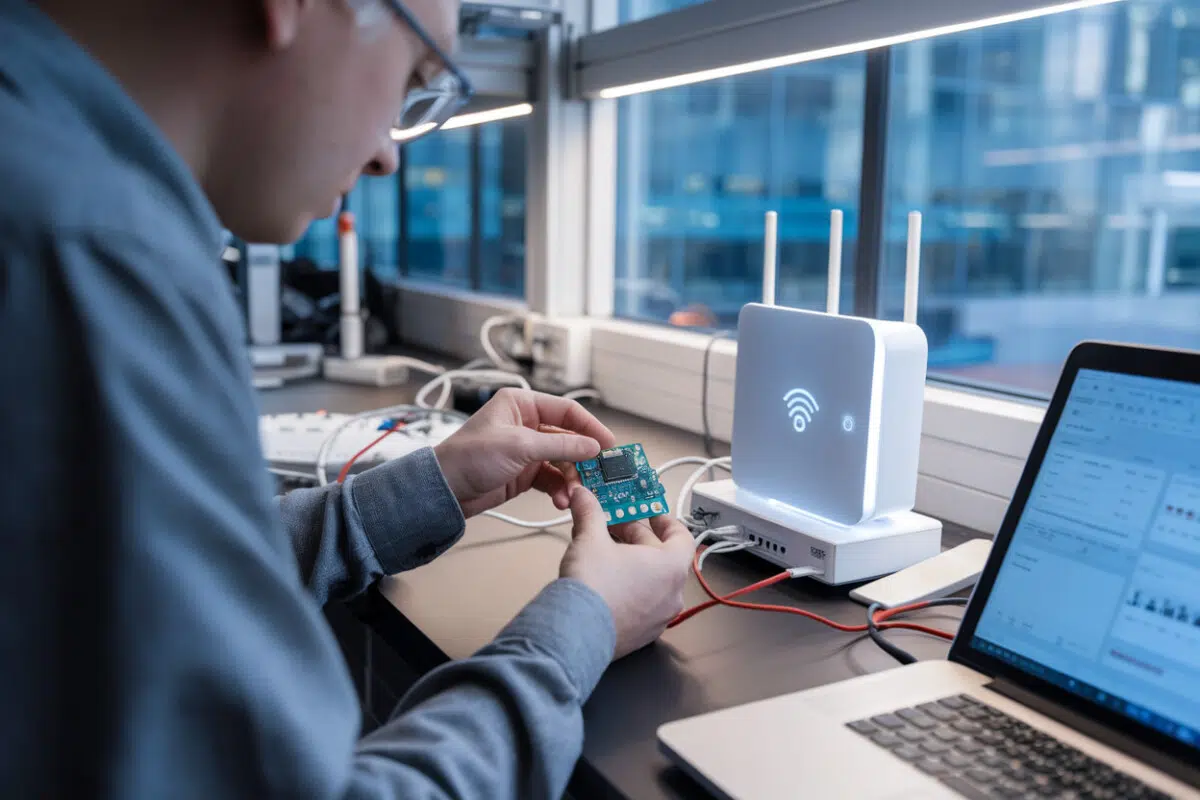
Wi‑Fi 7 has mostly lived in pricey routers and flagship phones. Synaptics wants to drag it into everyday smart devices, doorbells, thermostats, factory sensors, by bundling next-gen wireless and on-device AI into a single chip.
The company’s new SYN765x module is aimed squarely at battery-powered IoT gear that needs to respond fast without constantly pinging the cloud. The pitch: lower cost and complexity by collapsing multiple radios and edge computing into one part, while using the cleaner 6 GHz band to reduce interference and lag, if your network is ready for it.
One chip, three wireless standards: Wi‑Fi 7, Bluetooth LE, and Thread/Zigbee
The headline feature is consolidation. SYN765x combines Wi‑Fi 7 with Bluetooth Low Energy (BLE) 6.0 and Thread/Zigbee (the 802.15.4 mesh tech common in smart homes) on a single chip. For device makers, that can mean fewer separate modules, a simpler circuit board, fewer antenna headaches, and an easier path through certification and manufacturing.
Synaptics is also leaning into tri-band support, 2.4 GHz, 5 GHz, and 6 GHz. For consumers, 6 GHz can be a relief valve in apartment buildings where 2.4 GHz is jammed with everything from older routers to baby monitors. For industrial deployments, it can offer more predictable RF conditions, assuming the site has compatible infrastructure.
There’s also an interoperability angle. Many smart-home products effectively live a double life: Wi‑Fi for higher bandwidth, Thread or Zigbee for low-power mesh networking. A single hardware platform that can serve both worlds could reduce the need for extra hubs and bridges, at least in theory.
But combining radio stacks doesn’t magically simplify software. More protocols mean more firmware updates, more coexistence tuning, and more regulatory compliance work across markets. The user experience will depend heavily on how well manufacturers implement security and long-term updates.
Why Wi‑Fi 7, and especially 6 GHz, matters for battery-powered devices
Synaptics is selling Wi‑Fi 7 as a latency play: faster reconnections, smoother band switching, and more responsive links for devices that can’t afford hiccups. Think a video doorbell that needs to push a clip instantly after a brief drop, or a home hub juggling multiple devices without stutter.
The 6 GHz band is central to that argument. In dense neighborhoods, 2.4 GHz can be a brawl, and 5 GHz fills up quickly too. A less congested band can mean fewer retransmissions, often a hidden battery drain, though the benefit depends on having a Wi‑Fi 6E/7-capable router and a network environment that actually uses 6 GHz.
Synaptics also frames the chip as a way to make Wi‑Fi 7 practical in IoT, where tight margins and power budgets have kept the newest Wi‑Fi standards out of many products. Integrating more functions into one component can reduce the bill of materials and speed up design cycles.
Still, “low power” has limits. Wi‑Fi generally draws more power than ultra-frugal mesh networks. If manufacturers slap Wi‑Fi 7 into devices that don’t need it, battery life could take a hit depending on usage patterns, sleep strategies, and network quality.
Built-in edge AI: Arm Cortex‑M52 plus an Arm U55 NPU
The other half of the SYN765x story is compute. Synaptics calls it an “AI-native” Wi‑Fi 7 MCU, built around an Arm Cortex‑M52 microcontroller and an Arm U55 neural processing unit. The company claims up to 50 GOPS (giga operations per second) of AI performance, aimed at running compact models directly on the device.
In plain English: instead of streaming raw sensor data to the cloud, devices could do quick classification and filtering locally, spot meaningful motion on a camera, flag an abnormal vibration pattern on a factory sensor, or trigger an alert without waiting on a round trip to a server.
That can cut bandwidth use and reduce latency, and it can keep more sensitive data on-device, an increasingly important selling point as privacy rules tighten and consumers get more wary of always-on cloud connections.
The catch is that “edge AI” lives or dies on tooling, memory, and deployment pipelines, details not fully spelled out in the announcement. A capable NPU is only as useful as the software ecosystem that helps developers ship reliable models at scale.
Bluetooth “Channel Sounding” aims to estimate distance without UWB
Synaptics is also highlighting Bluetooth Channel Sounding, a feature designed to improve proximity and distance estimation using Bluetooth, potentially enabling “walk up and unlock” scenarios for smart locks, presence-based lighting triggers, or asset tracking in warehouses.
The subtext: this could cover some use cases typically associated with ultra-wideband (UWB) or mmWave radar. UWB is known for precision, Apple’s AirTag ecosystem helped popularize it in the U.S., but it adds cost and isn’t universal across devices. mmWave radar can do impressive sensing, but often demands more RF expertise and processing.
If Bluetooth-based ranging is “good enough” for mass-market scenarios, it could be a pragmatic option for high-volume products. But radio-based sensing can be finicky in real homes and workplaces, where walls, interference, and even furniture changes can throw off results and create false positives.
Smart homes and industrial IoT are the targets, and the chip can run solo or as a coprocessor
Synaptics is positioning SYN765x for smart-home devices, connected appliances, and industrial IoT. The company says it can be deployed as a coprocessor alongside an existing main processor, or in some designs operate without a host processor at all.
That flexibility matters for manufacturers with established platforms: a coprocessor approach can modernize connectivity and add some on-device intelligence without forcing a full redesign. In industrial settings, it could let a real-time control MCU keep doing its job while SYN765x handles wireless links and selected analytics.
Whether Wi‑Fi 7 becomes common in IoT will hinge on more than silicon. It requires Wi‑Fi 7 routers and enterprise policies that allow 6 GHz, plus teams willing to maintain firmware for years. And as devices get faster and smarter, the attack surface grows, making security updates and vulnerability management non-negotiable.
Key Takeaways
- The <strong>SYN765x</strong> combines <strong>Wi‑Fi 7</strong>, <strong>Bluetooth LE 6.0</strong>, and <strong>Thread/Zigbee</strong> on a single chip.
- Synaptics is emphasizing <strong>6 GHz</strong> to reduce interference and latency in IoT.
- The chip includes an <strong>Arm Cortex‑M52</strong> and a <strong>U55 NPU</strong>, rated at up to <strong>50 GOPS</strong>.
- <strong>Bluetooth Channel Sounding</strong> is positioned as a more power-efficient alternative to <strong>UWB</strong> for certain ranging use cases.
- The SYN765x can run as a <strong>coprocessor</strong> or in a standalone configuration, depending on the product.
Frequently Asked Questions
What is Synaptics’ SYN765x?
The SYN765x is a single-chip solution for connected devices that combines Wi‑Fi 7, Bluetooth LE 6.0, Thread/Zigbee, and compute capabilities to run AI processing directly on the device.
Why is Wi‑Fi 7 important for IoT?
Synaptics highlights more responsive connectivity, better band management, and access to 6 GHz, which can reduce interference and retransmissions. For battery-powered devices, fewer retransmissions can also help reduce power consumption, depending on the use case.
What does “edge AI” mean for the SYN765x?
It refers to running analysis or classification tasks locally, without routinely sending raw data to a remote server. Synaptics cites an architecture with a Cortex‑M52 and a U55 NPU, rated up to 50 GOPS, to handle control functions and signal processing close to the sensors.
What is the Bluetooth Channel Sounding mentioned by Synaptics used for?
Synaptics presents it as a more energy-efficient way to measure distance, which can be used for proximity and presence detection. The company says it can be an alternative to approaches like UWB or mmWave radar in certain scenarios.
Does the SYN765x replace the main processor in a connected device?
Not necessarily. Synaptics says the chip can be deployed as a coprocessor alongside an application processor or an existing MCU, or run in a standalone, hostless configuration, depending on the product design.