

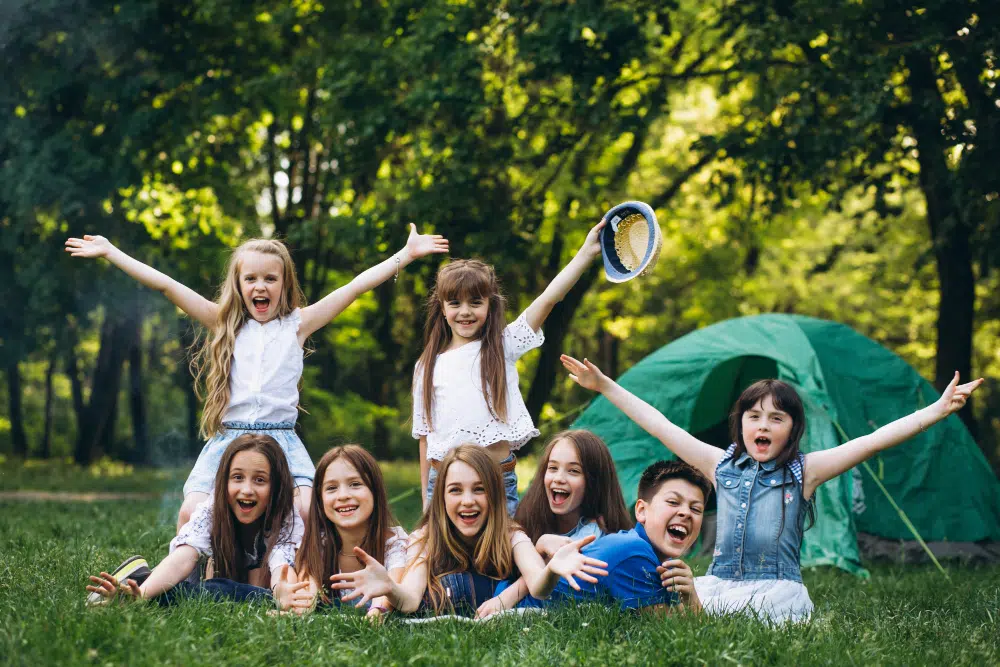
For more than a century, French “colonies de vacances”, the group summer camps known simply as “colos”, have been a childhood staple. But in France, these aren’t just places to swim, hike, and survive cafeteria food. They’re a national institution that helped democratize vacations, mix social classes, and teach kids how to live together outside the family bubble.
Even now, as parenting norms shift and safety rules tighten, the French camp model keeps reinventing itself. And it continues to leave fingerprints everywhere: in film and books, in arts education, and in the way generations of French adults remember their first taste of independence.
The roots of France’s summer camps go back to the late 19th century, when reformers pushed a public-health and social mission: get working-class kids out of crowded cities and into fresh air and nature. A Swiss pastor, Hermann Walter Bion, is credited with organizing what’s often described as Europe’s first modern camp in 1876, and the idea quickly spread into France.
After World War II, “colos” became something closer to public policy than a pastime. The French state and company “works councils” (employee committees that help fund benefits) poured money into organized trips, sending millions of children away each summer. The camps tracked with the broader postwar expansion of paid vacation in Europe, and helped build a shared cultural experience around childhood, community, and mixing across class lines.
That tradition still runs through today’s camp operators. Groups such as GoColo market trips built around community living and personal growth, often in rural regions like Auvergne and Aveyron, the kind of countryside settings that echo the movement’s original “back to nature” pitch.
How French pop culture turned camp into a symbol
In the U.S., summer camp stories are a genre. In France, “colo” stories are practically a cultural shorthand, for freedom, first crushes, group drama, and the thrill of being away from home.
On screen,Les Vacances du Petit Nicolas(2014), adapted from the beloved children’s books by René Goscinny and illustrator Jean-Jacques Sempé, plays camp life for warmth and comedy: the bus ride out, overwhelmed counselors, unlikely friendships, and legendary mischief. More recently, the TV seriesColo(2019) on TF1, one of France’s biggest broadcast networks, revived the theme by leaning into the social dynamics that define group stays.
The camp-adjacent vibe goes back decades. Films likeLa Guerre des boutons(1962) captured the same spirit of kid-run adventure and budding autonomy, even when the plot wasn’t literally set at a camp.
In children’s literature, camps have long been a recurring setting, especially in classic French youth series published under the “Bibliothèque Verte” and “Bibliothèque Rose” labels, roughly comparable to the way Scholastic series shaped generations of American readers. More recently, graphic novels and comics have mined camp as a coming-of-age stage, sometimes with humor, sometimes with nostalgia.
A gateway to arts education, and new tech
Beyond nostalgia, French camps often serve as a real on-ramp to culture. For many kids, a “colo” is their first chance to try creative activities they might not get at home or in school.
In recent years, themed camps have expanded sharply: theater workshops, photography introductions, circus training, dance intensives, and music programs. The point isn’t just to keep kids busy. Organizers sell these activities as confidence-builders that also teach collaboration, skills that can be harder to cultivate in a traditional classroom.
Some camps now lean into modern interests, offering video production, editing, and even robotics. The message is clear: camp isn’t stuck in the past. It’s trying to meet kids where they are, and, in the best cases, act as a low-stakes lab where a child can discover a passion that later becomes academic or professional.
The French “rite of passage” Americans might not recognize
In the French imagination, summer camp holds a place that’s closer to a national rite of passage than a niche activity. Sociologists who study youth leisure in France often describe the “colo” as a formative break between sheltered childhood and a first real taste of autonomy, a role they argue doesn’t map neatly onto most European countries.
The memories are built around rituals: the first night away from home, campfire gatherings, evening “veillées” (group nights of skits, songs, and games), and the end-of-session show. Those traditions get passed down like folklore.
Research from OVLEJ, a French research group focused on children’s and youth vacations and leisure, has found that group trips can significantly support kids’ social and emotional development, reinforcing what many French parents and former campers already believe: the experience changes you.
A living tradition that keeps adapting
France’s camp model hasn’t disappeared, it’s evolved. Families’ expectations have shifted, themes have multiplied, and safety and training standards have tightened. But the core pitch remains stubbornly consistent: give kids a space to explore, meet people outside their usual circles, and grow up a little.
That staying power helps explain why “colos” keep resurfacing in French media and storytelling. They reflect a distinctly French idea of education, one that treats social learning and personal development as seriously as academics, and sees the group as a pathway to individual independence.