

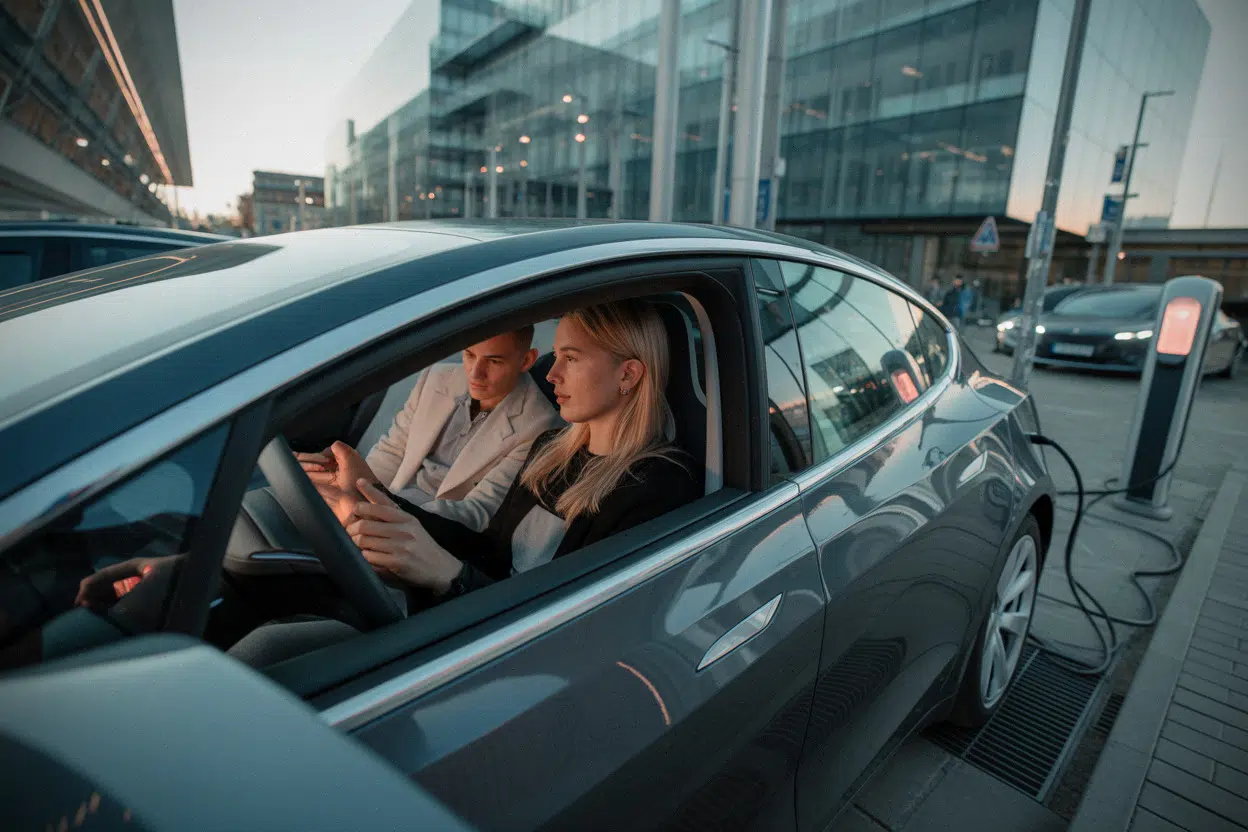
Tesla has started rolling out Grok—the artificial intelligence assistant developed by xAI—to eligible vehicles in Belgium through a free over-the-air software update, according to multiple posts circulated on July 23, 2026.
The move lands as Tesla continues to expand software-driven features in Belgium, including a gradual activation of driver-assistance functions and a broader push of connected services. Grok’s arrival is drawing extra scrutiny because the assistant, tied to Elon Musk, carries a reputation for controversy over tone, answers, and the guardrails expected from an in-car system.
Inside the cabin, Grok is positioned as an added conversational layer on top of existing controls, aiming to make the interface feel more natural. For Belgian drivers, the immediate questions are practical: which models get it, what conditions apply, what the limits are—and how much trust to place in an AI assistant when it touches navigation, driving-related tasks, or safety settings.
Tesla turns on Grok in Belgium through a free over-the-air update
The Belgium rollout is being delivered via an OTA update—Tesla’s standard method for adding or changing features without a service visit. Multiple sources say Grok is becoming available on eligible vehicles through a phased rollout, a familiar Tesla approach where access can depend on onboard hardware, software version, and sometimes region.
For drivers, the change shows up directly in the user interface, with a new assistant or a dedicated option appearing in the menus. The broader bet is that an AI assistant can reduce friction—fewer taps through menus, more natural language requests.
In practice, that could mean asking for a route, adjusting climate settings, placing a call, or requesting contextual information without navigating multiple screens. The open question is how far the assistant is allowed to go: Tesla already offers voice commands, and Grok introduces a more general-purpose AI, which raises safety tradeoffs—some actions may require confirmation, while others could be limited while the car is moving.
The integration also signals strategy. By bringing in a tool linked to xAI, Tesla tightens the connection between its in-car software and Musk’s broader ecosystem. That could speed innovation, but it also exposes Tesla to the controversies surrounding Grok—especially if a more talkative assistant becomes a distraction or encourages risky behavior behind the wheel.
Even framed as a free update, the rollout highlights how the modern car is increasingly an evolving software product. Features can arrive after purchase, and a free launch can serve as a springboard for future optional services, subscriptions, or partnerships centered on in-car AI and personalized assistance.
In day-to-day use, the first scenarios are expected to center on navigation—searching destinations and managing routes. A system like Grok could let drivers phrase more natural requests, such as building a trip around constraints: avoiding tolls, routing via a charging station, favoring highways, or choosing the shortest path.
How useful that becomes will depend on whether the AI can understand context, restate requests clearly, and offer alternatives without overwhelming the driver with information.
Comfort controls are another likely proving ground. In a Tesla, many settings run through the center screen, which pushes some drivers toward voice. Temperature, defogging, volume, ventilation management—and in some cases opening certain elements—could theoretically be handled by an assistant, but only if it responds quickly, asks for confirmation when needed, and avoids misinterpretations that force drivers to repeat themselves.
Belgium’s multilingual reality could also shape the experience, particularly between French and Dutch. Strong performance across languages would lower barriers and make the feature more compelling; poor comprehension, awkward answers, or trouble with local place names could quickly turn the novelty into a gimmick.
Beyond controls, Grok could be used for information—weather, news, calendar reminders, or explanations about the vehicle. Many drivers like being able to ask about range, consumption, or charge status without digging through submenus. The key distinction is between general conversation and vehicle data: an AI may sound confident, but it can’t afford to invent technical information. Any approximation about range or charging could lead to bad decisions.
And then there’s the core tension: an assistant can reduce distraction if it’s designed well, but it can also increase distraction if responses get too long, too jokey, or if drivers start treating it like a conversation partner—especially in dense traffic environments.
Grok, xAI, and Elon Musk: an integration that revives controversy
Mentioning Grok quickly pulls the discussion beyond cars. Because the assistant is associated with Elon Musk and xAI, it draws debate over response style, moderation, and how tightly the tool is governed. Consumer AI assistants are judged not just on reliability, but also on their ability to avoid problematic content—an even bigger concern in a vehicle, where the system may be used in a private space and potentially around children or passengers.
For Tesla, the reputational risk is real. The company sells a premium product heavily dependent on software, and its customer base is sensitive to safety and compliance. Any controversy over inappropriate responses, bias, or an overly provocative “personality” could become a media issue—particularly in Belgium, where digital regulation and European standards are closely watched.
The technical challenge is building guardrails. An in-car assistant must refuse certain requests, constrain others, and avoid “hallucinations”—made-up answers presented as fact. In a vehicle, the line is clear: an AI shouldn’t give dangerous advice, encourage illegal behavior, or replace safety procedures. Users may test boundaries intentionally or not, and screenshots or videos can spread quickly, raising the stakes for anticipating sensitive scenarios.
The rollout also raises questions about dependence on a single ecosystem. Leaning on xAI reinforces the idea of vertical integration—hardware, software, services, AI. Some customers may see that as a smoother experience; others may worry about lock-in, the ability to choose a different assistant, or transparency around updates that can change how the system behaves over time.
More broadly, Grok’s arrival in Belgian Teslas comes as public attention to AI risks has intensified—not only around outputs, but also training data, commercial priorities, and governance. In that climate, success will hinge as much on trust and clear limits as on the quality of the feature itself.
Data privacy and European rules loom large in Belgium’s connected-car debate
Adding a conversational assistant to a connected car immediately raises data questions. Voice interaction typically involves capturing speech, transcribing it, and processing it locally or remotely. For Belgian drivers, the practical concerns are what information is collected, how long it’s kept, and for what purpose.
The issue is compounded because vehicles already generate extensive data—location, routes, energy use, telemetry—and a conversational layer adds more potential touchpoints.
Across the European Union, privacy expectations are high, and users tend to demand clear settings. Teslas already include some data-sharing controls, but integrating a new assistant may require more explicit options: turning features on or off, managing history, and understanding what’s necessary for the service. In practice, control comes through the interface and through privacy policies that can be long and technical—making plain-language communication more important.
Location is central. If the assistant is used for navigation, charger searches, or place recommendations, access to position data is close to essential. The friction point becomes granularity—always-on access versus only during use—and whether that data can be tied to a user account. With many Belgian drivers regularly crossing borders, questions can also arise about cross-border data handling: the car crosses national lines without changing software, but compliance expectations still need to remain consistent.
Security also intersects with authentication. If an assistant can execute actions, it may need to distinguish driver from passenger in at least some situations. If an AI can open a trunk, change a critical setting, or interact with driving-related functions, authorization matters. Making actions easier through AI increases the importance of safeguards—voice confirmations, limits while moving, or restrictions tied to profiles.
Ultimately, Grok’s Belgium rollout illustrates a broader shift: regulators and consumers increasingly want proof of compliance, not just promises. Early user feedback, any incidents, and Tesla’s ability to correct problems quickly through updates will shape whether in-car AI is seen as genuinely helpful—or as intrusive and unpredictable.
Key takeaways
Tesla is rolling out Grok in Belgium via a free software update to eligible vehicles. The assistant is expected to be used heavily for navigation and voice controls, raising questions about distraction. Because Grok is linked to xAI and Elon Musk, the integration revives debates over guardrails and content moderation. Data privacy and consent carry extra weight in Europe’s connected-car environment, and adoption may hinge on reliability, multilingual performance, and transparent settings.
Sources
Combourse; Sudinfo; L’Echo (Facebook posts); The Brussels Times.
https://www.europe-infos.fr/actualites/10155/8170-e-590-me-viridien-viri-sur-euronext-paris-ecarts-de-cotation-et-liquidite-ce-signal-inattendu-a-surveiller-en-2026/
Key Takeaways
- Tesla is rolling out Grok in Belgium via a free software update for eligible vehicles.
- The assistant is mainly aimed at navigation and voice commands, raising concerns about driver distraction.
- Grok’s integration, tied to xAI and Elon Musk, is reigniting debates about safeguards and content.
- Data and privacy concerns are growing as connected cars expand in Europe.
- Adoption will depend on reliability, multilingual support, and transparent settings.