


SK Hynix has raised $26.5 billion in the United States after pricing its American depositary receipts, or ADRs, at $149, according to information reported by Boursorama.
The fundraising lands as semiconductor companies push to lock in deep investment capacity, with demand tied to computing infrastructure and servers still a central driver in memory markets. At this size, the deal stands out as one of the most closely watched tech financings of the moment, immediately shaping how investors read valuations and market conditions.
SK Hynix prices its ADRs at $149
The $149 ADR price is the key reference point for U.S. investors sizing up SK Hynix’s relative value and the entry price being offered. In a transaction like this, pricing is more than a number—it reflects a tradeoff between maximizing proceeds and keeping aftermarket trading stable once the securities begin changing hands.
That calibration is often treated as a test of order-book depth, especially when the transaction reaches an unusually large scale.
ADRs—American Depositary Receipts—give investors a simplified way to access a foreign stock through U.S. market infrastructure and trading. For an Asian semiconductor company, the appeal is twofold: expanding the potential investor base and gaining more direct visibility with managers who prefer U.S. venues.
The format also comes with higher expectations around financial disclosure, analyst coverage, and constant comparison with peers already well established in U.S. markets.
The $149 level is also being scrutinized for what it implies about valuation multiples, particularly against other tech names exposed to AI and the memory cycle. Investors weigh whether the pricing suggests a premium or discount versus companies with similar positioning, industrial capacity, and sensitivity to chip pricing.
In memory, perceptions of the cycle matter. Even small shifts in expectations around selling prices or inventories can quickly change how risk is priced.
For SK Hynix, the reputational stakes in the U.S. market are significant. A well-absorbed transaction can improve liquidity, broaden analyst coverage, and lower future financing costs. But sharp volatility after pricing can fuel the view that the deal was too aggressively priced or that the market is saturated in the near term.
That’s why large ADR offerings typically involve tight coordination among the issuer, banks, and institutional investors, with close monitoring of early trading.

A $26.5 billion raise—rare at this scale
The $26.5 billion total is drawing attention because it’s an uncommon size for an ADR-linked transaction in the semiconductor sector. At this level, the deal goes beyond opportunistic financing and becomes a market marker—an indicator of capital appetite for hardware technology at a time when AI, data centers, and supply-chain sovereignty are pushing companies toward heavier investment.
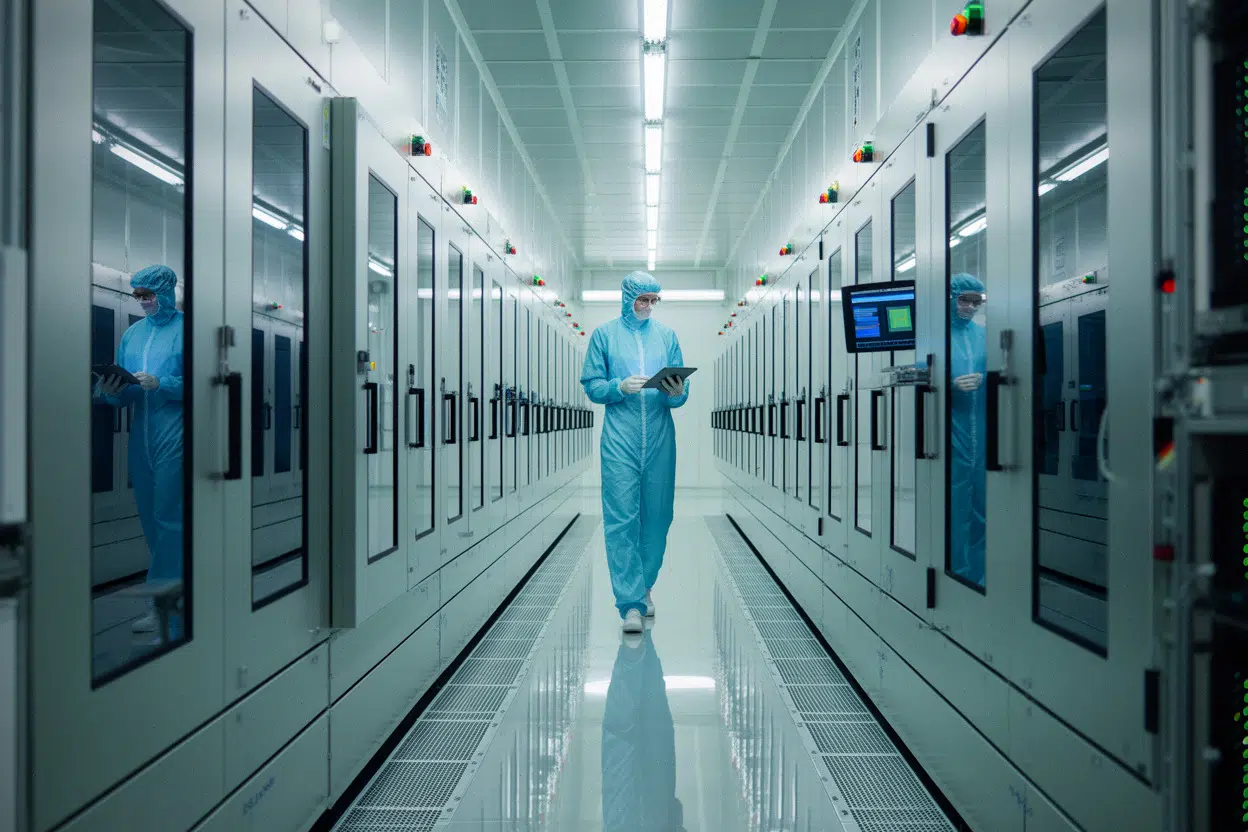
In the memory industry, capital needs are structurally high. Factories, lithography equipment, clean rooms, and testing tools can absorb billions of dollars in spending over just a few quarters.
A raise of this magnitude can serve multiple goals: strengthening financial flexibility, supporting an investment plan, smoothing the maturity schedule, and providing a cushion against historically cyclical chip-price volatility.
The U.S. setting matters, too. American markets offer deep pools of capital and a tech-investing culture that can support large amounts—especially when the investment theme is easy to understand. Institutional investors tend to value liquidity and standardization, which can make access to financing smoother than on other exchanges, provided execution is strong and financial messaging stays consistent.
A $26.5 billion transaction can also create second-order effects. It may increase the stock’s sensitivity to U.S. macroeconomic news, the cost of the dollar, and interest-rate moves, as the investor base and flows become more tied to the core U.S. market.
It can also intensify comparisons with giants already valued on AI narratives. In that environment, operating performance, capacity discipline, and inventory management become even more decisive in maintaining investor confidence.
Why the U.S. market: liquidity and a broader investor base
Raising funds in the United States through ADRs often comes down to liquidity and shareholder-base diversification. Many U.S. investors allocate through vehicles that favor domestic markets, creating a practical barrier for stocks primarily listed elsewhere.
ADRs reduce that friction by offering a holding format aligned with local market conventions, which can improve trading flow.
The logic is even stronger in sectors where the investment story is built around dominant themes such as AI, data centers, and the modernization of digital infrastructure. U.S. managers often compare companies using familiar frameworks: addressable growth, capital spending, gross margin, and the ability to secure long-term contracts.
An ADR presence makes those comparisons easier and can, depending on the period, reduce any discount tied to geographic distance or access complexity.
Liquidity also helps absorb large volumes—critical when the raise reaches $26.5 billion. Lead banks aim to place shares with investors capable of taking large allocations. The U.S. market’s density of participants—index funds, active funds, and technology-focused specialists—can reduce concentration risk.
As a result, the deal can be structured to limit initial volatility, even though no structure can fully eliminate market risk.
The tradeoff is higher expectations for investor relations. Communications must be frequent and consistent, and sector comparisons are unavoidable. U.S. markets can quickly punish gaps between promises and execution, particularly on investment timelines and profitability metrics.
For SK Hynix, the challenge is turning the raise into a lasting advantage—showing a clear financing and investment path without weakening its financial structure if the memory cycle turns.
Investors focus on what the money means for memory strategy
Beyond the $26.5 billion headline and the $149 price, investors are trying to understand how the funds will be used and what it means for industrial strategy. In semiconductors, memory is known for sharper cycles than other segments, with periods of tight supply followed by corrections.
A raise of $26.5 billion can be read as an intent to accelerate, but it can also raise questions about overcapacity risk if multiple players invest at the same time.
Markets are looking for specific signals: production discipline, prioritization of technology nodes, the ability to shift toward higher-value products, and inventory management. For SK Hynix, the equation is capturing demand tied to servers and computing infrastructure while avoiding supply that pressures pricing.
Investors are therefore watching indicators that reflect market balance, including factory utilization rates, customer inventory levels, and pricing trends in key segments.
Financial structure is another core lens. A deal of this size changes how risk and return are perceived, with close attention to dilution, cost of capital, and the ability to generate cash flow over time.
Tapping U.S. markets through ADRs can broaden financing options, but it also increases exposure to quarterly performance expectations and to comparisons with U.S. peers.
In the near term, the raise functions as a signal that the company sees investment opportunities large enough to justify a massive capital mobilization. Over the medium term, the outcome will hinge on execution—industrial timelines, product quality, commercial relationships, and cycle management.
Attention will focus on how SK Hynix converts these resources into competitive capacity without compromising resilience during less favorable phases of the memory market.