

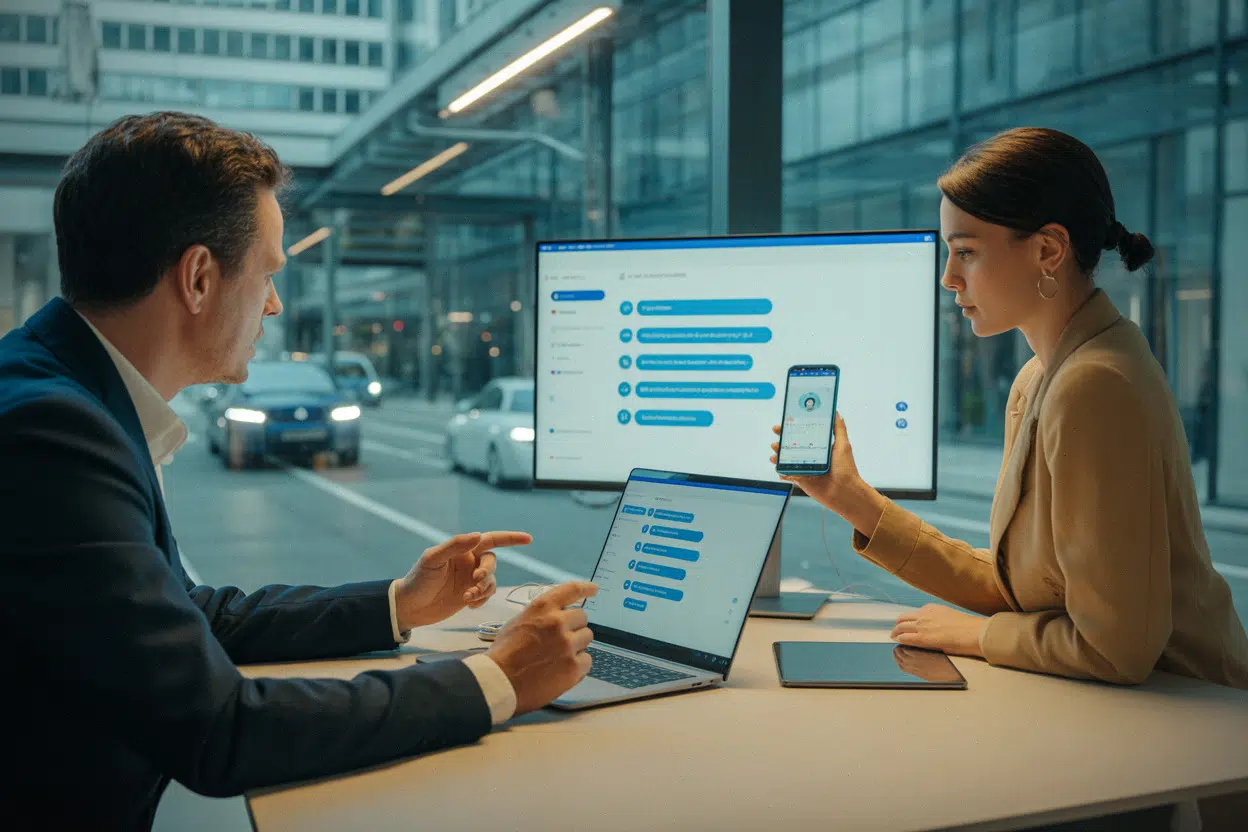
July 13, 2026 marks a moment many office workers already feel: artificial intelligence is no longer a pilot project. It’s showing up in offices, workshops and public services with a simple promise—save time, automate repetitive tasks and make jobs more interesting.
But early on-the-ground feedback is mixed. Some employers are asking workers to fundamentally change how they operate, while team-tracking research suggests workloads can rise instead of fall. At the same time, a public debate is intensifying over how many jobs could ultimately be eliminated.
Between productivity gains, reorganization and a search for meaning at work, AI is reshaping how work gets done—unevenly, depending on the job, the quality of the rollout and how much autonomy teams are given.
A summer column in Le Devoir asks whether AI can restore meaning at work
In a summer column, Le Devoir—a French-language newspaper based in Quebec—raises a question that goes beyond performance: what if artificial intelligence could bring back a sense of meaning at work?
The starting point is a familiar complaint across many organizations: more and more of the day gets swallowed by coordination, reporting and sorting information, leaving workers feeling like they’re losing the thread of their actual profession. AI, in that framing, can reduce friction—if it’s designed as help, not as a mandate to produce more.
The most common promise is a return to core work. For a customer adviser, handing off the summary of a case file to an AI assistant could free time for listening and problem-solving. For a legal team, AI can speed up extracting key elements from a large body of documents, leaving more room for analysis and strategy. In IT departments, the same logic applies to triaging incidents, drafting procedures and supporting diagnostics. The idea is straightforward: less time spent on “work about work,” more time on value-added work.
But meaning doesn’t come from software by itself. Le Devoir stresses a condition organizations often underestimate: leaders have to decide what they want to preserve. If time saved is immediately converted into higher targets, workers may experience it as intensification. If, instead, teams are given real room to improve practices, train colleagues or better document decisions, AI can help revalue the job. That’s a management choice more than a technical feat.
Another issue emerging inside companies is accountability. When an AI-produced response goes to a customer, who owns the mistake—who approves it, and who documents it? Here, meaning is tied to trust, ethics and quality. Organizations that push employees to move faster without clarifying rules of use risk creating lasting tension. In regulated sectors, the question also intersects with compliance, confidentiality and record-keeping requirements.
https://www.europe-infos.fr/actualites/9624/en-2026-kospi-sous-tension-puces-et-data-centers-dopent-seoul-la-peur-dune-bulle-revient-ce-que-les-investisseurs-redoutent/

Franceinfo points to a study of 200 workers where AI increased workload
A report highlighted by franceinfo, the French public broadcaster’s news service, points to a counterintuitive result: AI doesn’t necessarily reduce overall workload.
Over nine months, researchers observed 200 employees at an American technology company. The study found that ease of use can expand the scope of tasks and fill parts of the day that previously served as breathing room. In that setup, AI acts more like a production accelerator than a decluttering tool.
Designers offered a telling example. With code-generation assistants, some began programming—not because their roles originally required it, but because the technical barrier dropped. That shift can feel empowering, but it also adds work: testing, integration and fixes. The researchers also described AI use during breaks—lunch, waiting between tasks, even meetings—turning those moments into opportunities for micro-production and changing expectations around availability and the right to disconnect.
In other companies, the same dynamic shows up as version sprawl. A text, presentation, customer reply or internal memo can be generated in seconds in three or four variants. Time saved on the first draft is sometimes reinvested in choosing among versions, harmonizing tone, checking facts and meeting a higher bar. The paradox: more deliverables, but as much—or more—time spent validating them. AI doesn’t eliminate quality control; it shifts where it happens.
Mental load is another concern. A conversational tool doesn’t just mean writing faster. It requires knowing how to ask for what you need, spotting approximations, verifying sources and maintaining coherence. That adds a supervision skill—especially when management expects rapid adoption. In teams where targets haven’t been adjusted, workers may lean on AI to keep up, then accept intensification as the new normal. The debate about meaning at work becomes a debate about sustainability.

Companies are reorganizing jobs as workers shift from doing tasks to supervising them
Several recent analyses describe a broader shift: AI is forcing a change in posture inside organizations. Instead of executing a sequence of steps, many employees become pilots—scoping the work, prompting, arbitrating and verifying. That shift is visible in support functions like HR, finance and communications, as well as technical roles. Companies that roll AI out most successfully talk less about a tool and more about process, investing in training, documentation and quality rules.
One change is the granularity of work. AI encourages shorter, more frequent tasks—summaries, translations, data extraction, email drafts, template responses. That can smooth workflows, but it can also fragment them. In already overburdened teams, fragmentation increases interruptions and the feeling of never finishing. Some managers try to set dedicated AI windows or usage rules to keep every urgent request from becoming an instant-generation demand.
A second change is collective responsibility. When AI is inserted into a production chain, an error can spread quickly—a spreadsheet misread, a clause poorly rephrased, an incomplete summary. Companies respond by strengthening validation steps, sometimes through paired work (a producer and a reviewer) or additional automated checks. That structure costs time and coordination. It can also protect the meaning of the job if it restores value to expertise and caution rather than reducing work to clicks.
Management itself is being reshaped. In some teams, AI becomes an implicit performance metric: if the tool exists, the task should be faster. In others, it’s used to free time for qualitative goals—customer relationships, continuous improvement, mentoring. The difference often comes down to how goals are set and whether “invisible work” is recognized: verification, arbitration and decision-making. Without that recognition, AI can add a layer of expectation without reducing the original workload.
A French TV debate raised fears of layoffs and “5 million jobs” threatened
The jobs question remains central in public opinion—and it has moved into mainstream programming. On C Ce Soir, a French current-affairs talk show, aired May 6, 2026, the question was blunt: will AI eliminate your job?
The panel discussed a wave of layoffs that began in the United States and reached France, citing examples in industry and services. The show mentioned an estimate of 5 million jobs threatened in France over five years, fueling anxiety about white-collar work—managers, administrative functions, analysis, writing and customer relations.
Guests came from multiple backgrounds: economists, sociologists, union representatives and leaders of digital services companies. A key friction point emerged: replacing tasks is not the same as replacing a job. Many roles are composite—part automatable, part relational, decision-driven and context-specific. The risk grows when organizations standardize more, reduce task variety and industrialize processes. That’s when the line between automation and job cuts gets thinner.
The discussion also pointed to timing. Change won’t move at the same speed across sectors. Banking, insurance, consulting, big-box retail and public services face different compliance constraints and legacy IT systems. Many organizations are moving through pilots before scaling. In that phase, employment effects are often indirect—hiring freezes, attrition, outsourcing and reorganizations—raising questions about labor-management dialogue and whether retraining can be planned rather than rushed.
In that context, “meaning” takes on sharper stakes. If AI is seen mainly as a headcount-adjustment tool, it can erode trust and trigger resistance. If it’s presented as a way to secure career paths—training, reskilling and enriching roles—it can support engagement. Large companies are beginning to formalize usage charters, mandatory training and skills frameworks. The trajectory remains uncertain, depending on governance choices, how productivity gains are shared and whether organizations can measure what AI actually changes in a workday.
In Quebec, officials and a public-sector union describe partial automation—not sudden job extinction
In Quebec, some findings complicate the idea of an immediate employment shock. An article in L’Action draws on results from the Canadian Survey on Business Conditions and analysis by Statistique Québec, concluding that AI is first changing how work is done. The tasks most affected involve text analysis, data processing and automating internal processes. That matches what many organizations report: AI arrives as an assistance layer that speeds steps up without wiping out an entire profession overnight.
The SPGQ—a union representing professionals in the Quebec government—makes a similar point: AI mainly partially automates tasks rather than eliminating professions. A worker might save time on document research, an analyst on formatting, a manager on drafting meeting minutes. What happens next depends on how the saved time is used—service improvements, backlog reduction, user support, or simply higher volume expectations.
That makes work organization the priority. Partial automation can make a job more interesting if it removes the most repetitive tasks, but it can also increase pressure if targets are recalibrated without discussion. Several public administrations are testing guardrails: restrictions on sensitive data, mandatory human validation, trace retention and training on bias. Those rules can slow deployment, but they aim to protect quality and accountability—two dimensions closely tied to meaning at work.
Quebec also highlights a skills challenge. Value shifts toward the ability to define needs, verify outputs, add context and align AI use with public-service rules. Training isn’t only about the tool; it’s about method—use cases, risks and limits. On the ground, some workers see AI as a way to serve the public better, while others see it as added pressure. Often, the difference comes down to clear goals, transparency about expected gains and a real right to say a use case isn’t appropriate.
Key takeaways
- In 2026, AI is spreading across workplaces with a promise to save time, but outcomes vary widely by organization.
- A nine-month observation of 200 employees found workload can increase as AI intensifies output and fills downtime.
- Companies are pushing a shift in posture: workers increasingly scope, verify and take responsibility for AI-assisted work.
- France’s public debate remains heated, including a TV discussion citing an estimate of 5 million jobs threatened over five years.
- In Quebec, sources emphasize partial task automation more than the rapid disappearance of entire professions.
Key Takeaways
- In 2026, AI promises to free up time, but the effects vary by organization.
- A study of 200 employees over 9 months describes a workload that sometimes increases due to work intensification.
- Companies are asking for a shift in mindset: set boundaries, verify, and take responsibility.
- The jobs debate remains heated, with estimates of 5 million positions at risk in France.
- In Quebec, sources mostly describe partial task automation rather than the disappearance of entire occupations.
Sources
- Avec l'IA, les postures au travail vont devoir changer du tout au tout
- L'IA augmente notre charge de travail au lieu de l'alléger | franceinfo
- Nouvelles sur Intelligence artificielle (IA)
- L'IA va-t-elle supprimer votre emploi ? Débat sur le futur du travail – C Ce Soir du 6 mai 2026
- Intelligence artificielle : changer le travail sans bouleverser l’emploi – L’Action