

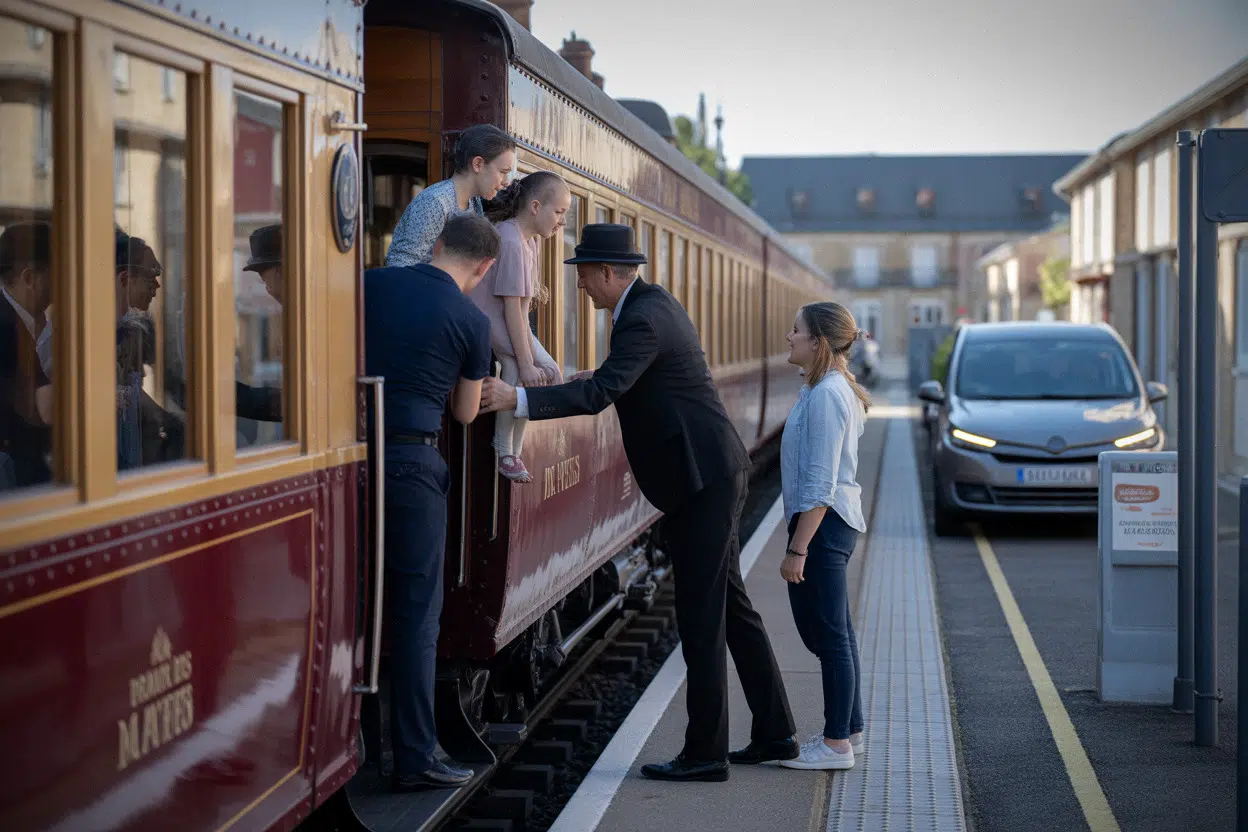
Riders can climb aboard a working steam tourist train on France’s Atlantic coast this fall for a flat €5 (about $5) during the country’s 2026 Heritage Days weekend, with departures scheduled from 9:30 a.m. to 6 p.m. on September 19 and 20.
The Train des Mouettes—an old-fashioned tourist railway in the Seudre estuary area—will pair those rides with visits to its rail depot, giving the public a look at what it takes to keep historic rolling stock operating safely. Reservations are required through the operator’s website, according to the event listing.
Organizers are also leaning into a milestone: 2026 marks the 150th anniversary of the Saujon–La Tremblade line, which opened in 1876. The program is designed to go beyond the “postcard” appeal, highlighting the maintenance work, staffing, and operating constraints behind heritage rail service.
Steam train rides run 9:30 a.m. to 6 p.m. on Sept. 19-20
The public-facing offer—“Voyagez à bord du Train des Mouettes”—lists service from 9:30 a.m. to 6 p.m. on Saturday, September 19, and Sunday, September 20, 2026. The wide operating window is meant to fit into a full day of Heritage Days visits, including family outings.
The fare is a single price: €5 (about $5) for everyone. The listing frames that as an accessibility choice that also simplifies ticketing during a weekend when visitors often try to fit multiple sites into tight schedules.
The main departure point is the Saujon tourist station at 3 Chemin Vert, 17600 Saujon. Tourism materials describe the route as a 21-kilometer trip—about 13 miles—between La Tremblade and Saujon, with stations that structure the experience for visitors.
Registration is handled via the operator’s website, suggesting capacity management during a typically busy weekend. With older equipment, the listing notes, crowd control isn’t just about comfort—it affects operations, including seat counts, turnarounds, dwell times, and technical requirements.
Onboard, the appeal is as much sensory as scenic: steam traction, the sounds and procedures of operation, and a slower pace that turns the ride into a lesson in industrial heritage rather than simple transportation.
[[EMBED_PLACEHOLDER_0]]
À bord, l’embarquement et le contrôle s’effectuent comme sur une exploitation ferroviaire encadrée.
Depot visits spotlight the behind-the-scenes work of steam operations
The 2026 Heritage Days schedule also includes visits to the Train des Mouettes rail depot on both September 19 and 20. The depot is where visitors can see that preservation isn’t just displaying an object—it’s daily work, inspections, and repairs that are usually invisible to the public.
The tour is positioned as a look behind the curtain: preparing equipment, managing consumables, and meeting safety constraints. A steam locomotive requires pre-run checks, maintenance operations, and precise protocols, and the visit is meant to explain what gets inspected, how overhauls are organized, and which jobs are involved—mechanics, boilermakers, switching staff, and association volunteers or employees depending on how the operation is structured.
The listing also points to the economics of running a tourist train. Visitors can see what supports ticketing—even at an accessible price—because costs extend beyond fuel or energy to parts, tools, insurance, training, and compliance.
Organizers describe the depot as a place of transmission, where enthusiasts can connect technical history to local stories. The goal is that visitors who come for nostalgia leave with a clearer sense of the operating chain, rules, and responsibilities that come with running historic equipment.
Safety is part of the message, too. By showing procedures and constraints, the operator implicitly sets expectations about restricted areas, safe distances, and caution around hot components and moving parts.
[[EMBED_PLACEHOLDER_1]]
La visite du dépôt met en avant les opérations d’entretien nécessaires avant chaque circulation.
A 150-year-old line, still carrying passengers—now as heritage rail
The Train des Mouettes is highlighting the 150th anniversary of the Saujon–La Tremblade line in 2026. The line entered service in 1876, a date that anchors the Heritage Days programming in a longer history: the train runs on infrastructure built for economic and mobility needs that have since changed.
The 1876 reference ties to the broader expansion of secondary rail lines in France, when rail connected towns, ports, markets, and coastal destinations. In the Seudre area, that history is visible in the geography of the trip—stations, level crossings, and views over marshland.
The tourist run is presented as a 21-kilometer (about 13-mile) itinerary between La Tremblade and Saujon. Tourism content describes locomotives that evoke the Belle Époque, turning the distance into an experience where slower travel becomes the point.
The anniversary is also framed as a tool for public education: a 150-year-old line requires preservation choices, alignment with modern rules, and tradeoffs over what can be restored, reused, or presented—context that organizers say helps explain why a tourist train exists at all.
For local tourism stakeholders, the event is also positioned as a draw that can encourage longer stays and combinations of train rides, walks, and heritage visits around the Seudre—an added angle for 2026 because the milestone is clearly dated.
Chaillevette and the Seudre estuary help anchor the Heritage Days experience
Promotional material for the European Heritage Days program with the Train des Mouettes cites the Chaillevette station as another focal point. That matters for visitors mapping out a weekend of stops across villages, ports, and marsh landscapes.
The Seudre estuary setting gives the ride a strong scenic identity. Tourism content describes a train that “goes up the Seudre,” emphasizing travel alongside the water and the coastal Charente-Maritime landscape—an argument that heritage here is not only architectural, but also industrial and environmental.
On a weekend packed with competing options—monuments, museums, industrial sites, and walks—the Train des Mouettes differentiates itself with a mobile, sensory experience that can be slotted into a broader day that might include markets, oyster ports, and promenades. Extended hours and a single fare make that kind of planning easier.
Operationally, the station experience is part of the point: lines, platform access, staff presence, safety rules, and wait management. The message is that this isn’t an improvised attraction—it’s a supervised rail operation where railway rules still apply, even in a leisure setting.
By linking multiple towns, the train also spreads Heritage Days activity across several communities, using a historic piece of infrastructure to move people through the area rather than concentrating them at a single site.
Key takeaways
• The Train des Mouettes will take part in France’s 2026 Heritage Days on September 19 and 20.
• Tourist runs are scheduled from 9:30 a.m. to 6 p.m., with a single €5 (about $5) fare.
• A rail depot visit is also scheduled on both days.
• The tourist route is presented as 21 km (about 13 miles) between Saujon and La Tremblade.
• In 2026, the Saujon–La Tremblade line marks 150 years since opening in 1876.
Sources
• https://journeesdupatrimoine.culture.gouv.fr/w/391796/evenement/19652889/voyagez-a-bord-du-train-des-mouettes
• https://www.leparisien.fr/etudiant/sortir/bordeaux/eve-jep-visite-du-depot-ferroviaire-du-train-des-mouettes-1
• https://www.leparisien.fr/etudiant/sortir/bordeaux/eve-jep-voyagez-a-bord-du-train-des-mouettes
• https://www.facebook.com/100064414040495/videos/journ%C3%A9es-europ%C3%A9ennes-du-patrimoine-avec-le-train-des-mouettes-en-gare-de-chaille/2215322888935239
• https://www.royanatlantique.fr/train-des-mouettes
Key Takeaways
- Le Train des Mouettes is taking part in the 2026 Heritage Days on September 19 and 20.
- Tourist train runs are scheduled from 9:30 a.m. to 6:00 p.m., with a flat fare of €5.
- A tour of the rail depot is scheduled on both days.
- The tourist route is a 21 km trip between Saujon and La Tremblade.
- In 2026, the Saujon–La Tremblade line will celebrate its 150th anniversary, having opened in 1876.