

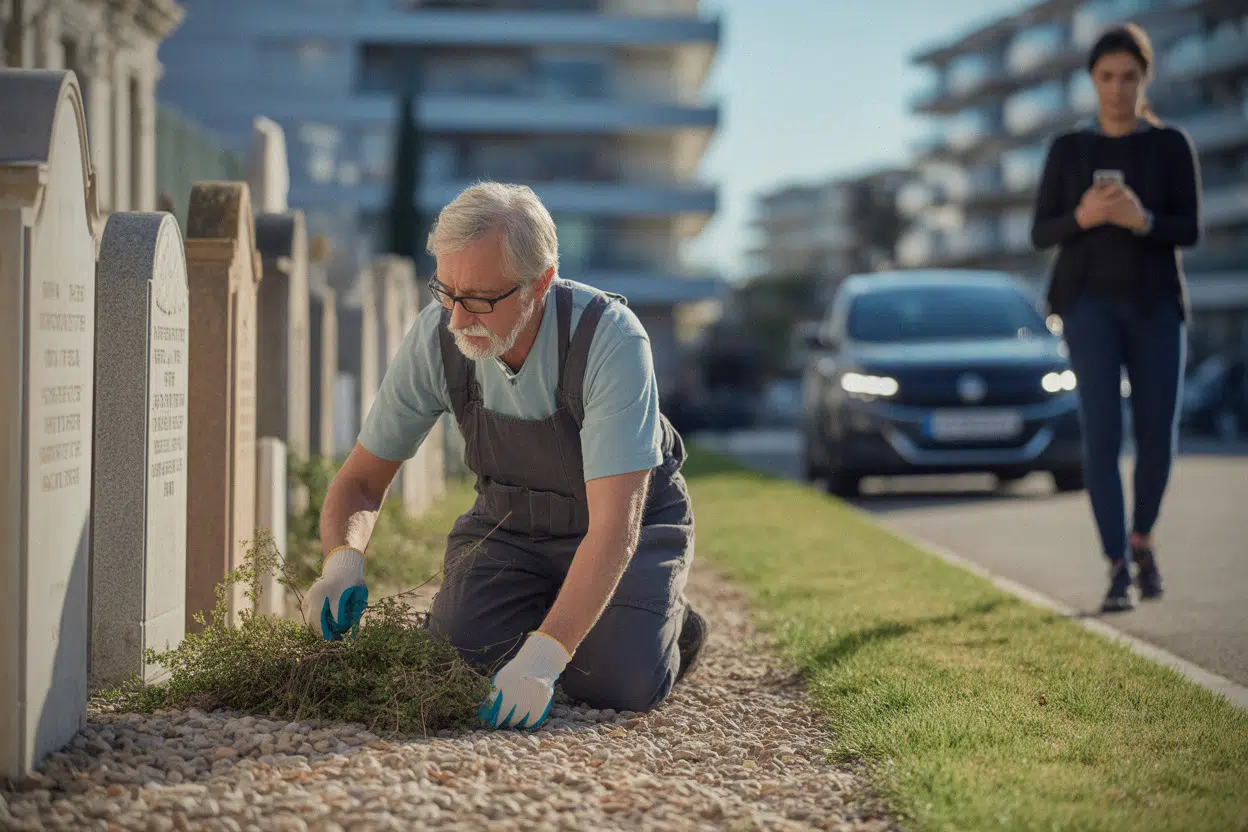
In many French towns, keeping cemeteries clean falls to small municipal crews working with tight staffing, strict limits on chemical weedkillers in public spaces, and a schedule that can swing with the weather. In that gap, some residents step in.
A report highlighted by L’Union centers on a retiree who says he weeds a local cemetery every day—“from morning to night”—without pay. The story points to a kind of neighborhood volunteerism that’s steady and mostly unseen, yet can shape the condition of a place that carries emotional weight, local heritage, and legal obligations.
Similar efforts are showing up elsewhere in France, from a long-serving gardener at a Canadian military cemetery in Normandy to a national remembrance group raising money to restore war graves in the southern city of Arles. Together, the examples sketch a broader shift: cemetery upkeep is increasingly leaning on citizens and associations as local governments juggle costs, rules, and families’ expectations.
A daily, unpaid routine: “I weed from morning to night,” L’Union reports
L’Union builds its account around a line that captures how constant the work has become: “I weed from morning to night.” In practical terms, that means hand-pulling weeds, hoeing, cleaning pathways, and removing growth along graves and borders—tasks that quickly repeat as rain feeds new shoots, gravel and joints trap seeds, and summer heat speeds regrowth.
The fact that it’s volunteer work is central. With no contract and no financial compensation, the effort rests on personal motivation—often tied to attachment to the place, loved ones buried there, or a sense of service to the community. But it also raises basic questions for a town: Who provides tools? Who approves where someone can work? What happens if there’s an injury or accidental damage?
French cemeteries are public spaces with specific rules and strong expectations from families—cleanliness, accessibility, and safety, especially for older visitors, alongside respect for graves. Frequent weeding can reduce slipping hazards, keep paths readable, limit insects, and prevent plots from looking abandoned. That can immediately change how visitors experience the site.
At the same time, a daily volunteer presence can become something a town quietly counts on. If one retiree shows up every day, municipal leaders may—consciously or not—factor that into the overall maintenance balance, leaving the system vulnerable if the person stops. In small municipalities, budgets are tight, with costs for fuel, equipment, staff time, and occasional contractors. The story described by L’Union highlights that uneasy equilibrium: one person’s effort improves conditions while also revealing how large the underlying need is.
Weeding has also gotten harder in many areas as public-space use of phytosanitary products has been restricted, pushing more work toward manual or mechanical methods that take longer and cost more. A retiree devoting full days to the job is, in effect, responding to a structural constraint—and reflecting a long-term change in how cemeteries are maintained.
https://www.europe-infos.fr/actualites/10015/788-1215-e-rebond-a-115900-e-et-140-sur-euronext-paris-ce-que-vusiongroup-doit-affronter-maintenant/
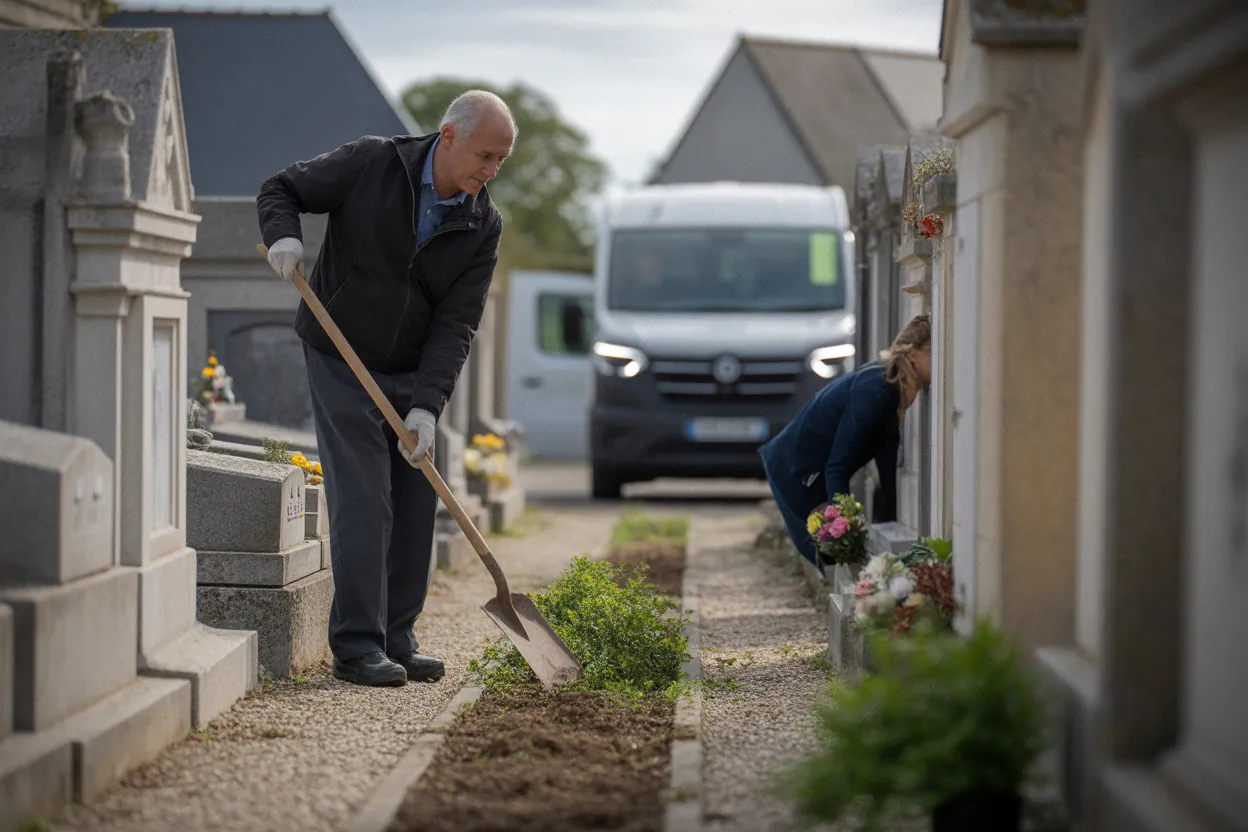
In Normandy, Samuel Levasseur tends 2,048 graves—and helps families find a story
A separate report by ICI Normandie follows Samuel Levasseur, who has worked for 32 years as the gardener at the Canadian military cemetery in Bény-sur-Mer. He works among 2,048 buried soldiers. His mission, assigned by the Commonwealth War Graves Commission, covers the lawn, flowers, and the visual order of a site where every detail contributes to the solemn atmosphere.
But the job goes beyond horticulture. The gardener speaks with Canadian families who arrive looking for a name or trying to understand a relative’s path. He points to places, units, and circumstances of death, helping visitors locate an ancestor. In a military cemetery, that kind of guidance can be decisive: people aren’t only facing a grave; they’re searching for context and a point of reference. The professional becomes a relay of memory—sometimes the first person a family meets on site.
The report also describes a delicate practice: preserving objects left on graves, then removing them after a period while carefully storing them in a building. It’s a reminder that maintenance must balance mourning, preservation, safety, and a coherent appearance. Crews can’t leave everything in place—because of mowing, weather, deterioration, or sheer accumulation—but removing items without care can feel like a symbolic injury.
The Bény-sur-Mer example offers a contrast with the volunteer described by L’Union. One is an institutional mission with procedures under an international organization; the other is local help, often without a formal protocol. In both cases, daily repetition matters more than occasional major projects.
Levasseur’s announced retirement also raises the question of handoff. When one person holds deep knowledge of a site, its families, routines, and historical details, their departure can create a real break—forcing managers to recruit, train, and document. It’s a challenge that echoes towns relying heavily on volunteers: continuity can hinge on a single individual.
https://www.europe-infos.fr/actualites/10005/2026-45-a-55-ans-la-fenetre-ideale-pour-acheter-avant-la-retraite-sans-etouffer-le-budget-ce-detail-inattendu-change-tout/
https://www.europe-infos.fr/actualites/9989/comment-sortir-un-site-dun-filtre-google-methode-complete-pour-retrouver-sa-visibilite/

In Arles, Le Souvenir Français raises funds for $70,000 in restoration work
In Arles, an article about Le Souvenir Français—a French remembrance association—focuses on targeted restoration of graves funded by donations. The local committee cites 69 non-perpetual graves and cenotaphs for people who “died for France” during World War I. The planned work includes removing overgrowth and placing cockades, steps that are both technical and symbolic, aimed at preventing these graves from physically disappearing.
Funding relies on a collection drive around All Saints’ Day, when cemeteries see heavy visitation and outreach is easier. The text also mentions an estimate prepared in 2024 putting the work at €65,000 (about $70,000), largely to be covered by the French state, with participation from the city. A €10,000 departmental subsidy (about $10,800) is cited as valid through 2027, with a condition: if work doesn’t begin, the aid could be lost.
The financing plan reflects on-the-ground realities. Heritage restoration depends not just on goodwill, but on administrative timelines, co-funding, project-management approvals, and contractor availability. For an association, the challenge is to keep pressure on, justify spending, and persuade donors that memory is made tangible in cleaned stone, readable inscriptions, and stabilized graves.
This approach differs from daily weeding, but it complements it. A cemetery can look tidy and still be structurally fragile—tilting headstones, failing joints, fading plaques. Major restoration doesn’t replace routine upkeep, and routine upkeep can’t solve everything. Association-led efforts can cover part of the need, especially when the heritage burden exceeds what a city can handle alone.
In that context, the case reported by L’Union takes on added meaning. A retiree working every day addresses immediate maintenance. An association prepares medium-term preservation by linking fundraising, memory, and construction work. Both meet in the same place: a cemetery is not only a burial ground, but a public facility with expectations of service, dignity, and historical transmission.
The mix of municipal work, volunteers, and associations also raises a question of equity. Places with highly engaged citizens can end up visibly better maintained, while others—without the same social fabric or donor base—can deteriorate faster. The difference may not come from a political decision so much as from uneven local capacity to mobilize help.
What citizen-led cemetery upkeep changes for towns: liability, safety, and continuity
Volunteer work in a cemetery forces towns to confront practical issues: responsibility, insurance, permission to intervene, and tool management. Hand weeding may sound simple, but risks include falls, cuts, and handling heavy equipment. Allowing work without a framework can create a gray zone. Formalizing the arrangement—through an agreement, charter, or written authorization—can protect both sides and clarify limits: no work on monuments, respect for plots, hours, and where equipment is stored.
Regulatory constraints also weigh heavily. Maintaining public spaces without chemical weedkillers means more frequent passes and more labor. Cemeteries are often large, with narrow paths, access needs for funeral services, and sensitive periods around burials. Regular volunteer help can absorb part of the load, but it doesn’t replace municipal organization, which must ensure opening hours, green-waste handling, water access, and safe circulation.
The social dimension is also central. For a retiree, the activity can structure days and maintain a sense of connection and routine. “From morning to night” describes a schedule that resembles paid work. In some cases, this kind of volunteerism also makes a person’s presence visible in town—someone who talks with families and acts as an informal watch, flagging a damaged grave, a dangerous tree, or a broken gate.
But there’s a risk of blurring the line between public service and individual devotion. If cemetery upkeep depends on one person, it’s fragile—illness, fatigue, or a move can end the continuity overnight. Towns, the article argues, should treat volunteer contributions as a supplement, not the sole pillar. Where staffing is stretched, priorities often fall to schools, roads, parks, and sports facilities, leaving cemeteries lower on the list.
The examples from ICI and Le Souvenir Français point to another reality: maintenance is also a form of mediation. A well-kept cemetery makes it easier for visitors to navigate and reinforces respect for the site. In a military cemetery, that role expands to shared history; in a municipal cemetery, it touches the intimate. The volunteer work described by L’Union fits squarely in that reality—where the look of paths and borders becomes a marker of collective dignity.
https://www.europe-infos.fr/actualites/9979/10-ans-dusage-contrat-reconduit-jusqua-2028-remplacement-complet-vise-en-2029-pourquoi-la-dgsi-peine-a-lacher-palantir/
https://www.europe-infos.fr/actualites/9951/wall-street-cloture-en-baisse-nasdaq-sous-pression-depenses-massives-dans-lia-remises-en-cause-ce-que-les-profits-doivent-prouver/
Key Takeaways
- A retired man weeds a cemetery for free every day, according to L’Union
- Maintaining grounds without pesticides increases the workload and encourages manual labor
- In Bény-sur-Mer, gardener Samuel Levasseur combines maintenance with outreach to families
- In Arles, Le Souvenir Français funds vegetation removal and restoration, with an estimate of €65,000
- Volunteer work improves the site’s condition but raises questions about oversight, safety, and continuity
Sources
- "Je les aide à trouver leur ancêtre" : le jardinier-poète du cimetière canadien de Bény-sur-Mer part à la retraite – ICI
- FAIT DU SOIR Une mémoire à entretenir, la quête du Souvenir Français à Arles
- « Je passe des figures imposées aux figures libres » : la vraie-fausse retraite médiatique d’Alain Duhamel – Le Parisien
- « Je suis sur le terrain du matin au soir » : Jérémy Le Mével est le nouveau directeur du Carrefour K2, à Lorient | Le Télégramme
- "Il est resté du matin au soir", Christine Bravo raconte cet homme présent auprès d’Isabelle Mergault dans ses derniers instants – Purepeople