

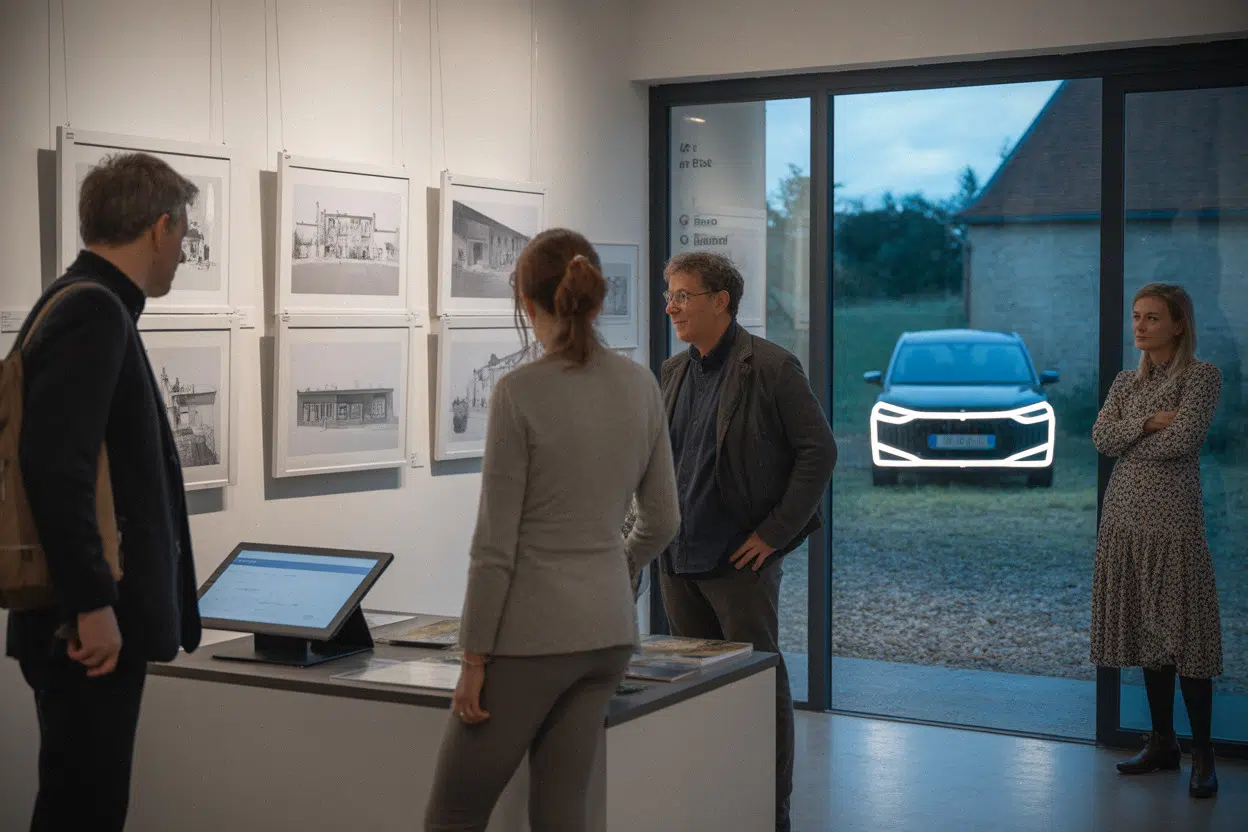
A summer art show in the small village of Montsalvy, in France’s Cantal department, is turning heads with an intentionally spare approach: black-and-white drawings of local churches, farm buildings, and stone-built streetscapes.
The Montsalvy tourist office is hosting an exhibition of monochrome works by artist Jean Artus from July 1 through August 31, 2026. Admission is free, and the show is positioned to catch both summer visitors stopping in for travel information and locals looking for a low-key cultural outing.
The exhibit is part of a broader seasonal push to keep arts programming visible and accessible during peak tourism months in this rural corner of south-central France, where hikers and heritage-minded travelers often build itineraries around “villages of character” and historic sites.
Jean Artus’ drawings are on display at Montsalvy’s tourist office through August 31
Local event listings place Artus’ exhibition at Montsalvy’s Office de tourisme—the visitor center that often doubles as a cultural gateway in summer—running from July 1 to August 31, 2026. The choice is practical: it’s a well-marked, high-traffic stop where people may wander into an exhibition even if they didn’t plan a museum visit.
Published schedules vary by calendar listing, but they point to broad seasonal hours, including morning openings and additional visiting windows depending on the day. The idea matches how summer travel works in the area, with people alternating outdoor excursions and indoor stops, especially during hot spells or rainy afternoons.
Free entry is central to the setup. It lowers the barrier for spontaneous drop-ins and makes repeat visits more likely for residents from Montsalvy and nearby towns.
Several listings also connect the show to Montsalvy’s “Printemps des Arts” (Spring of the Arts), a local arts program that includes a vernissage (opening reception) and a published list of award recipients. Mentions of a first prize awarded to two names—including Jean Artus—frame the exhibition as part of a curated, recognition-based lineup rather than a one-off display.
Organizers in Montsalvy are also trying to keep a cultural throughline between heritage events, markets, concerts, and guided visits. Hanging drawings inside the tourist office turns art into a natural extension of exploring the area—an approach common in tourist towns that don’t rely on a dedicated museum.
The two-month run is also a signal that the exhibition isn’t aimed only at quick-stop tourists. It gives locals time to choose their moment, and it allows word-of-mouth to build across the season.
Black-and-white sketches spotlight Cantal’s churches and stone-built architecture
The exhibition centers on monochrome drawings inspired by Cantal’s built heritage. In Artus’ black-and-white approach, color drops away and structure takes over: massing, façade details, rooflines, openings, and the way a building sits in a street or against the landscape.
That fits a department known for rural churches, village houses, farm structures, low stone walls, and small architectural features that shape local identity. The source material emphasizes how monochrome drawing can bring out texture and shadow—an overhang’s dark edge, the roughness of a wall, the depth of a porch—details that can get lost when color dominates.
Beyond aesthetics, the drawings also function as a kind of visual memory. They capture the state of buildings at a specific moment, including recent restorations, wear, and elements threatened by time. While not presented as an official inventory, the series can resonate in small communities where the depicted places are familiar and tied to personal history.
Monochrome also unifies natural and human-made elements in a single visual language. A road, a tree, a façade, and a stone cross can share the same composition, with line and light doing the work. For visitors, the reading is immediate: recognition first, then comparison—what the artist emphasized, what he pared back.
The show is presented as part of a tradition of heritage drawing associated with travel sketchbooks and close observation. It also aligns with a contemporary appetite for restrained, non-folkloric representations of place—images that can sit easily in a home while still “telling” a region.
Montsalvy’s Printemps des Arts highlights multiple local award recipients
Event announcements tie the exhibition to Montsalvy’s Printemps des Arts, described as a structuring local arts rendezvous with an opening reception and awards list. One reference points to a 25th edition, suggesting unusual longevity for an arts event in a rural setting and a continuity that regular summer visitors can come to expect.
Within that framework, multiple artists are cited, with award recipients highlighted—Jean Artus and Pierrette Charmes are named in the available sources. For non-specialist audiences, the presence of a prize or ranking serves as a simple guidepost: it signals selection, evaluation, and an intentional program.
The Printemps des Arts is also described as a social meeting point. When vernissages are held, they create direct exchanges among artists, residents, volunteers, and local officials—often as important in small towns as the exhibition itself.
From a tourism standpoint, placing an exhibition inside the tourist office adds another stop to a visitor’s route. Art becomes a complement to the area’s natural and heritage draws, and multi-artist programming can encourage people to linger, return, or recommend the town to friends.
That collective structure doesn’t erase individual styles. In Artus’ case, the monochrome drawing focus sits alongside the broader mix often seen in such events—painting, drawing, photography, and sometimes sculpture—helping sustain a cultural calendar that isn’t dependent on a single audience.
Jean and Betty Artus, longtime Cantal residents, build work rooted in the region
Additional context in the cited publications describes Jean Artus and Betty Artus as originally from Normandy and living in Cantal for a long period. That matters to how the work is framed: the relationship to place is not a brief stopover, but a long-term vantage point shaped by daily proximity and seasonal change.
One reference uses the term “art brut,” a label that can cover a wide range of realities. In media usage, it often points to spontaneous, non-academic creation grounded in material and gesture. Applied to the couple, it mainly signals an independent approach—possibly outside traditional institutional circuits—and a desire to work without bending to market trends, a stance that can be valued in rural areas with strong craft traditions.
Another document notes that Jean Artus also offers reproductions of his drawings, pointing to a practical economic dimension. Summer exhibitions often double as sales opportunities, with accessible formats that let visitors take home a trace of their trip—part souvenir, part décor—especially when the images depict recognizable local landmarks.
Together, the exhibition, the artists’ local roots, and the circulation of images help explain why Montsalvy is leaning into this kind of programming. It’s a way to reinforce a local narrative: the village and its surroundings aren’t only described in brochures—they’re interpreted through an artist’s eye.
As many small communities work to maintain services and stay attractive, the presence of identifiable artists can contribute to a sense of momentum. Exhibitions like this don’t replace a full cultural policy, but they create recurring touchpoints, opportunities for exchange, and another way to value heritage beyond guided tours alone.
https://www.europe-infos.fr/actualites/9995/a-deyvillers-isabelle-limonier-part-a-la-retraite-du-ministere-des-armees-un-metier-discret-ce-que-la-commune-retient/
Key Takeaways
- The Jean Artus exhibition will be on view in Montsalvy from July 1 to August 31, 2026.
- The works on display are monochrome drawings focused on Cantal’s heritage.
- The event is featured in the Printemps des Arts program in Montsalvy.
- The Tourist Office venue makes access easier, with a visit designed for the summer season.
https://www.europe-infos.fr/actualites/9969/askou-quitte-motherwell-pour-toulouse-succession-express-avant-leurope-mercato-et-preparation-sous-tension-ce-que-le-club-doit-affronter/