

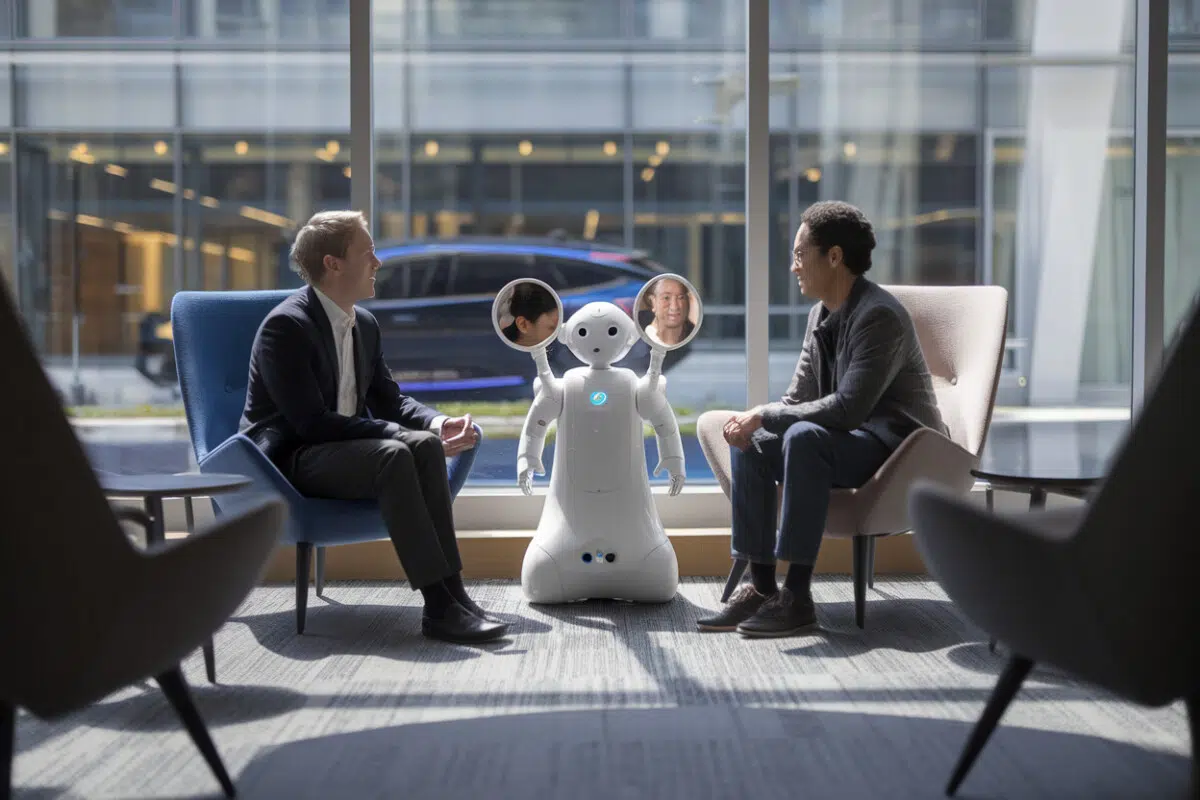
Cornell researchers have built a robot that doesn’t chat, crack jokes, or try to be your friend. It just rolls up, angles two mirrors, and quietly dares two strangers to actually look at each other.
The device, called MirrorBot, stands about 4 feet tall and positions itself between two people so each person can see both their own reflection and the other person’s face at the same time. The point isn’t human-robot bonding. It’s human-human connection, engineered with a simple trick of optics.
The team at Cornell University’s Architectural Robotics Lab tried MirrorBot in a deliberately awkward environment: a plain waiting room about 12 feet by 12 feet, with three chairs lined up against a wall. Thirty-two participants ages 18 to 50 were told they were taking part in a short-term memory study, until the real experiment revealed itself.
After a brief stretch of typical waiting-room silence, MirrorBot emerged from behind a partition. In this phase, it wasn’t fully autonomous. Researcher Serena Guo teleoperated the robot, controlling its movement and selecting from pre-programmed mirror positions designed to line up the reflections without requiring participants to do anything.
The results were striking in a very human way. In 12 of 16 groups, participants said their first “meaningful” contact with the stranger across from them happened through the mirrors, not through direct face-to-face eye contact. Some pairs tried to figure out the device together. Others tested the waters with a cautious glance, then a smile, then a small gesture, tiny signals that can thaw a room.
The researchers also acknowledge a key complication: any moving robot is going to draw attention. To separate “robot novelty” from the mirror effect, the team ran comparisons (more on that below). And because a human operator was steering the system, MirrorBot, at least for now, looks more like a supervised tool than something ready to roam an airport terminal on its own.
The goal isn’t conversation, it’s the first look
Guo’s premise is almost minimalist: engineer the moment before the conversation. The team isn’t trying to force strangers to talk. They’re trying to make the first spark of connection, eye contact, feel less risky.
In everyday American life, locking eyes with a stranger can read as intrusive or confrontational, especially in tight public spaces. MirrorBot uses the mirror as a social detour: a more acceptable “side door” into noticing someone, because you’re not staring straight at them, at least not at first.
That design choice is intentional. Instead of adding another screen or voice assistant to a world already saturated with them, MirrorBot uses a familiar object that redirects attention back to the body and the immediate space. The mirrors can shift between “I see myself,” “I see the other person,” and “I see both,” creating a gradual ramp-up rather than a forced face-off.
Still, the team flags an obvious concern: eye contact isn’t universally welcome. For people with social anxiety, certain cultural backgrounds, or past trauma, being nudged toward eye contact can feel aggressive. A soft exterior and small size help, but they don’t solve the deeper question of consent, how much “nudge” is too much.
A response to screen-driven isolation, without adding another screen
Lab researcher Keith Evan Green frames MirrorBot as a pushback against the way modern computing has reshaped public life. In his view, the most popular digital tools, especially social media, often pull people apart even when they’re physically near each other, feeding loneliness and mental health strain.
MirrorBot aims for the opposite: use technology to connect people who are already in the same place. Think of the familiar scene in the U.S., a doctor’s office waiting room, an airport gate, a campus hallway, where everyone retreats into their phones and the room goes socially dead.
The robot’s intervention is small by design. It doesn’t deliver a lecture about community. It creates a brief micro-situation, seconds long, where attention shifts from a private bubble to a shared moment. When it works, the “data” is visible without sensors or apps: a relaxed posture, a grin, a few words exchanged.
But the researchers also concede the flip side: sometimes people choose solitude for good reasons. A hospital waiting room can be stressful. Not every space needs to be more social, and not every person wants a prompt to engage.
MirrorBot beat a wall mirror, and a robot without mirrors
To test whether MirrorBot was doing something unique, or just benefiting from being a rolling curiosity, the team compared it with three alternatives: a robot with no mirrors, a fixed wall mirror, and a control condition with no device. That related study involved a larger sample of 40 pairs.
The reported takeaway: MirrorBot performed best at triggering that initial shared visual moment. A wall mirror is common, but passive, it doesn’t actively align two people into the same visual frame. A mirror-less robot may attract attention, but it doesn’t create the specific “I see me and I see you” effect that seems to lower the barrier to acknowledgment.
The lab describes multiple mirror “states,” ranging from showing an empty reflection to configurations where participants see themselves, then the other person, then both. In plain English: it stages a gradual approach to connection, closer to how people naturally warm up, quick glance, look away, glance back, smile, then maybe talk.
Even so, the evidence so far comes from controlled settings where participants know they’re in a study (even if they don’t know the true purpose at first). Real-world public spaces add noise, fatigue, and a higher chance people feel watched, especially if a mirror seems to be “framing” them.
Airports and campuses are potential targets, along with big ethical questions
The researchers point to places built around waiting and passing time, airport terminals, lobbies, campus common areas, as natural testbeds. The ambition isn’t to turn strangers into best friends. It’s to raise the odds of a brief, human exchange: a 10-second interaction that makes a space feel less cold, or helps someone ask a simple question like where to find a gate.
MirrorBot’s modest size, about 4 feet tall, and soft covering are meant to reduce intimidation and avoid the vibe of a security robot. But perception is everything. In an airport, where Americans already expect surveillance, a mobile device that positions itself between people and angles reflective surfaces could easily trigger suspicion, even if it’s not recording anything.
Control is another pressure point. In the experiment, MirrorBot was teleoperated, meaning an unseen human was choosing mirror positions. For any real deployment, the team would need to be explicit about what’s automated, what’s controlled by staff, what data (if any) is collected, and how people can opt out. Without transparency, a robot meant to build trust could do the opposite.
Still, MirrorBot hints at a different future for “social robotics” in America, less like a talking companion, more like a piece of mobile architecture that reshapes how people share space. If it ever leaves the lab, it will likely be in carefully chosen environments, with clear rules, and with room for people who’d rather be left alone.
Key Takeaways
- MirrorBot, developed at Cornell, uses two mirrors to initiate initial eye contact.
- In the trial, 12 out of 16 groups reported making initial contact via the mirror.
- The robot was tested in a waiting room with 32 participants aged 18 to 50.
- Comparisons with a wall-mounted mirror and a robot without mirrors suggest MirrorBot has an advantage.
- Deploying it in public places raises questions about consent and perception.
Frequently Asked Questions
Is MirrorBot autonomous or controlled by a human?
In the described experience, MirrorBot was teleoperated: an operator controlled its movements and selected preprogrammed mirror positions to align the two participants’ reflections.
What concrete results were observed during the tests?
In the waiting-room study, 12 of the 16 groups reported that their first meaningful contact with the other person happened via the mirrors rather than through direct face-to-face interaction, sometimes leading to playful conversations and exchanges.
Why use mirrors instead of a screen or a talking robot?
The project targets the very first moment of connection—eye contact—without shifting attention to a screen. The mirror acts as a familiar, nonverbal object that supports a gradual transition from self-reflection to recognizing the other person.
Does MirrorBot work better than a fixed wall mirror?
In comparative tests cited by the team, MirrorBot was judged more effective than a wall mirror, a robot without mirrors, and a no-device condition, largely because its adjustments made eye contact easier.
What are the main risks of deploying it in public places?
Key concerns include perceived intrusion, implicit consent, and trust—especially if it isn’t clear whether the system is human-operated, automated, or collecting data. A realistic deployment would require explicit rules and appropriate contexts.