

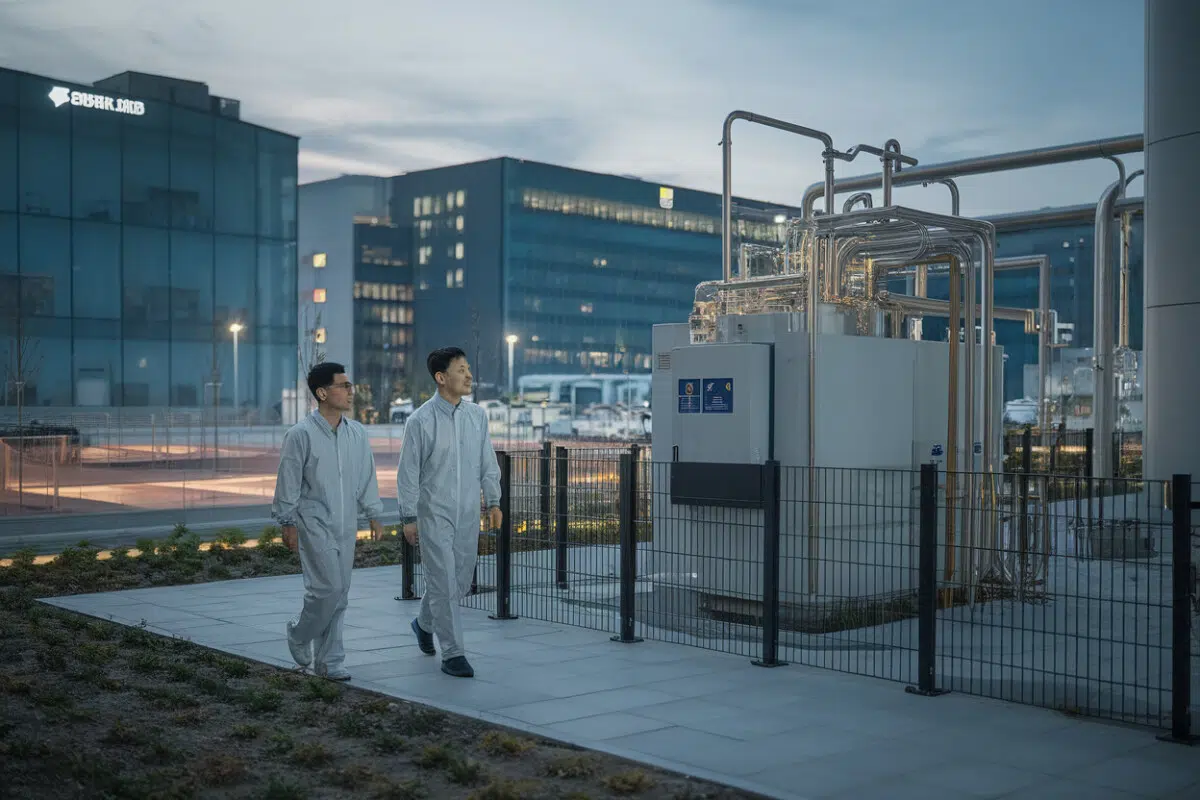
French industrial-gas giant Air Liquide is making a roughly $215 million bet on the infrastructure behind the AI chip race, signing a long-term deal to supply SK hynix with ultra-high-purity gases for a new semiconductor packaging and testing plant in South Korea.
The company says it will build and operate a dedicated nitrogen production unit in Cheongju, a manufacturing hub about 70 miles south of Seoul, with start-up targeted for late 2027. The gases will support SK hynix’s new P&T7 facility, designed to package and test high-bandwidth memory (HBM), a critical component in many AI systems.
A $215 million nitrogen plant built for nonstop chip production
At the center of the agreement is an on-site nitrogen unit, an expensive, purpose-built installation meant to run continuously and deliver extremely stable, ultra-pure output. In chipmaking, nitrogen isn’t a nice-to-have; it’s part of the cleanroom backbone that helps prevent contamination that can ruin entire batches.
Air Liquide put the investment at nearly €200 million, about $215 million at current exchange rates. The timeline matters: late 2027 lines up with the multi-year planning cycles that govern semiconductor expansions, especially in advanced packaging where capacity is tight and mistakes are costly.
The contract also covers other high-purity industrial gases and high-purity compressed air. Outside the industry, that can sound abstract. Inside a fab, these utilities can be as mission-critical as electricity, powering tools, actuating equipment, and supporting cleaning steps where even tiny particles can hammer yields.
Why SK hynix is pouring billions into HBM packaging
SK hynix, one of the world’s top memory chipmakers and a key supplier in the AI supply chain, is building P&T7 as a packaging-and-test site in Cheongju, in North Chungcheong Province. The project has been tied to an investment of $12.9 billion, underscoring how packaging has become a strategic battleground, not just a final step before shipping.
HBM, or high-bandwidth memory, is used to feed data quickly to AI accelerators and other high-performance chips. As demand for AI computing has surged, HBM has become a chokepoint, and advanced packaging is where performance, reliability, and manufacturing yield can be won or lost.
That’s why gas purity and supply stability are treated like strategic assets. Advanced HBM packaging is unforgiving: small deviations can show up immediately in yield, reliability, and cost per usable chip.
Air Liquide leans on its South Korea footprint, and a recent acquisition
Air Liquide says the deal is also a payoff from its acquisition of DIG Airgas, described as a leading local industrial-gas supplier in South Korea, which it bought in January 2026. The pitch is straightforward: combine a local operating network with Air Liquide’s ultra-high-purity gas technology to move faster on complex semiconductor projects.
The company has already been operating multiple installations in the Cheongju area serving SK hynix, giving it an on-the-ground base to expand from. That matters in industrial gases, where reliability, safety systems, and a track record of uptime can weigh as heavily as price.
Still, big integrations can create friction, aligning safety standards, procedures, and control systems across legacy operations. In semiconductors, where downtime can cost millions and contaminate production, execution is the real test.
Cheongju’s growing role in the global chip supply chain
By adding a dedicated unit in Cheongju, Air Liquide is doubling down on a cluster strategy: build near major customers, deepen logistics and maintenance capabilities, and lock in long-term demand. For SK hynix, it’s about securing a critical input for a capital-intensive facility designed to run at high utilization.
The project could also bring specialized local jobs, construction, instrumentation, automation, maintenance, and process safety, though Air Liquide hasn’t provided employment figures. Air separation and nitrogen production facilities are long-life assets that typically require stable, highly trained teams.
The bigger backdrop is the AI-driven boom-and-bust risk. HBM demand is tied to AI spending by major tech companies, which can swing with budgets and market cycles. Long-term supply contracts help smooth that volatility, but they don’t erase it.
The invisible infrastructure powering the AI era
Air Liquide, which operates in 59 countries and reported about €27 billion (roughly $29 billion) in 2025 revenue, is positioning itself as a behind-the-scenes enabler of the AI hardware buildout. The logic mirrors other critical supply chains: when continuity matters, customers pay for reliability.
For SK hynix, the deal is insurance for P&T7, one less point of failure in a facility built to serve the world’s most demanding AI customers. For Air Liquide, it’s a capital-heavy project that only pays off if the company hits its schedule and delivers purity and uptime without surprises.
Key Takeaways
- Air Liquide is investing nearly €200 million to build and operate a nitrogen unit in Cheongju.
- Start-up is planned for late 2027 to supply SK hynix’s P&T7 fab.
- The contract covers high-purity gases and compressed air for AI-related HBM packaging.
- The integration of DIG Airgas, acquired in January 2026, is presented as a commercial accelerator.
- The project strengthens Air Liquide’s position in the Cheongju industrial hub.
Frequently Asked Questions
How much is Air Liquide’s announced investment in South Korea?
Air Liquide announced an investment of close to €200 million to build and operate a nitrogen production unit to supply SK hynix’s P&T7 plant in Cheongju.
When is the nitrogen production unit expected to start operations?
Start-up is announced for late 2027. The facility is expected to supply nitrogen and other high-purity utilities to support SK hynix’s packaging and testing operations.
Why are HBM chips mentioned in this agreement?
The P&T7 site is dedicated to advanced packaging of HBM memory, a key component for artificial intelligence applications. These processes require ultra-high-purity gases and compressed air to reduce contamination risks.
What role does DIG Airgas play in Air Liquide’s strategy in South Korea?
DIG Airgas, acquired in January 2026, provides a local footprint and customer relationships in South Korea. Air Liquide highlights combining this network with its ultra-high-purity gas technologies to accelerate regional growth.
Where is SK hynix’s P&T7 plant that will be supplied with gases located?
The P&T7 plant is located in Cheongju, in South Korea’s North Chungcheong Province. Air Liquide also says it already operates several facilities there serving SK hynix and plans to expand its footprint.
Sources
- Air Liquide announces milestone investment in South Korea to support SK hynix’s advanced AI memory chip project | Air Liquide
- Air Liquide to supply SK hynix with €200m plant in South Korea | Electronics & Semiconductors | gasworld
- Air Liquide Signs Major Contract with SK hynix to Support HBM Chip Production in Korea
- Air Liquide investit 200 millions d'euros en Corée du Sud pour aider SK hynix à produire des puces – Investir
- Air Liquide: nearly €200m investment to supply SK hynix's P&T7 in Cheongju