

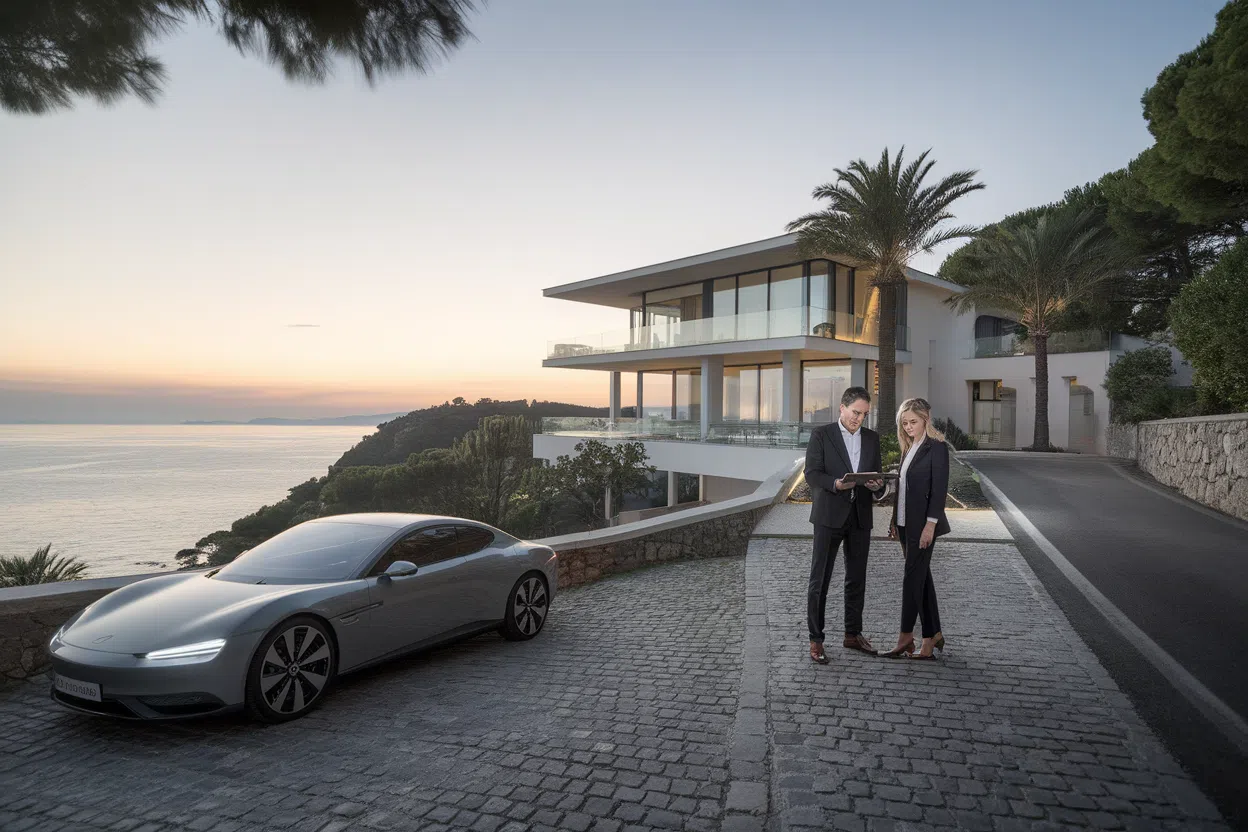
On France’s sun-splashed Côte d’Azur, better known to Americans as the French Riviera, the ultra-luxury housing market is still moving, even as higher interest rates cool much of Europe’s real estate scene.
The reason is simple: the most coveted villas aren’t priced by square footage so much as by what can’t be manufactured, cliffside views, walkable access to the water, tight privacy, and addresses where new construction is heavily restricted. For the world’s wealthy, these homes are being treated less like discretionary splurges and more like hard assets meant to ride out market turbulence.
That demand is concentrated in a handful of micro-markets, think of it as the Riviera’s version of a few blocks in Beverly Hills or the Hamptons. And many of the best listings never hit public sites, trading quietly through brokers, “property hunters,” and family offices.
A tiny slice of the Riviera is driving the biggest deals
The French Riviera is a long coastline, but the rarest sales cluster in a few places: Saint-Jean-Cap-Ferrat, Cap d’Antibes, the California hills above Cannes, Super Cannes, Mougins, and select pockets of Nice and Villefranche-sur-Mer.
In these enclaves, geography and zoning do the heavy lifting. There simply aren’t many villas that combine a sweeping sea view, easy access, sizable land, and neighbors far enough away to keep paparazzi, and curiosity, at bay. Agents say the most sought-after properties often sell off-market after buyers are vetted.
Cannes, famous in the U.S. for its film festival, also benefits from year-round high-end demand tied to conferences, luxury hotels, and the yachting scene. Homes with big terraces, pools, and unobstructed views over the bay tend to be the most liquid, matching an international checklist similar to prime corners of Monaco or Italy’s Riviera.
“Move-in ready” is the new nonnegotiable, especially for Americans and Gulf buyers
Industry professionals on the ground report increased visibility of American and Middle Eastern buyers in top-tier deals since the post-pandemic rebound, alongside the Riviera’s long-standing European clientele. Motivations range from second homes and family ties to wealth diversification and securing a foothold in a place viewed as stable and well connected.
One filter now dominates: turnkey condition. Buyers want to avoid the uncertainty of major renovations, construction timelines, contractor availability, permitting headaches, and materials costs. A fully renovated villa with modern finishes, smart-home systems, air conditioning, strong insulation, and polished outdoor spaces can command a premium because it reduces execution risk.
Energy performance is also rising on the priority list. Even when luxury buyers aren’t bound by the same constraints as typical middle-class homeowners, they still weigh whether an older property will hold value, and whether it will require expensive upgrades to meet evolving standards.
Lifestyle logistics remain central: proximity to an international airport, access to international schools, quality medical care, dining, and boating infrastructure. Buyers compare the Riviera with other global playgrounds, Spain’s Balearic Islands, Portugal’s Algarve, Tuscany, Miami, and Dubai, then decide based on legal certainty, taxes, ease of travel, and the social environment.
Higher rates widen the gap between true trophy homes and everything else
France’s broader housing market has been jolted by rising interest rates and tighter lending. At the very top, the impact looks different: many buyers use little debt, but monetary conditions still shape sentiment, portfolio decisions, and negotiating posture.
Agents describe buyers taking more time, asking for more documentation, and pushing harder on price when a property has flaws, bad access, noise, overlooked views, awkward layouts, or heavy work required. Renovation costs, inflated by energy and materials prices, have become a major factor in whether a deal closes quickly or stalls.
The result is sharper polarization. Prime, hard-to-replicate homes, best addresses, sea views, strong architecture, land, and privacy, continue to trade at high levels. More ordinary villas, or those with legal and permitting complications, face bigger discounts or longer time on the market.
Sellers are adjusting in different ways. Some pull listings rather than accept a cut they consider too steep, keeping supply tight at the top. Others reprice pragmatically to close within a reasonable window, especially if they’re planning to reinvest elsewhere.
Waterfront villas are still treated like “real” assets, because they’re nearly impossible to replace
Luxury brokers on the Riviera repeatedly frame prime property as a tangible asset: it offers personal use, structural scarcity, and long-term wealth storage. When financial markets swing, that pitch gets louder.
It’s most persuasive on or near the water, where environmental protections and local rules make new supply extremely limited. Add steep terrain and intense land pressure, and the number of comparable properties shrinks even further. In this tier, the land, and the ability to preserve privacy, can matter as much as the house itself.
Buyers aren’t blind to risk. Maintenance, security, insurance, and ongoing upgrades can be costly. Coastal climate threats, erosion and intense Mediterranean storms, are also pushing some buyers to demand deeper technical studies and more complete documentation before they commit.
Even so, local players say the Riviera’s fundamentals, global brand recognition, accessibility, culture, and a deep network of high-end services, keep pulling in international money. What’s changing is the bar: the market is getting less forgiving, and the winners are the homes that are truly exceptional on every detail that matters.