

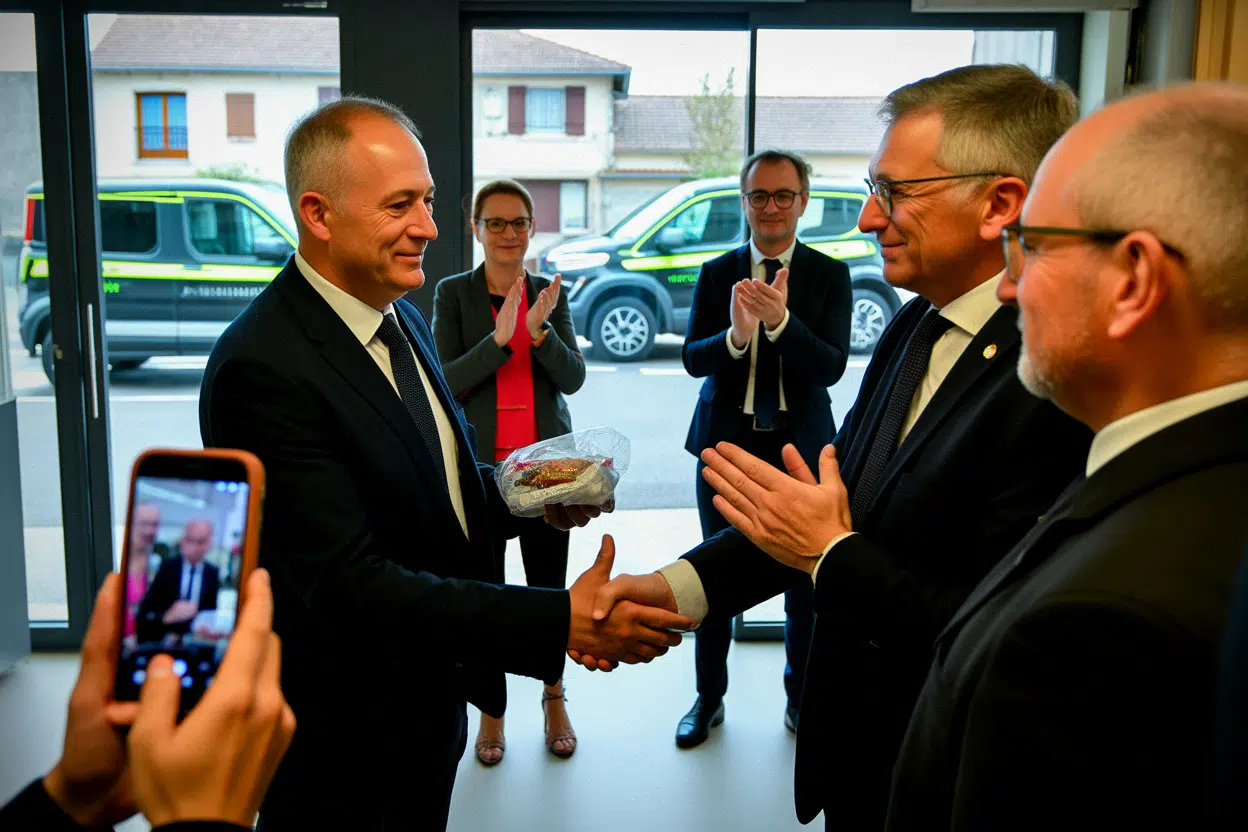
In the small southern French town of Saint-Estève, a retirement ceremony for longtime public servant Franck Esponda drew a full house, elected officials, co-workers, and family members packing the room to mark the end of a decades-long career.
Local newspaperL’Indépendantdescribed the event as more than a polite goodbye: it was a public handoff, a community thank-you, and a reminder that the people who keep a town running often do it far from the spotlight.
A small-town sendoff with big turnout
In France, municipalities commonly hold formal retirement ceremonies for veteran staffers whose work has shaped day-to-day operations. Saint-Estève, just outside Perpignan in the country’s far south near the Spanish border, followed that playbook, turning Esponda’s departure into an official moment of recognition.
The speeches focused on what he delivered over the years: steady service, institutional memory, and the kind of practical know-how that doesn’t always show up in job descriptions but matters when something breaks, a deadline hits, or a crisis lands on a town’s doorstep.
For local leaders, these events also serve a political purpose in the best sense of the word, connecting government to the governed. In a community where residents often know the people behind the counter or on the crew, retirement isn’t just an HR milestone. It’s a visible change in the town’s daily rhythm.
Colleagues and officials praise a career built on reliability
Co-workers typically have the most credibility at ceremonies like this, because they can speak to the unglamorous reality of public service: the early mornings, the last-minute problems, the constant adjustments. That theme ran through the tributes to Esponda, portrayed as a dependable presence who helped keep operations stable over time.
Elected officials framed his career in the broader story of the town, how long-serving staff accumulate a detailed understanding of neighborhoods, facilities, local groups, and residents’ expectations. That kind of knowledge is rarely written down, but it’s often what makes local government function smoothly.
And because municipal employees often work through multiple mayoral administrations, longevity can also mean adaptability. The remarks highlighted the ability to navigate shifting priorities, internal reorganizations, and high-pressure periods when teams have to coordinate projects and respond fast.
Why retirements can rattle local services
Beyond the personal milestone, a retirement can expose a practical challenge: continuity. When an experienced employee leaves, they take relationships, routines, and hard-earned judgment with them, things that can’t be replaced by a binder of procedures.
Like many local governments, French municipalities face constraints Americans will recognize: tight budgets, hiring hurdles for hands-on roles, and the need to train replacements quickly. A public tribute can double as a message to remaining staff that the institution values long-term commitment.
It can also be a quiet warning sign. If a department relies too heavily on one person’s expertise, a retirement forces leaders to formalize processes, build backup coverage, and make sure the next generation isn’t starting from scratch.
A public ceremony that strengthens trust in local government
Saint-Estève’s decision to make the event public reflects a broader tradition in French civic life, town halls regularly host ceremonies, commemorations, and awards as a way to maintain closeness between residents and local institutions.
When done well, the speeches stay grounded in specifics: what was built, improved, handled, or protected. That helps keep the moment from feeling like empty pageantry and instead turns it into a record of service, one that neighbors can recognize and successors can build on.
For Saint-Estève, the message was straightforward: the town is more than its elected leaders. It’s also shaped by the steady careers of people like Franck Esponda, workers whose names may not travel far, but whose impact is felt every day.