

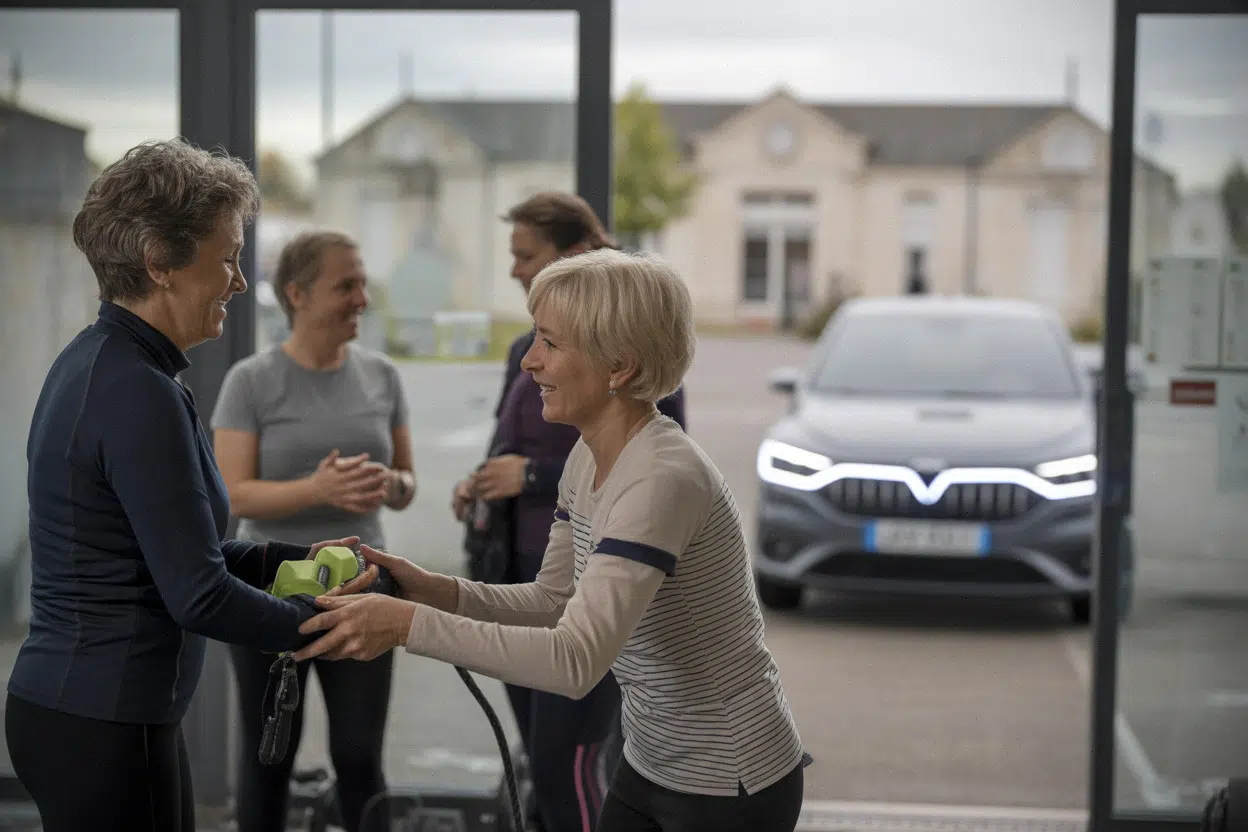
HÉRIMONCOURT, France — A small-town fitness routine is about to change in Hérimoncourt, where the local association Gym Harmonie is closing out its season in July 2026 with a major transition: the two women who have led its weekly maintenance-gymnastics classes for years are stepping down and retiring.
For members, the double departure marks the end of an era. The classes have been a steady fixture week after week, built around established groups and habits—and a loyalty that’s not always easy to sustain in neighborhood sports associations.
Now the club faces a practical question with immediate consequences: how to keep classes running, preserve the club’s spirit, and ensure qualified supervision at a time when many community groups struggle to recruit leaders.
A season-ending gathering doubles as a turning point
Gym Harmonie’s end-of-season event in Hérimoncourt brought members together in the kind of close-knit atmosphere typical of local French associations. But the get-together also served another purpose—marking the end of classes and acknowledging the announcement that dominated conversations: the retirement of the two instructors who provided regular supervision.
In a club like this, the end of the year is more than a date on the calendar. It’s a moment to take stock of attendance, consistency, and whether the association can keep time slots that members find appealing. Participants described structured sessions focused on maintenance fitness, mixing strength work, mobility, and balance, with adjustments for different ability levels.
That formula tends to succeed when progression is carefully paced and safety is treated as non-negotiable—two points on which the instructors had built their reputation.
The gathering also highlighted the social role these classes play. Members described a weekly rendezvous that can be more consistent than other activities. In towns where leisure life often revolves around a handful of associations, the gym becomes a place to connect—and the instructor becomes a familiar figure who can hold a group together.
That kind of relational capital doesn’t automatically transfer, even if the club keeps the same schedule and equipment.
Club leaders used the evening to discuss what comes next, balancing logistics such as facility scheduling, insurance, and compliance requirements with the biggest need of all: having qualified supervision in place. In today’s environment, the continuity of a class often depends less on demand—which remains strong—than on finding capable people who can commit week after week for an entire season.
Communication is also part of the transition. Keeping members informed, limiting rumors, and clarifying what’s decided for the fall can help prevent drop-offs. Gym Harmonie’s situation captures a familiar moment for local associations: turning a departure into a reorganization without losing momentum built over years.
Gym Harmonie’s instructors step away after years of leading classes
The retirement of the two instructors is the central event for Gym Harmonie. In maintenance-gymnastics classes, the leader’s job goes well beyond running through a routine: watching posture, correcting movement, adjusting intensity, and sustaining group energy. Over time, that creates trust—often a key reason participants stay.
Members described sessions where adaptation mattered as much as effort. Between beginners, people returning after a break, and those seeking steady training, an instructor has to offer variations, manage different levels, and prevent injuries. That know-how depends on experience and preparation: selecting exercises, planning sequences, managing equipment, and staying vigilant about warm-ups and cool-downs.
In an association, a long-serving leader also shapes internal life. New members often join through word of mouth after hearing about a class that’s serious and accessible. Stability helps on the practical side too—reliable calendars, consistent hours, and a coherent atmosphere.
Replacing two people at once raises the risk of disruption. It’s not just a matter of filling a slot; it’s rebuilding an entire operating rhythm.
The retirements also raise the issue of handoff. The instructors leave with teaching habits, playlists, progression plans, warm-up routines, and detailed knowledge of some participants’ limitations. In amateur clubs, that institutional memory isn’t always written down. To reduce the loss, the association could document typical class content, plan a transition period, or organize trial sessions with potential future leaders.
As leaders thanked the instructors, they emphasized a basic reality of amateur sports: without supervision, the activity stops. In Hérimoncourt, that reality is immediate—the retirements affect the backbone of the program, not a minor organizational detail.
Recruiting qualified fitness leaders is a growing challenge for local clubs
Gym Harmonie’s situation reflects a broader challenge shared by many associations: finding people who are available long-term and have enough expertise to lead safely. In maintenance fitness, demand often grows as local sports offerings diversify, but staffing doesn’t always keep pace.
And it’s not only about money. Even when an association can compensate an instructor, the equation can still be difficult: evening hours, travel, session preparation, and committing for a full season. Trained professionals may already work for multiple organizations, creating indirect competition—while towns farther from major employment centers for sports professionals can be less attractive.
Association leaders typically point to a few options: hiring independent instructors, sharing an instructor across multiple towns, or training motivated volunteers from within. That last path takes time and rigor, because leading a group carries responsibility. In wellness-oriented classes, a poor instruction or a badly adapted exercise can cause injury, and associations have to anticipate that risk with clear procedures.
Media coverage in France has also highlighted that gym classes can draw increasingly broad audiences, including people who start later in life. Some examples elsewhere in the country feature very active seniors, sometimes even serving as instructors themselves—but those cases remain exceptions.
In the short term, the priority is avoiding canceled time slots. Over the medium term, the goal is to secure a stable model—through annualized scheduling, shared training, and a core of volunteers who can support whoever leads the class. In a town like Hérimoncourt, the ability to recruit directly determines whether residents can keep access to regular, local fitness activity.
Demand for maintenance fitness classes remains strong in 2026
Across multiple areas, the signals point in the same direction: in 2026, maintenance gymnastics and general fitness activities often see sustained attendance, sometimes to the point of full classes. The tension between demand and capacity is driven by several factors cited in the community sports world—interest in accessible activity, health prevention, and the appeal of regular exercise without competition.
Associations offering structured sessions with progressive exercises tend to attract a wide mix of participants. Some come to rebuild strength; others focus on mobility or balance. Evening time slots are especially sought after because they fit work schedules. When a class works well, it can quickly hit capacity—particularly in smaller rooms or when the instructor intentionally limits numbers to maintain close supervision.
That dynamic makes leadership even more important. When a well-known instructor leaves, members naturally wonder whether the quality will hold. For Gym Harmonie, keeping full classes will depend on finding a credible replacement with a compatible approach—and avoiding a long gap between seasons.
Clubs can also try to expand to meet demand by adding a second time slot, offering themed workshops, or organizing occasional sessions during school breaks. But those options require a pool of instructors. Locally, sharing staff across towns can be a pragmatic solution: one coach rotates among communities on an optimized schedule, coordinated with town halls for facility access and with enough visibility to stabilize enrollment.
The retirements in Hérimoncourt come at a moment when appetite for this kind of activity remains high. For members, the goal is not to lose a beneficial routine. For the association, the challenge is turning a page into an opportunity to reorganize—while staying aligned with what participants want now: regular, supervised, accessible fitness close to home.
https://www.europe-infos.fr/actualites/9534/1-600-drones-feu-dartifice-le-13-juillet-2026-show-de-20-minutes-au-champ-de-mars-les-meilleurs-spots-a-viser-vite/
Key Takeaways
- In Hérimoncourt, Gym Harmonie’s two instructors will retire in 2026
- Their simultaneous departure threatens the continuity of the maintenance fitness classes
- The association must recruit or arrange a handoff to ensure stable supervision
- Demand for fitness classes remains strong, with time slots often fully booked
https://www.europe-infos.fr/actualites/9506/2e-edition-repas-mensuel-de-lamac-a-masseube-tombola-et-depart-a-la-retraite-ce-rendez-vous-fait-fureur-au-bourg/