


Artificial intelligence and automation are no longer confined to labs in 2026. They’re showing up across offices, factories, hospitals and public services—sold as a way to boost productivity, cut errors and lower costs.
But the same rollout is also shifting day-to-day tasks, weakening some occupations and changing how people define themselves through work. The central question isn’t just technological. It’s social: as machines take up more space in the economy and daily life, what’s left that only humans should do?
Across sectors—from call centers and logistics to banking, government administration, health care and media—the debate is increasingly focused on three concrete issues: jobs, the quality of work, and social dignity.
Automation is reshaping jobs, pushing repetitive work toward oversight roles
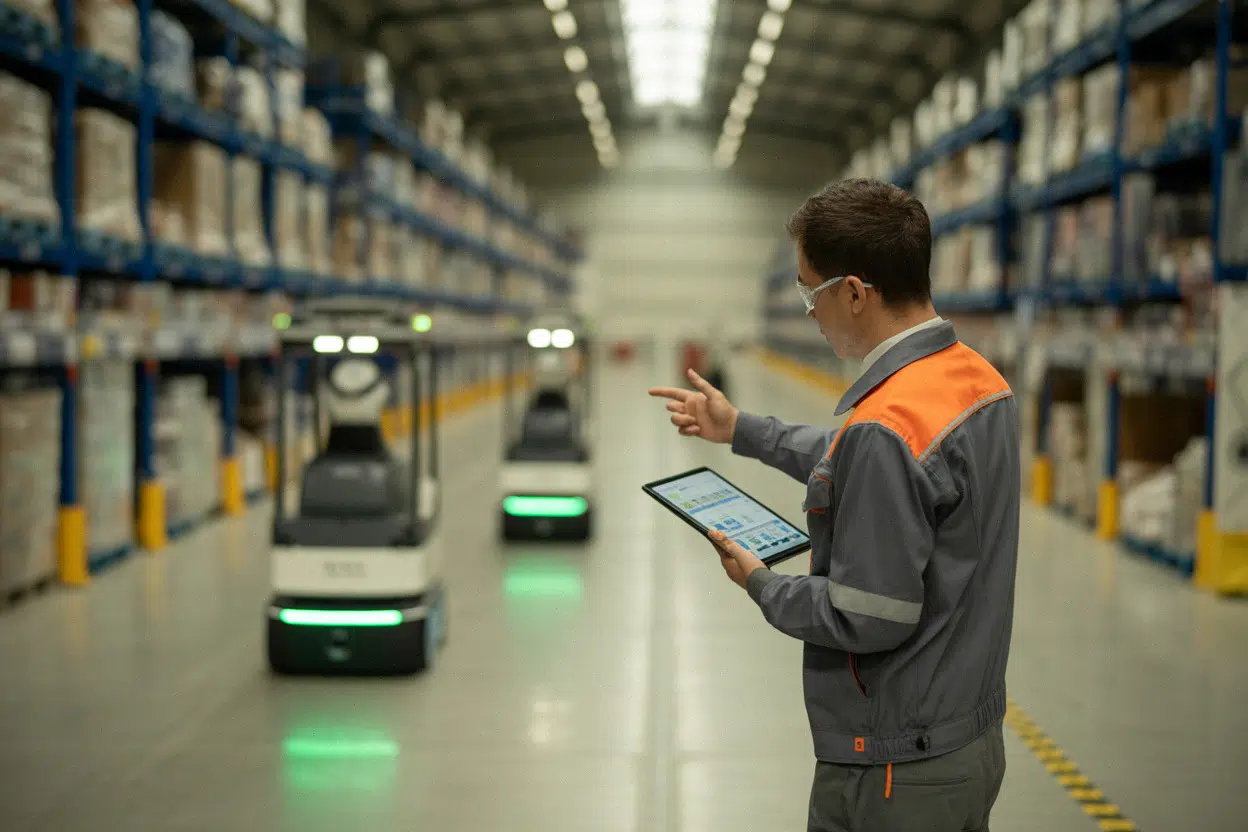
In most industries, automation hits predictable, paced and measurable tasks first. Warehouse robotics, automated document-processing software and AI writing assistants can shift large volumes of activity away from people. That doesn’t always mean immediate layoffs—it often means reorganized workflows and rewritten org charts.
The roles most exposed are those where value comes from repetition: data entry, basic verification, standardized handling and routine manual tasks. For employers, the pitch is speed, continuity of operations and fewer human errors.
On the ground, full replacement is still less common than reallocation. Jobs rarely vanish overnight; they change. Workers may be moved into supervision, maintenance, quality control or customer-facing roles. But that transition isn’t automatic—it requires time, training budgets and a real effort to recognize transferable skills.
Without that support, the article warns of a polarized labor market: highly skilled jobs tied to data and systems on one side, precarious service work on the other, and a shrinking “middle” of intermediate roles.
In office work, AI tools are changing what people do faster than job titles change. A production assistant, for example, may be asked to complete in minutes what used to take half a day—summarizing documents, generating outlines, drafting responses. The productivity gain is real, but it can also create a new expectation: produce more, faster, often with less tolerance for mistakes.
That shifts the pressure point to work intensity, mental load, and how much room remains for human initiative inside processes increasingly guided by automated recommendations.
The reshuffle also reaches questions of dignity. Moving from execution to monitoring can increase autonomy. But if the job becomes little more than approving what a machine proposes—or fixing its errors under tight time pressure—professional satisfaction can drop.
Managers speaking anonymously describe a paradox: higher overall productivity, but more individual frustration when a person’s contribution becomes less visible. Recognition becomes a central issue—who gets credit, the human who corrects, or the tool that produces?
In that environment, protecting employment depends less on preserving the status quo than on building bridges between roles. The companies that navigate the shift best, the article argues, tend to invest in upskilling and clearly define the limits of automation—keeping space for human decision-making and learning rather than turning workers into executors of machine choices.
https://www.europe-infos.fr/actualites/9577/herimoncourt-les-deux-animatrices-de-gym-harmonie-prennent-leur-retraite-apres-des-annees-de-cours/
Companies are trying to govern AI—between productivity, surveillance and accountability
Rolling out automated systems isn’t neutral, the article notes—it comes with a new way of managing work. In service jobs, AI can track response times, analyze exchanges, suggest scripts and set priorities. In logistics, it can optimize routes, assign tasks and monitor performance.
Executives may see better resource allocation. Employees may experience it as added convenience—or as expanded surveillance. The line often depends on usage rules, transparency and whether workers have a real right to challenge decisions.
Accountability becomes urgent as soon as AI influences decisions that affect people: hiring, assigning a case file, prioritizing a patient, detecting fraud, moderating content. Even when the tool is framed as “assistive,” organizations can be tempted to treat its recommendation like an order—either for efficiency or out of fear of missing a signal.
That can leave a worker with responsibility but little power: expected to own the decision while being pushed to follow the machine. Legal and compliance teams therefore emphasize traceability—who decided what, on what basis, and with what oversight.
Corporate messaging often stresses AI as a tool that helps without replacing. That approach does exist, particularly in decision support and administrative automation. But economic pressure pushes companies to maximize return on investment, which can mean smaller headcounts or faster pace.
In sectors facing international competition, productivity becomes the central argument. The social fight then turns to how gains are shared: higher wages, reduced working time, investment in training, or simply improved margins. The article says this question is rarely settled publicly, yet it shapes how the public views the technology.
In daily life, dependence on technology has become more visible since the early-decade health crisis. Remote work, government paperwork, online commerce and connected health tools have pushed more interactions through digital interfaces. That dependence is cultural as much as technical: access to rights and services increasingly requires digital skills.
Inequality shifts toward access to devices, connectivity and know-how. As machines take up more space, exclusion can become quiet—showing up as people giving up: not applying for help, not asserting a right, not applying for a job.
To avoid automation imposed from above, some companies are adopting usage charters, internal ethics committees or impact assessments. These measures vary in strength, but they reflect a growing recognition that performance alone isn’t enough if trust collapses.
The most sensitive issues include employee surveillance, data management, the right to an explanation and the ability to appeal. Where guardrails exist, acceptance rises. Where AI arrives as an ultimatum, resistance grows—sometimes as disengagement, sometimes as quiet workarounds.

Creativity, empathy and judgment remain practical human advantages
With machines now able to produce text, images, analysis and recommendations, the idea of a “human remainder” can sound abstract. The article argues it isn’t. Some capabilities remain hard to formalize—and still matter in real workplaces.
Creativity isn’t just generating variations. It depends on intent, meaning, social context and the ability to propose a relevant break from the expected. In a newsroom, communications shop or agency, AI can speed production, but choosing an angle, ranking information and exercising caution around a rumor are editorial judgments.
Empathy and relationship-building are just as central. In health care, education, social services and customer support, quality often depends on listening, trust and interpreting subtle signals. An interface can guide, remind, and sort requests, but it struggles with what’s unspoken—anxiety, shame, fatigue—factors that often shape the right decision.
Professionals, the article notes, say technology can help diagnose or route people more effectively, but it doesn’t replace the relationship—especially in complex or sensitive situations.
Human judgment also shows up in handling exceptions. Automated systems perform well on common cases but can become fragile when context shifts, data is incomplete, or rare events occur. In industry, an experienced operator might notice an unusual noise, vibration or smell before sensors flag a problem. In public administration, an agent may recognize an atypical case and adjust support.
That ability to navigate uncertainty isn’t a luxury, the article argues—it affects safety, quality and sometimes justice.
These human advantages aren’t guaranteed. If work is organized to strip autonomy and impose total standardization, creativity and judgment erode. But if AI takes over some repetitive tasks, it can free time for listening, reflection and process improvement.
The outcome depends on management choices: cut staff, or reinvest the time saved. On that point, unions argue that promises of “more human” work only matter if workplaces track quality-of-work indicators—not just output volume.
Public anxiety often becomes identity-based: if the machine does better, where is my value? The article frames the challenge as redefining value not only through production, but through social usefulness, service quality and responsibility. In an economy saturated with tools, knowing when not to automate can even become a competitive advantage.
Governments and schools in 2026 are betting on training and regulation
The speed of AI adoption is forcing public authorities to balance support for innovation with the risk of widening inequality. Employment policy is being pressed on retraining, career guidance and protections for exposed workers.
The goal isn’t only to teach people how to use tools, but how to use them critically—understanding limits, biases and the conditions under which outputs are reliable. In public services, that ambition collides with budget constraints and sometimes fragmented IT systems.
In education and workforce training, the article describes a two-part challenge: building digital skills and basic data literacy, while also strengthening human skills—writing and speaking, critical thinking, cooperation and the ability to keep learning.
Teachers describe a tension: assistive tools can personalize learning, but they can also encourage shortcuts and reduce effort. Schools are looking for usage rules—different ways to assess work, assignments grounded in real-world tasks, and training in source-checking and building an argument.
Regulation focuses on transparency, data protection, non-discrimination and responsibility when harm occurs. Regulators face a practical problem: auditing complex systems that may be proprietary and ensuring their effects are controlled.
Consumer groups and rights organizations are calling for accessible appeal mechanisms, especially when automated decisions affect access to credit, jobs or benefits. The social demand is straightforward: the ability to speak to a human and contest a decision.
In workplaces, collective bargaining becomes a key lever. Agreements can spell out how a tool is introduced, its objectives, what data is collected, how long it’s kept, and what guarantees workers receive. Companies that anticipate these talks reduce the risk of internal crisis; opaque automation can trigger lasting distrust, lower engagement, higher turnover and conflict.
The article closes on the shape of the 2026 compromise: accept a growing role for machines, but set limits and build protections. Schools and training systems are expected to prepare career paths, the state to regulate and model best practices in public services, and companies to share productivity gains while protecting work quality. In that framework, the place of humans depends less on fighting machines than on collective rules that keep technology compatible with dignity, equal access and trust.
Key takeaways
- In 2026, automation is mainly shifting repetitive tasks into supervision and control roles.
- AI can raise productivity but also intensify work and expand surveillance.
- Creativity, empathy and judgment remain decisive in complex, sensitive situations.
- Training, transparency and a right to appeal shape public acceptance of AI tools.
- How productivity gains are shared affects trust in companies and institutions.
- Quand les machines prennent de plus en plus de place, que reste-t …
- Quand les machines prennent de plus en plus de place, que reste-t …
- L’intelligence artificielle n’est plus un simple outil capable de …
- La machine va-t-elle remplacer l’homme ? Une perspective optimiste
- La puissance des machines a-t-elle dépassé la puissance des …
Sources
Key Takeaways
- In 2026, automation mainly shifts repetitive tasks into supervisory roles
- AI boosts productivity but can intensify work and increase monitoring
- Creativity, empathy, and judgment remain decisive human strengths in complex cases
- Training, transparency, and the right to appeal determine the social acceptability of these tools
- Sharing productivity gains affects trust in companies and institutions
Sources
- Quand les machines prennent de plus en plus de place, que reste-t …
- Quand les machines prennent de plus en plus de place, que reste-t …
- L'intelligence artificielle n'est plus un simple outil capable de …
- La machine va-t-elle remplacer l'homme ? Une perspective optimiste
- La puissance des machines a-t-elle dépassé la puissance des …