

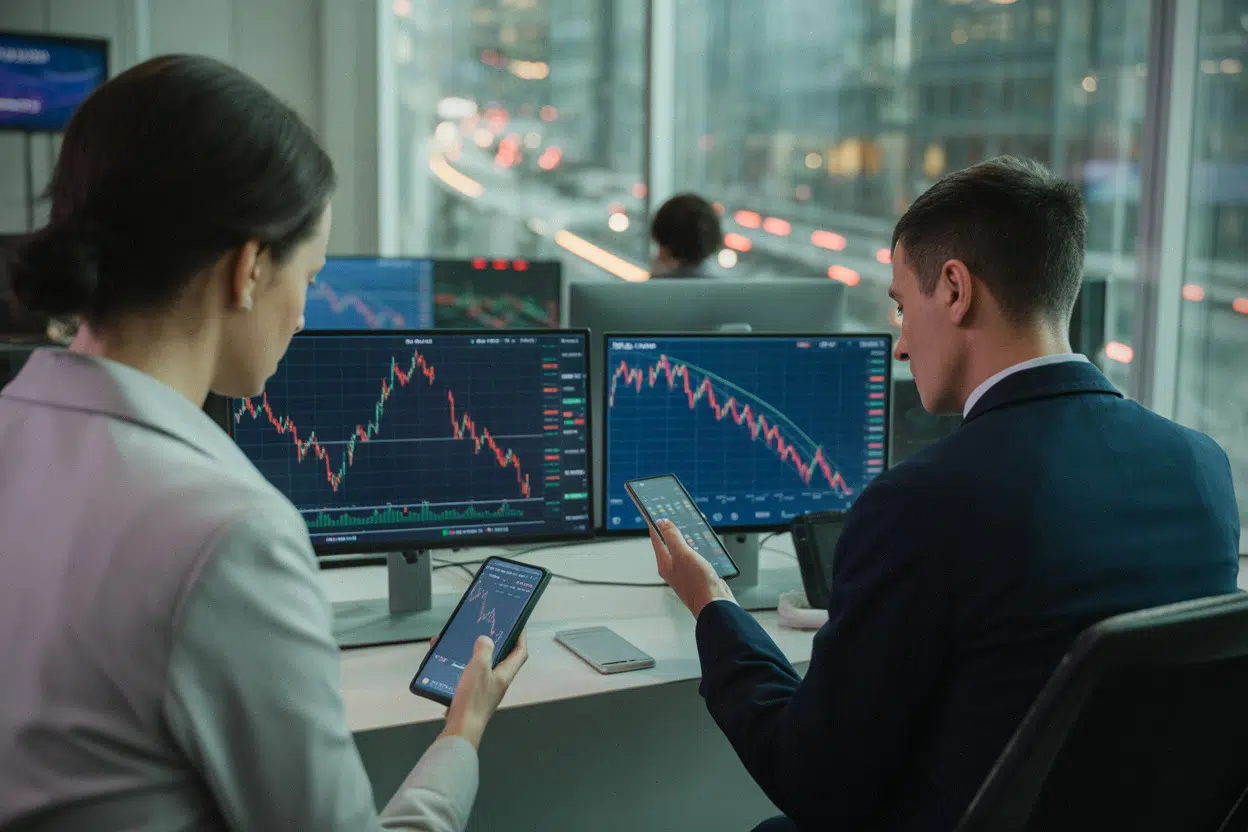
U.S. markets opened the week under pressure on July 13, 2026, after renewed political talk of potential “blockades” resurfaced in Washington—an uncertainty that pushed investors out of risk and into safe havens.
According to Boursorama’s “Jour de Bourse” market column, the shift showed up quickly in two classic places: stocks moved lower while U.S. Treasury yields fell, a pattern that typically signals a flight to safety. When traders rush into Treasuries, prices rise and yields drop.
The market mechanics weren’t unusual. What grabbed attention was the trigger: a political risk that’s hard to model, tied to institutional tensions and contested executive decisions, and carrying the potential—at least in investors’ minds—to disrupt trade, logistics, and corporate planning.
Trump puts “blockades” back at the center of political risk
Boursorama pointed to Donald Trump’s role in bringing the blockade theme back into political statements, reviving a risk markets tend to treat differently than routine campaign rhetoric. Investors can often shrug off slogans—until they start to look like actions that could be implemented, even temporarily.
The idea of an executive branch using coercive measures such as blockades changes how traders price risk because the potential impact can be immediate across commerce, energy, logistics, and insurance costs. In a globalized economy, the word “blockade” multiplies the number of scenarios investors feel they must consider.
Bond analysts may start penciling in weaker activity if flows are constrained, while equity analysts worry about a squeeze: lower volumes paired with higher costs. Even without knowing the exact form a blockade might take, investors often reallocate first and ask questions later—helping explain the speed of the move Boursorama described on July 13.
Credibility matters as much as the threat itself. A blockade—however limited—would require administrative capacity, coordination across agencies, and institutional acceptance. Markets don’t resolve those questions instantly; they add a risk premium and wait for signals, including official reactions, diplomatic exchanges, and responses from counterparties.
Companies most exposed are those dependent on tight supply chains—imported components, ocean shipping, and narrow delivery windows. Investors also focus on sectors where geopolitics is already embedded in pricing, including energy, defense, and transportation.
For households, the effect is indirect but real. If markets anticipate disruptions, some commodity prices can tighten and companies may pass along higher costs. For now, Boursorama framed the move as anticipatory—yet the financial reaction itself signals that political risk is again a top-tier driver of pricing in 2026.
https://www.europe-infos.fr/actualites/9708/bourse-etf-assurance-vie-en-2026-pourquoi-de-plus-en-plus-de-francais-passent-a-linvestissement/

Treasury yields fall as investors reach for a safe haven
Boursorama highlighted the drop in Treasury yields on July 13, 2026, consistent with rising demand for U.S. government bonds. The logic is straightforward: more buying pushes prices up and yields down, reflecting a classic safety trade where liquidity and perceived issuer strength take priority.
Falling yields can also reflect a shift in growth expectations. If blockade risk is viewed as even partly credible, investors may see higher odds of trade friction, logistics disruptions, and slower exchange of goods—conditions that bond markets, often more sensitive to macro scenarios, tend to price quickly.
Markets can also read such events as short-term disinflationary if activity slows faster than prices rise. But the equation is messy: a logistics blockage can also be inflationary if it creates shortages. In the moment, the dominant force is often portfolio mechanics—de-risking, buying sovereign debt, and pushing yields lower.
Moves in yields ripple across asset classes. When long-term rates shift, equity valuation models change, especially for growth stocks. But in a session dominated by political risk, psychology can override math: equity risk premiums rise and valuation multiples compress even as yields fall. That combination—stocks down, yields down—is common during stress episodes.
Boursorama also noted the global transmission channel: because Treasuries sit at the center of international portfolios, a safety bid in New York can influence sovereign curves in Europe through cross-border allocation and currency hedging decisions.

Stocks slide, with trade-exposed sectors in the spotlight
The stock decline described by Boursorama fit a simple framework: rising political uncertainty increases the risk premium investors demand. In those sessions, markets don’t just tally headlines—they reset the price of risk, and the adjustment can be abrupt.
Sectors most closely watched tend to be those dependent on international trade, transportation, and smooth logistics. Boursorama pointed to areas such as retail distribution, manufacturing, autos, parts of hardware technology, and maritime shipping as particularly sensitive to disruption risk.
A blockade threat raises the perceived odds of delays, higher freight costs, and shortages. Even without an actual blockade, the risk alone can change behavior—companies may stockpile inventory, delay investment, or face more expensive currency hedges.
Energy stocks can react in conflicting ways. A geopolitical shock can lift prices on fears of supply disruption, while a growth shock can weigh on expected demand. The result is higher volatility and shifting correlations, complicating risk management.
While indexes capture the broad move, dispersion often increases—some companies are punished more than others. Firms that can produce locally or rely on diversified supply chains tend to be viewed more favorably, while highly leveraged companies or those dependent on frequent market financing can come under pressure as risk aversion raises the cost of capital, even if sovereign yields fall.
In that environment, corporate communication becomes crucial. Investors look for operational specifics—inventory levels, contract clauses, substitution options, and geographic exposure of sales—that can separate a broad selloff from a more targeted correction.
A past shutdown offers a reminder of the economic cost of prolonged disruptions
Boursorama’s broader framing also pointed to a prior example of institutional gridlock: a prolonged U.S. government shutdown described as lasting 43 days, in an assessment referencing the Congressional Budget Office. The current situation is different, but markets often use concrete precedents to calibrate risk.
A shutdown partially paralyzes the federal government, creating delays in services, permits, procurement, and even the release of some statistics. A blockade, depending on its form, would hit physical and commercial flows more directly. In both cases, the common thread is disruption to a system investors typically assume is stable.
The cost isn’t limited to an aggregate GDP figure. Businesses can postpone decisions, households can adjust spending, and local governments can face cash strains. Financial markets react earlier because they price the future; when political risk raises the odds of disorganized economic outcomes, the discounted value of expected profits falls.
The comparison also helps investors separate noise from lasting impact. A political flare-up can drive volatility for a few sessions and fade if compromise emerges. If it drags on, effects can compound—pushing traders to watch secondary indicators such as credit risk premiums, implied volatility, funding spreads, and the dollar’s behavior.
For 2026, Boursorama argued, the blockade debate brings back a central question: how far can politics interfere with the real economy without triggering a durable investor backlash? The July 13 session suggested sensitivity is high—and that markets want clarity quickly to stabilize expectations.
https://www.europe-infos.fr/actualites/9665/franchise-et-ia-en-tunisie-comment-le-modele-peut-diffuser-lintelligence-artificielle-dans-leconomie/
Key Takeaways
- On July 13, 2026, stocks fell and Treasury yields declined.
- The threat of a blockade is driving up the risk premium and prompting defensive repositioning.
- Sectors reliant on global trade are under the closest investor scrutiny.
- Past episodes of institutional gridlock highlight the potential economic cost if the crisis drags on.