

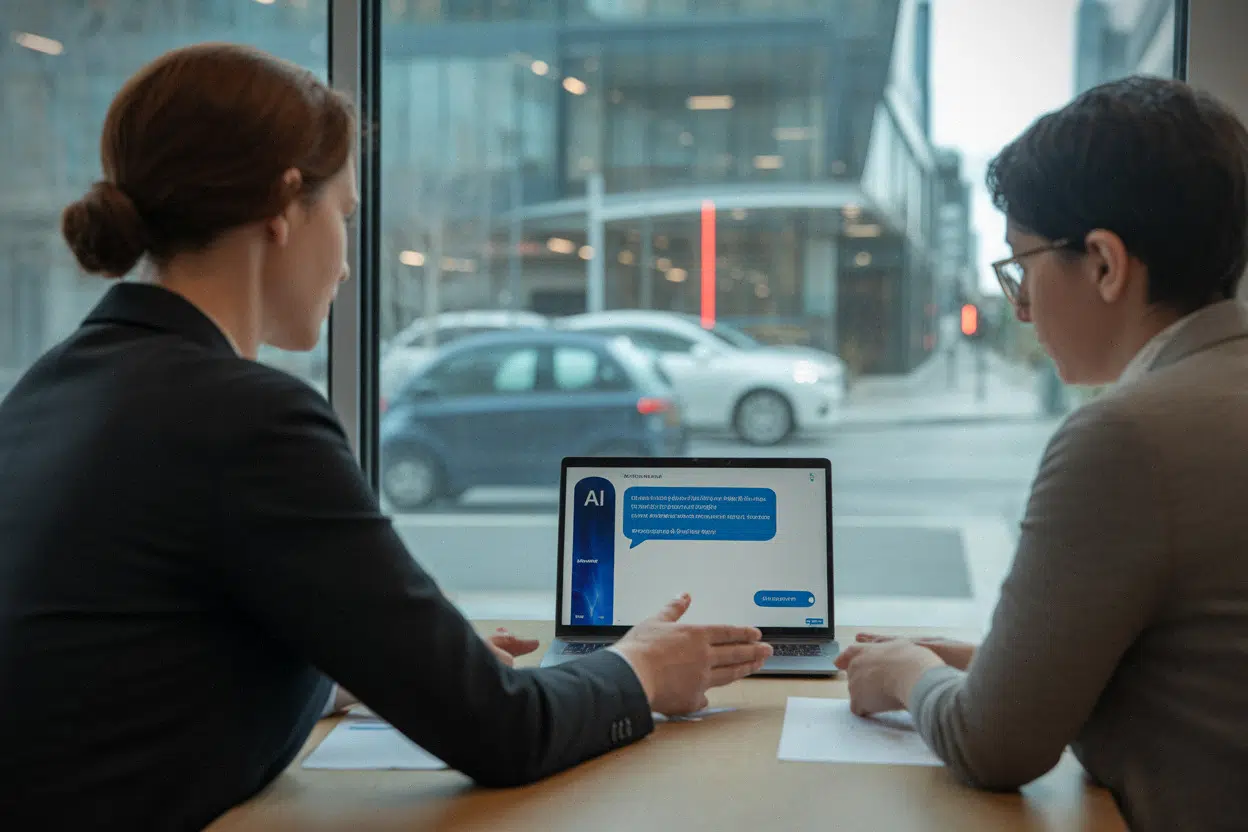
Companies in Quebec are increasingly turning to artificial intelligence as a fast, trackable way to strengthen French on the job—especially for English-speaking employees. Instead of relying on occasional classroom-style courses that managers often view as too theoretical, these employers are deploying conversational AI tools that act like always-on language tutors.
The pitch is practical: simulate real workplace interactions, correct phrasing in the moment, and tailor exercises to each employee’s level. The goal is twofold—help workers speak more comfortably in concrete situations and reduce dependence on one-off training sessions.
The approach mirrors a broader trend already visible in schools, where AI is used to support learning for homework—alongside repeated calls for responsible use and anti-plagiarism safeguards.
A Quebec-built tool that rehearses real office French
Quebec-focused solutions are built around practice, not memorizing rules. An employee logs into an interface, describes their job and proficiency level, then trains through typical scenarios: greeting a customer, replying to an email, joining a meeting, or explaining a production incident. The AI plays the other person, adjusts difficulty, and suggests more idiomatic rewrites along with targeted corrections.
The core argument is repeated exposure at low marginal cost, with practice available outside a classroom. In workplaces where operational pressure leaves little time for training, that flexibility matters. Managers interviewed in the services sector described 10- to 15-minute sessions folded into the workday—before a shift starts or during a slow period.
Exercises focus on concrete outcomes: clarifying an instruction, asking for details, or announcing a delay. The improvements employers want are functional—less switching to English, better comprehension in meetings, and fewer misunderstandings around safety or quality instructions.
These tools also promise more personalization than a group course. AI can spot recurring errors—agreement mistakes, prepositions, false cognates—and then propose targeted drills. For English speakers who often hesitate out of fear of speaking incorrectly, the appeal is a judgment-free environment where a phrase can be repeated 10 times.
But language quality remains central. AI can generate fluent responses, yet the level of professional French depends on training data, settings, and guardrails. Designers highlight correction features, while training leaders want proof: residual error rates, register quality, and whether Quebec French turns of phrase are handled appropriately. In many industries, nuance matters—an imprecise word can change an instruction, a commitment, or how a process is understood.
Rollouts also run into internal acceptance. Some employees see AI as a discreet assistant; others worry it’s a monitoring tool. To avoid that perception, some leadership teams emphasize confidentiality and say the goal is to support learning—not evaluate individual performance. That balance can determine adoption, especially in teams already facing productivity tracking.
https://www.europe-infos.fr/actualites/9819/action-fdj-united-a-paris-autour-de-23-recul-du-chiffre-daffaires-et-fiscalite-sous-surveillance/

Employers want measurable ROI from language training
Workplace training is often judged by tangible indicators: participation rates, progress, and effects on service quality. Traditional group French classes still have value, but their effectiveness depends on frequency, having participants at similar levels, and whether employees practice between sessions. In many teams, staff turnover, variable schedules, and workload make that model hard to sustain.
Employers are drawn to AI because it promises continuity—available on a computer or phone—with individualized tracking. The management case centers on reducing daily friction: fewer clarifications in English, smoother customer service interactions, and more convincing sales presentations.
In that framing, AI is positioned as a complement, not a replacement. It prepares employees for real situations, then on-the-job exposure reinforces what they’ve practiced. Training leaders also value the ability to generate company-specific scenarios—internal vocabulary, products, procedures, and customer types.
Measuring impact, however, remains tricky. Companies can count sessions, time spent, and topics covered, and they can test proficiency through internal or external assessments. But day-to-day improvement also depends on workplace context: team culture, tolerance for mistakes, and whether French-speaking colleagues allow time for an exchange. AI alone won’t change informal norms in an organization where English takes over in urgent moments.
The issue of French at work also ties to obligations and image. For some companies, strengthening French supports compliance and customer relationships. There’s also a reputational argument: being able to respond in French, in a professional register, can reduce complaints and build trust. That pushes leadership to seek solutions seen as modern and demonstrably invested in language skills.
Cost comparisons also shape decisions. A software license can be extended to many employees, while a trainer can only handle a limited group. But an all-automated approach can hit a ceiling. Several training specialists note that human interaction still helps with pragmatics, implied meaning, intonation, and managing real conversation. Hybrid setups—daily AI practice plus less frequent human workshops—are often described by HR teams as the most effective path.

Privacy, bias, and fears of surveillance in English-speaking teams
Introducing conversational AI at work immediately raises data questions. Employees may type information tied to customers, internal incidents, or products. Even with a learning goal, an exercise can drift into an overly specific description of a real situation. Companies therefore need usage rules: don’t enter sensitive data, anonymize scenarios, and stick to generic cases. Vendors, for their part, are expected to clarify storage practices, server location, and deletion mechanisms.
Concerns about indirect surveillance are real. An employee may wonder whether their language mistakes will be visible to a manager, whether their level will be scored, or whether practice time could affect performance reviews. To ease those fears, some organizations set privacy controls: aggregating statistics at the team level rather than the individual level, limiting data access, and separating training from performance management.
Linguistic bias is another issue. AI may favor a standard register, penalize regional phrasing, or suggest wording that doesn’t fit certain industries. In manufacturing, overly administrative vocabulary can sound off. In health care, lexical precision matters. To reduce these gaps, companies ask for contextualized content and configurable options. Designers promise adjustments, but quality depends on training, oversight, and the ability to correct quickly.
Questions about controlling AI use echo debates already playing out in schools, where AI is used to help with homework. Common guidance emphasizes using AI as a tutor—rephrasing, explaining, practicing—rather than as a shortcut. In the workplace, the stakes differ but the risk remains: AI should help employees learn, not produce work in their place.
With French, an employee might be tempted to have the AI write a full email and send it without understanding it. That can improve appearances without improving skill. As a result, some internal policies are beginning to draw a line between two uses: permitted learning practice and tightly governed generation of professional content. A customer email may be assisted, but it must be reread and understood; a sensitive internal note may be prohibited in the tool. The governance is meant to reduce legal risk and keep the focus on learning—and it also raises a cultural question: does the company want French genuinely carried by its teams, or simply clean text produced by a machine?
Workplace scenarios designed to build speaking confidence
AI tools aimed at French learning in companies put special emphasis on speaking—a weak spot often acknowledged by English speakers who can read well but hesitate to talk. Conversation drills, with follow-up prompts and corrections, try to recreate the pressure of a real exchange while allowing employees to restart and repeat.
Typical situations are job-centered: giving a supervisor an update, requesting a schedule change, handling a complaint, explaining a breakdown, or participating in a team meeting. Scenario-based training can also be paired with measurable goals: mastering a list of technical terms, reaching a certain level of fluency on a topic, or reducing frequent anglicisms.
Supervisors see an advantage in training that maps directly onto tasks. In service roles, greeting scripts can be practiced. In sales, customer objections can be simulated. In operations, safety instructions can be repeated until they become automatic. The benefit employers are chasing is pragmatic—fewer errors and better coordination.
Confidence gains also depend on the quality of feedback. Useful correction doesn’t just flag a mistake; it explains why, offers two or three alternatives, and gives an example in a sentence close to everyday work. Tools that build in that kind of teaching—rather than just a score—tend to be better received. Employees also value being able to ask why a phrasing is better or how to say something more politely, two common needs in professional settings.
Still, AI speaking practice doesn’t erase the human side of using a second language at work: fear of being judged, worry about slowing down the group, and feelings of illegitimacy. AI can lower initial anxiety, but transferring skills to real conversations requires a supportive environment. Companies that report results often describe complementary efforts: language buddy systems, meetings where hesitation is accepted, and a culture where people correct without mocking.
For employees, the biggest advantage is repetition. Even in Quebec, exposure to French can remain limited in some sectors where English dominates. AI can provide the volume of practice many workers lack—especially those without a French-speaking social circle. And scenarios can be updated as needs change, for example ahead of a busy season or a procedure change, anchoring language in immediately useful situations.
Key takeaways
- Quebec companies are using AI to help employees practice French in workplace settings, particularly English-speaking staff.
- The tools emphasize job-based scenarios and personalized correction tailored to each employee’s level.
- Employers are looking for measurable returns through usage metrics and smoother internal communication.
- Privacy rules and clear governance are critical to avoid fears of surveillance and protect sensitive data.
- Hybrid approaches—daily AI practice plus periodic human coaching—are often viewed as more effective than automation alone.
Sources
Key Takeaways
- Quebec companies are using AI to help employees practice French in a professional setting
- The approach emphasizes workplace scenarios and personalization based on the employee’s level
- Return on investment is pursued through usage metrics and smoother internal communication
- Data privacy and governance of how the tools are used determine acceptance
- Hybrid setups—everyday AI plus human support—are often seen as more effective