

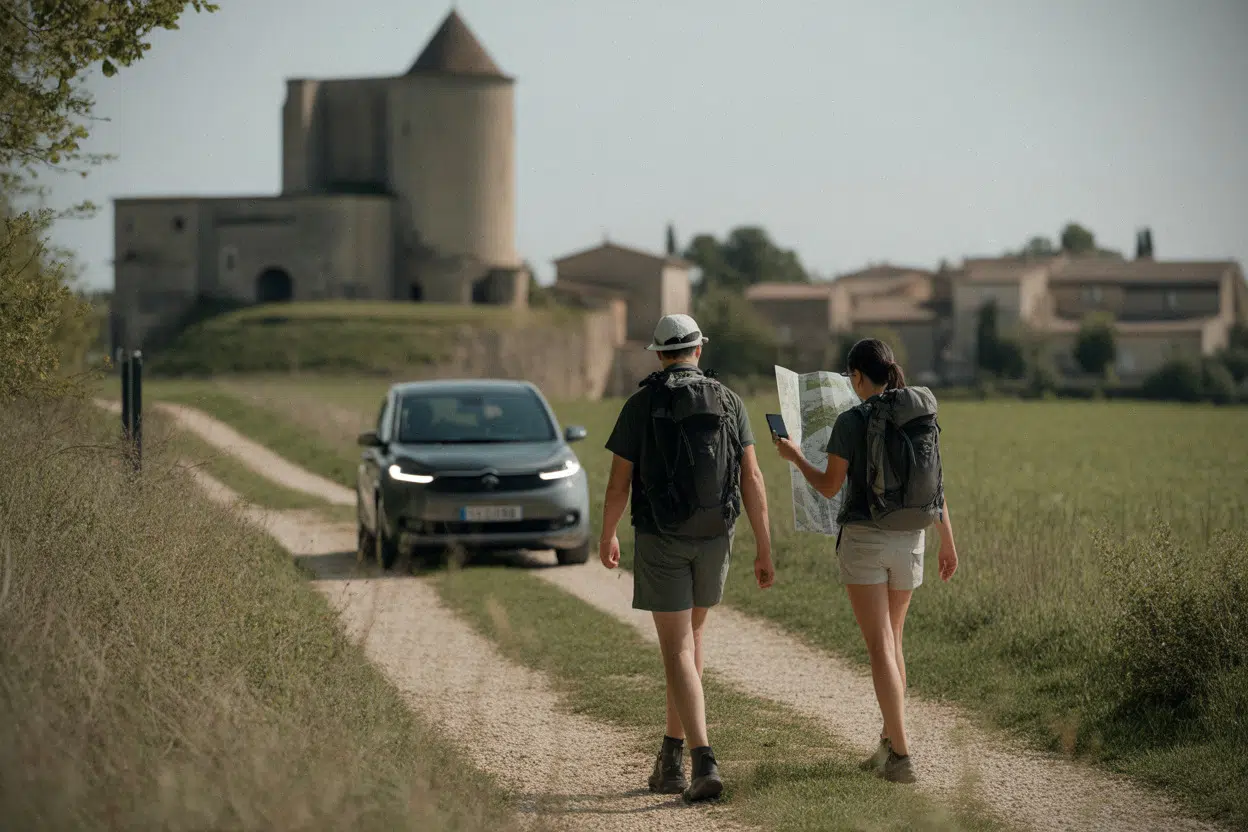
BASSANNE, France — A roughly 13-kilometer (about 8-mile) organized hike in the rural Gironde department is drawing attention to an unusual piece of medieval infrastructure: the Moulin de Piis, described by local volunteers as a fortified flour mill likely dating to the 13th century.
The walk, organized by the nonprofit Amis du moulin de Piis (Friends of the Piis Mill), is designed to do more than get people outdoors. It’s meant to introduce visitors to a little-known historic site—one the group says sits on a feudal motte, a raised earthwork associated with medieval defensive and seigneurial control of the landscape.
Along the way, hikers also get a nature-focused experience that locals say can include autumn flights of “palombes,” the regional term for wood pigeons—an unexpected detail that has become part of the route’s appeal.
A volunteer-led 8-mile route built around the Moulin de Piis
The Amis du moulin de Piis has laid out a daylong hike of about 13 kilometers (8 miles) through and around the communes near Bassanne, with an early start time listed as 8:00 a.m., according to information published by the association.
The format is familiar to anyone who has joined a community walk: a group departure, a steady progression along paths and small roads, breaks along the way, and a return or finish tied to a local landmark. Here, the Moulin de Piis serves as both the visit site and the symbol of the volunteers’ broader preservation effort.
Organizers describe the route as generally calm, with one caveat: the opening stretch includes a short section on a roadway. In rural parts of Gironde, that kind of detail matters—especially for families and occasional walkers—because those first few hundred meters can require extra attention to traffic, safety instructions, and timing to avoid heavier vehicle flow.
Beyond mileage, the group is pitching the day as a blend of hiking and heritage interpretation. The association positions itself not just as an event organizer, but as a local guide—pointing out traces of older agricultural uses, explaining the terrain, and placing the mill within the area’s history as the group moves from stop to stop.
Accounts of similar routes around Bassanne describe a walk that unfolds in two parts, with a passage by the mill, and an atmosphere shaped by the season—autumn colors and wildlife watching, including flights of palombes. The detail signals that the outing is meant to be as much about landscape as it is about architecture.
For a small commune like Bassanne, these meetups also serve a social purpose: bringing in visitors, sparking conversations between residents and newcomers, and giving visibility to a volunteer effort operating with limited resources. The model is simple—use the terrain itself as the strongest argument for why local heritage is worth saving.
https://www.europe-infos.fr/actualites/10185/18-juillet-2026-senven-lehart-la-maison-jagu-leguee-puis-rehabilitee-devient-logement-communal-ce-detail-inattendu-intrigue-les-habitants/
A fortified flour mill linked to the 13th century
The Moulin de Piis is presented as a former fortified flour mill, likely built in the 13th century on a feudal motte. That medieval footing is central to its heritage value: supporters argue it should be read not merely as a utilitarian rural building, but as a site connected to defensive planning and seigneurial authority.
In heritage inventories, the “fortified” label typically signals architecture intended to resist attack or deter threats—thicker walls, smaller openings, and an internal layout shaped by security concerns. Applied to a mill, the designation is a reminder that production sites could be economic targets. A flour mill concentrates a strategic resource—the processing of grain—and protecting it could align with local power structures.
Available documentation also indicates the mill later stopped operating, a common fate for water and wind mills as processing modernized and production centralized. Once activity ends, buildings often enter a more fragile phase: less maintenance, secondary uses, and gradual deterioration. Those decades can determine whether a site is forgotten or reclaimed by owners, municipalities, or associations.
In Piis’ case, local interest is also tied to the building’s distinctiveness—a mill treated as cultural heritage rather than a simple agricultural remnant. That uniqueness can attract visitors, but it also raises expectations for clear, concrete storytelling: chronology, functions, changes over time, materials, and how the site connects to valley life.
By routing the hike through the mill, organizers aim to show what a fortified mill looks like in the Entre-deux-Mers landscape—how it fits into a network of paths, parcels, and water points. The setting helps explain why the location mattered, from controlling movement to staying close to cultivated areas. For many visitors, that geographic reading can be more persuasive than a photo in making the case for preservation.
Country lanes, farm tracks, and a seasonal wildlife draw
Walking routes around Bassanne rely on a web of rural paths, farm tracks, and small roads, creating a hike that’s accessible but varied. Descriptions point to a countryside that remains easy to “read”—hedgerows, small wooded patches, meadows, and cultivated fields.
That mix of road and trail shapes the day. The opening stretch on pavement demands a disciplined group, but once hikers peel off onto paths, the pace changes—less noise, more observation. Over about 13 kilometers (8 miles), the variety of terrain can matter as much as the distance itself, influencing fatigue, heat exposure, and the overall interest level for curious walkers.
Local hiking narratives also mention an autumn feel and flights of palombes. In southwest France, the palombe is both a seasonal marker and a cultural reference point. Spotting migrating flocks adds a moving element to the landscape—proof the countryside isn’t static, but actively traversed.
As with many volunteer-led hikes, practical concerns are central, too: weather and heat can turn open countryside into a tougher outing. Organizers lean on early start times, breaks, and gear recommendations—unflashy details that often determine whether an intergenerational group has a good day.
The stop at the Moulin de Piis provides a narrative pivot. After miles of paths, the building becomes the focal point, and hikers can connect what they’ve crossed—relief, water, farming patterns—to what they’re seeing on site. That back-and-forth between walking and reading the landscape is the kind of hands-on lesson organizers say can make heritage feel real.
A new book aims to keep the mill’s revival story alive
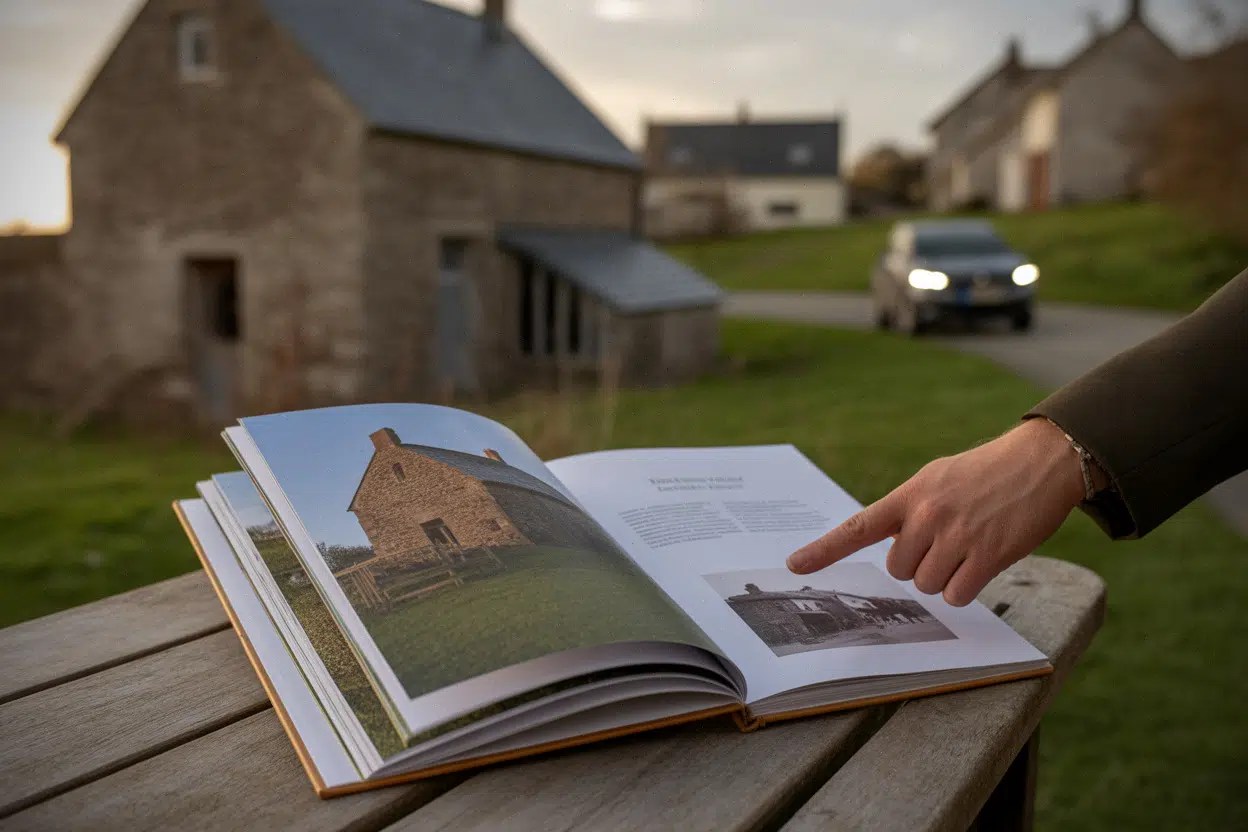
The association’s push isn’t limited to guided outings. A book devoted to the “renaissance” of the Moulin de Piis—produced by the group with Éditions de l’Entre-deux-Mers—has been presented as another tool to build and share a coherent account of the site.
In preservation efforts, publishing can be practical: it fixes information on the record, gathers testimony, organizes archives, and gives residents a way to understand what’s behind restoration work or administrative steps. Putting out a book can also signal that a project has reached a new stage—enough material to tell the story, enough mobilization to support publication, and enough interest to find readers.
For a volunteer association, the book can serve multiple purposes. It can help recruit by showing faces, methods, and milestones. It can support outreach to partners—patrons, local governments, and cultural organizations—by presenting a clear, documented project. And it can strengthen on-site visits with plans and before-and-after photos that change how the public perceives the building.
The link between hiking and publishing is intentional: the walk brings people to the mill, and the book lets them extend the experience afterward. Many participants aren’t specialists, but they want reliable information to take home—reducing the risk of vague legends that can swirl around old buildings.
Together, the approach in Bassanne amounts to a straightforward local strategy: bring people in, show them the place, then document it. In a crowded media environment, that combination—hiking, heritage, and publication—keeps the Moulin de Piis in the public eye through concrete, on-the-ground action.
Key takeaways
- A roughly 13-kilometer (8-mile) hike is being organized around Bassanne by the Amis du moulin de Piis.
- The Moulin de Piis is described as a fortified flour mill likely dating to the 13th century.
- The route mixes rural paths with short road sections and emphasizes nature observation, including flights of “palombes” (wood pigeons).
- A book published with Éditions de l’Entre-deux-Mers is helping renew local interest in the site.
Key Takeaways
- A roughly 13-kilometer hike is organized around Bassanne by the Friends of the Piis Mill.
- The Piis Mill is described as a fortified flour mill dating back to the 13th century.
- The route combines rural paths, short stretches of road, and nature observation.
- A book published with Éditions de l’Entre-deux-Mers has renewed interest in the site.