

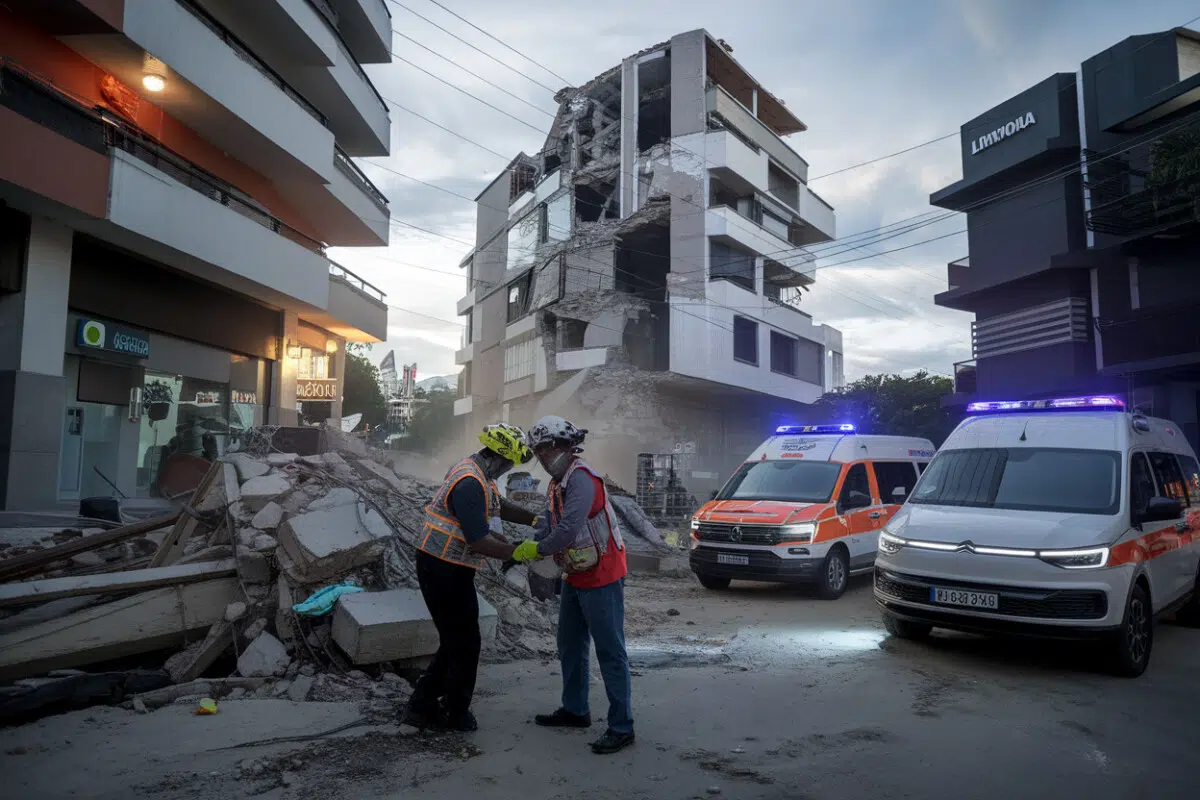
Two powerful earthquakes ripped through Venezuela on Tuesday evening, striking just 39 seconds apart and leaving at least 32 people dead and more than 700 injured, according to the country’s interim government.
The twin jolts, measured at magnitude 7.2 and 7.5, hit west of Caracas, toppling buildings, knocking out power, and triggering a nationwide state of emergency. Officials warned the toll could rise sharply as rescuers struggle to reach hard-hit areas, including the coastal state of La Guaira, where communications and damage reports remain incomplete.
International models from the U.S. Geological Survey (USGS) suggest the disaster could be far larger than the first official count, with worst-case scenarios projecting fatalities in the tens of thousands, though those figures are probabilistic estimates, not confirmed counts.
A rare one-two punch: 7.2, then 7.5
The USGS described the event as a double earthquake: a magnitude 7.2 shock followed by a stronger 7.5 just 39 seconds later. That timing matters. The second quake can slam into buildings already weakened by the first, dramatically increasing the risk of collapses.
Preliminary data also indicates the first quake struck deeper underground, while the second was closer to the surface, often a recipe for more intense shaking and heavier localized damage.
Aftershocks followed, rattling nerves and slowing search efforts as residents and rescuers faced the constant threat of additional collapses.
Caracas in crisis: collapsed buildings, blackouts, and an airport shut down
In Caracas, witnesses described people sprinting into the streets, some still in pajamas, as dust clouds rose from damaged blocks and debris rained onto sidewalks. Storefront windows shattered. Facades cracked. Panic spread fast as the second jolt hit before many people had even processed the first.
One of the most consequential blows: the closure of Caracas’s main airport, which authorities said suffered serious damage. That’s not just an inconvenience, it’s a logistical choke point. Medical evacuations, incoming rescue teams, and heavy equipment shipments all become harder when the primary air hub goes offline.
The government also ordered precautionary gas shutoffs in some areas and reported widespread power outages. Hospitals shifted to generators. Elevators stopped. Cell service became unreliable, complicating everything from emergency calls to coordination on the ground.
What officials are saying, and what they still don’t know
Interim President Delcy Rodríguez, Venezuela’s top official in the current government, announced the initial toll of 32 dead and more than 700 injured. She emphasized a major gap: authorities still lack consolidated data from La Guaira, a densely populated coastal state near Caracas that officials fear may be among the hardest hit.
In major earthquakes, early death tolls often rise as rescuers reach cut-off neighborhoods and sift through unstable structures. Tuesday’s timing, early evening, also increases risk because many people are at home, commuting, or inside shops and restaurants.
The state of emergency is meant to speed mobilization, cut red tape, and allow the government to requisition resources. But it can’t instantly reopen roads, stabilize damaged buildings, or expand overwhelmed hospitals, especially when communications are patchy and aftershocks keep coming.
USGS projections: why models mention up to 100,000 deaths
The USGS issued a grim assessment: based on early modeling, a much higher death toll is possible, with estimates ranging from 10,000 to 100,000 fatalities in the most severe scenario. The agency also cited a 44% chance that deaths could exceed 10,000.
Those numbers are not a headcount. They’re statistical projections that combine quake magnitude, depth, proximity to population centers, and building vulnerability, tools used to anticipate how much international assistance may be needed.
Still, the fact that the upper-end scenario is even plausible underscores how violent the shaking may have been, especially with two major quakes landing back-to-back.
Shaking felt far beyond Venezuela, and a tsunami alert briefly added to the confusion
The quake was felt as far away as Bogotá, Colombia, about 620 miles away, highlighting how much energy the event released and how widely the seismic waves traveled.
Authorities also issued, then lifted, a tsunami alert. Emergency managers often err on the side of caution because the cost of a false alarm is far lower than the cost of a late warning. But in a country already under strain, the rapid shift can fuel confusion and fear.
International help is coming, but getting it in may be the hardest part
Several Latin American countries offered assistance, and the United States said it was deploying rescue teams with specialized expertise in searching collapsed structures and coordinating emergency response.
The challenge will be access. With Caracas’s airport damaged and roads potentially compromised, aid may have to route through regional hubs and move by road or helicopter, an operation that depends on fuel, functioning communications, and safe landing zones.
For Venezuelans, the next few days will likely hinge on a blunt reality: how quickly rescuers can reach the worst-hit areas, how many buildings are too unstable to enter, and whether the country’s strained infrastructure can withstand a disaster that arrived in two devastating waves.
Key Takeaways
- Two earthquakes measuring 7.2 and 7.5 struck Venezuela just a few dozen seconds apart.
- The preliminary official toll reports at least 32 dead and more than 700 injured.
- The situation remains unclear in La Guaira state, which is described as being heavily affected.
- The USGS cites a scenario that could reach up to 100,000 deaths according to its models.
- International aid has been announced, but logistics are complicated by the damage.
Frequently Asked Questions
Why is there talk of a “double” earthquake event in Venezuela?
Because two major earthquakes struck almost back-to-back, about 39 seconds apart, with magnitudes of 7.2 and then 7.5. This sequence can worsen damage, as the second jolt hits buildings that have already been weakened.
What is the confirmed death toll so far?
Venezuelan authorities have reported an initial provisional toll of at least 32 deaths and more than 700 injured. They also say they still lack consolidated data for some areas, so these figures may change.
Why is the USGS mentioning up to 100,000 deaths?
This is a probabilistic estimate based on models that factor in magnitude, depth, proximity to populated areas, and the vulnerability of buildings. It is not a body count, but an indicator used to anticipate the potential scale of the response.
Which infrastructure was directly affected in Caracas?
Buildings collapsed in the capital, and Caracas’s airport was reported to be severely damaged, leading to its closure. Power outages and precautionary gas shutoffs were also reported.
What international aid has been announced?
Several Latin American countries have offered assistance. The United States also announced the immediate deployment of rescue teams, in a situation where access and transporting equipment may be complicated by the damage.
Sources
- Double séisme au Venezuela: au moins 32 morts et 700 blessés | RTS
- Le Venezuela touché par deux puissants séismes, l’état d’urgence déclaré
- Venezuela : le bilan du double séisme s'élève à 32 morts | RTS
- Venezuela. Deux puissants séismes : au moins 32 morts et plus de 700 blessés
- Séismes au Venezuela : la présidente par intérim déclare l’état d’urgence | Couverture en direct | Radio-Canada Info