

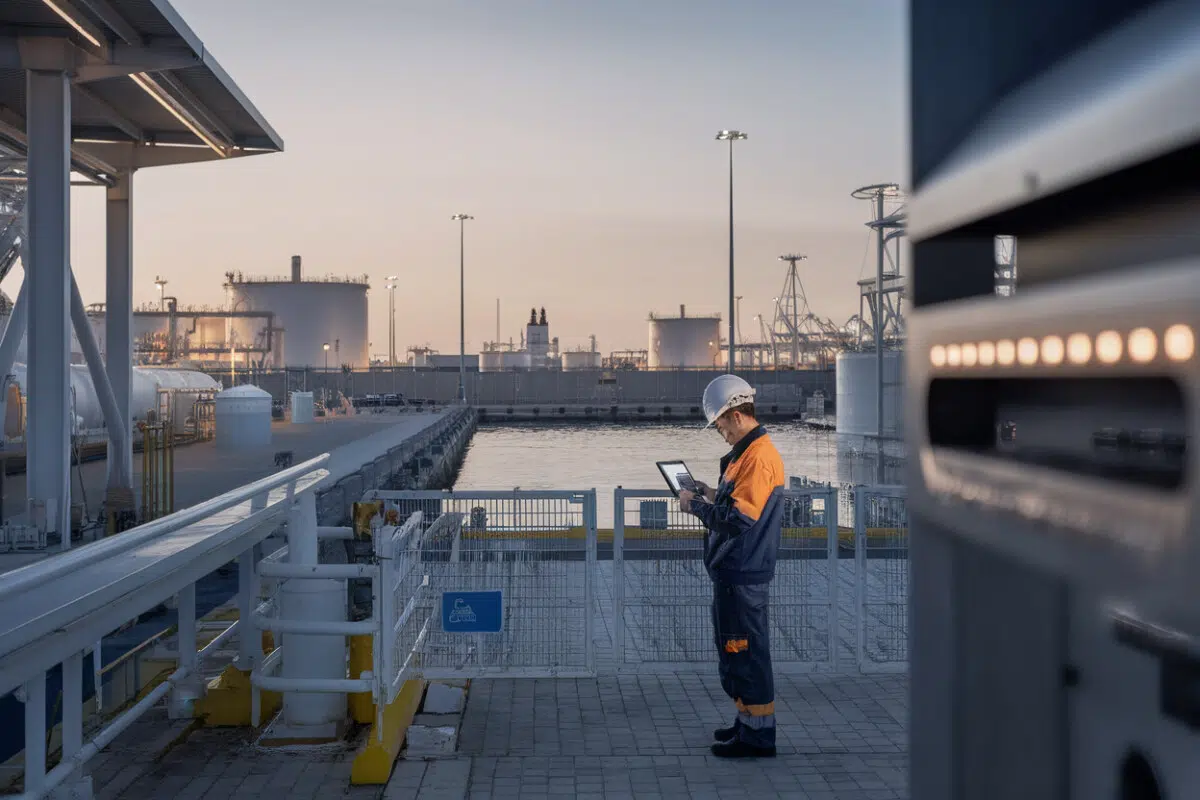
The United Arab Emirates once floated a straightforward idea to blunt one of the world’s biggest energy risks: build an LNG export terminal on the country’s east coast at Fujairah, so shipments could reach open ocean without threading the Strait of Hormuz.
That plan is now effectively dead. Abu Dhabi National Oil Company (ADNOC), the state energy giant, signaled in 2023 it would instead build at Ruwais, a major industrial hub west of Abu Dhabi. The pivot doesn’t erase the underlying problem: when tensions spike around Hormuz, energy markets move fast, and there are only so many ways to reroute oil and gas out of the Gulf.
ADNOC’s 2022 Fujairah pitch, and the 2023 switch to Ruwais
When the Fujairah concept resurfaced in 2022, it came with big numbers and a fast timeline. The proposal envisioned two liquefaction trains of 4.8 million tons per year each, about 9.6 million tons annually total, with construction starting as early as 2023 and operations targeted around 2027.
The strategic logic was simple: diversify export outlets and reduce reliance on a single maritime bottleneck. The engineering concept leaned on an overland link from gas facilities at Habshan to the east coast, turning a sea-lane vulnerability into an infrastructure challenge inside the UAE, where the government has far more control.
Then came the reversal. In 2023, ADNOC indicated the LNG terminal would be built at Ruwais instead. In project-tracking databases, the Fujairah export terminal is widely treated as canceled, another reminder that in the Gulf, geopolitics can drive ideas, but industrial strategy and cost decide what gets built.
Fujairah has seen LNG plans fade before. A separate import and regasification project proposed in 2013 by EmiratesLNG, pegged at 8 million tons per year, was delayed, shifted toward a floating unit, and then went quiet, with public trackers also listing it as likely canceled.
Why the Strait of Hormuz still scares energy traders
Hormuz is a global choke point in the most literal sense. At its narrowest, it’s about 34 miles wide, and it funnels enormous volumes of energy exports from the Persian Gulf into the Arabian Sea.
By commonly cited estimates from the International Energy Agency, roughly 15 million barrels a day of crude move through Hormuz, plus about 5 million barrels a day of refined petroleum products. That’s close to a quarter of the world’s seaborne oil trade, meaning even a limited disruption can jolt prices, insurance costs, and shipping decisions.
Natural gas is just as exposed. Around 20% of the world’s liquefied natural gas (LNG) shipments are believed to pass through Hormuz, including nearly all LNG exports from Qatar and the UAE. Qatar, often described as the world’s second-largest LNG exporter, shipped more than 112 billion cubic meters of gas in 2025, roughly 4 trillion cubic feet. If Hormuz is blocked, it’s not a minor delay; it’s a market shock.
Most of those flows head to Asia. Widely cited shipping patterns suggest about 84% of crude and condensate moving through Hormuz ends up in Asian markets, with China a dominant buyer. China’s strategic petroleum reserves, often estimated around 1 billion barrels, can cushion a hit, but they can’t replace daily flows for long.
Fujairah’s appeal: a major port outside the Gulf, almost
Fujairah keeps coming up for a reason. It’s widely described as the UAE’s only multipurpose port on the east coast, facing the Gulf of Oman and the Arabian Sea rather than the Persian Gulf. The port sits about 81 miles (70 nautical miles) from the Strait of Hormuz, close enough to matter, but positioned to reach open-ocean routes without re-entering the Gulf.
Port officials tout heavy traffic, around 12,500 vessel calls in the anchorage area, and more than 125 million metric tons of cargo handled, roughly 138 million U.S. tons. It’s already a working maritime hub with oil terminals, berths for very large ships, and established services. An LNG export terminal could have plugged into that ecosystem, though LNG brings stricter safety and specialized infrastructure requirements.
The UAE already uses Fujairah as an “export insurance policy” for crude. The Abu Dhabi Crude Oil Pipeline runs from Habshan to Fujairah and is often cited at about 1.8 million barrels per day of capacity, useful, but not enough to cover total UAE production that’s frequently put around 3.5 million barrels per day. The lesson is blunt: even when a Plan B exists, it rarely replaces Plan A at full scale.
Pipeline workarounds can’t replace Hormuz volumes
Across the region, alternatives to Hormuz exist, but they top out quickly. Operational pipeline capacity in Saudi Arabia and the UAE is often estimated at roughly 3.5 to 5.5 million barrels per day. That’s a fraction of the roughly 20 million barrels per day of crude, condensate, and products that typically transit Hormuz.
Saudi Arabia’s East-West pipeline to the Red Sea port of Yanbu is the most cited workaround. Its capacity is sometimes described as 5 million barrels per day, with Saudi Aramco at times pointing to 7 million, but reports indicate it hasn’t been proven at that level, and recent flows have been closer to 2 million barrels per day. In other words, “nameplate capacity” doesn’t automatically translate into real-world throughput during a crisis.
For some Gulf producers, there’s effectively no detour. Analysts often point to Kuwait, Bahrain, and most of Iraq (outside the Kurdistan region) as lacking meaningful alternatives. In a serious disruption, that can mean forced production shut-ins, emergency contract clauses, and millions of barrels a day suddenly missing from the market.
On natural gas, the options are even thinner. The Dolphin pipeline moves Qatari gas to the UAE and Oman, about 20.5 billion cubic meters a year, roughly 724 billion cubic feet, but that’s regional supply, not a global LNG export bypass. Oman’s LNG plants are also widely described as running near full utilization, leaving little spare capacity to absorb a major Qatari outage.
What the Fujairah reversal says about the next energy shock
The broader backdrop is a global LNG buildout, driven in part by energy security fears that intensified after Russia’s invasion of Ukraine, and by long-term demand growth in Asia. Industry projections for 2026 have pointed to trillions in global energy investment, with rising spending on natural gas and LNG projects, including major expansions in the United States and Qatar.
In that environment, export routes become an economic variable, not just a military one. A terminal at Fujairah would have been a clear hedge: a way to load LNG outside the Gulf and reduce exposure to a single chokepoint. ADNOC’s decision to prioritize Ruwais instead suggests the company sees better integration, cost control, or timing there, even if it doesn’t solve the Hormuz problem.
And that’s the uncomfortable takeaway for markets: you can build pipelines and terminals, but you can’t engineer away risk perception. If shipowners and insurers decide the area is too dangerous, trade slows regardless of what’s on the map. Fujairah may sit on the “safer” side of the UAE’s coastline, but it’s still in the neighborhood of Hormuz, and in a crisis, that proximity can show up in freight rates, insurance premiums, and whether LNG carriers are willing to sail.
Key Takeaways
- An LNG export terminal in Fujairah was announced in 2022, but it was redirected to Ruwais in 2023.
- The Strait of Hormuz remains a critical chokepoint, with about 15 million barrels per day of crude and 5 million barrels per day of refined products passing through.
- Nearly 20% of global LNG transits the Strait of Hormuz, with heavy dependence on Qatar.
- Fujairah is a major port hub on the east coast, but it is close to the tension zone.
- Pipeline alternatives exist, but they make up only a fraction of the usual volumes.
Frequently Asked Questions
Why was Fujairah considered for an LNG terminal?
Because Fujairah is on the UAE’s east coast, facing the Arabian Sea. A terminal there could, in theory, reduce reliance on shipping through the Strait of Hormuz by using pipeline supply from inland.
Is the Fujairah LNG terminal project still moving forward?
Project tracking indicates that after the 2022 announcement, ADNOC said in 2023 that the terminal would be built at Ruwais. The proposed LNG export project in Fujairah is considered canceled at this stage.
Commonly cited estimates suggest that about 20% of the LNG shipped worldwide transits Hormuz. Nearly all LNG exports from Qatar and the UAE use this route, making the market highly sensitive to any disruption.
Are there credible alternatives to Hormuz for hydrocarbons?
There are pipelines in Saudi Arabia and the UAE, but their combined capacity is limited—often estimated at 3.5 to 5.5 million barrels per day—compared with the much larger volumes that typically pass through Hormuz. For some countries such as Kuwait, Bahrain, and Iraq, alternatives are described as nonexistent.
Why doesn’t a pipeline solve everything, even when one exists?
Because a pipeline has a capped capacity and can’t absorb all seaborne volumes. In the UAE, the Habshan–Fujairah oil pipeline is cited at 1.8 million barrels per day, which doesn’t cover total national production often put around 3.5 million barrels per day, and it also doesn’t replace regional flows.