

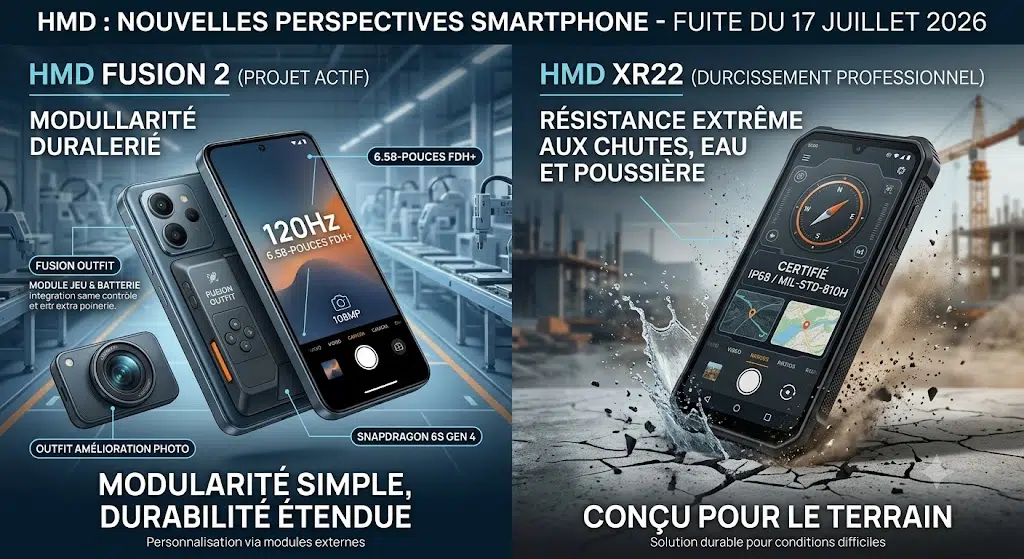
A fresh leak circulating July 17, 2026, is reviving talk around the HMD Fusion 2, a modular smartphone that some recent rumors had written off as canceled. According to information relayed by Notebookcheck, the device is still in development—though HMD has not announced a timeline or pricing.
The same reporting also keeps a second handset in view: the HMD XR22, a rugged model expected to follow the XR21. As with the Fusion 2, there’s still no official launch window, but the repeated references suggest HMD is continuing work behind the scenes.
For HMD, the appeal of these two projects is strategic. The Fusion line leans into modular add-ons meant to extend a phone’s useful life, while the XR series targets jobs and environments where drops, dust, and weather translate into real costs. For now, the story is built on leaks from indirect sources—so the most reliable signals are the details that keep resurfacing across multiple reports.
Notebookcheck pushes back on claims the Fusion 2 was canceled
The latest shift starts with what amounts to an implicit correction. Notebookcheck reports that a recent leak claimed the HMD Fusion 2 had been canceled, but a newer data point points the other way: the project appears to remain active.
That distinction matters in the rumor economy, where devices can vanish from databases for weeks and then reappear. For readers, the takeaway is straightforward: the lack of a public announcement isn’t, by itself, proof a product has been scrapped.
The existing HMD Fusion already stands apart in HMD’s lineup because its modularity centers on a swappable back—often framed as an accessory system. Earlier leaks referenced “Fusion Outfits,” add-on backs that could bring features such as extra protection, wireless charging, or gaming-oriented accessories. If a Fusion 2 follows that path, it would preserve a simpler, easier-to-explain approach than fully block-by-block modular phones, which have often been criticized as too complex and expensive.
Notebookcheck’s reporting also lands in a market where consumers tend to prioritize battery life, camera performance, and smooth day-to-day speed over add-ons that can drive up the final price. Still, HMD could be aiming at a niche: people who want to customize their phone or make repairs more practical. The promise is to replace a part or module rather than the entire device—assuming accessories remain available long enough to matter, something brands rarely quantify.
Even so, “in development” can mean a lot of things. A project can change names, specs, or remain an internal prototype. But repeated mentions of the Fusion 2 across multiple sites, including YugaTech, at least suggest spec sheets are circulating somewhere in the pipeline—among suppliers, distributors, or testing databases. Without official images or public certifications, the only certainty is that work appears to be happening.
YugaTech leak points to a 6.58-inch 120Hz screen and Snapdragon 6s Gen 4
The most detailed spec rundown cited in the French report comes from YugaTech. It describes a 6.58-inch FHD+ display with a 120Hz refresh rate—now a familiar midrange formula aimed at smoother scrolling and certain games without the cost of higher-end panels. Key details like peak brightness, panel type, and software tuning weren’t included in the leak.
YugaTech also names Qualcomm’s Snapdragon 6s Gen 4 as the processor. A Snapdragon choice is often seen as a bet on broad network compatibility, power efficiency, and stable software behavior. In a modular concept, performance can matter for another reason: it may need to offset compromises that come with add-ons, such as thicker backs or accessories that draw extra power. The rumored positioning suggests a measured step up rather than a jump into flagship territory.
On cameras, the leak highlights a 108-megapixel main sensor paired with an 8-megapixel ultrawide. In real-world use, a 108MP sensor’s value often comes down to image processing, pixel-binning, and optics. An 8MP ultrawide is a more budget-friendly choice, but it can still cover common needs like group shots and architecture. There’s no mention of a telephoto lens, which points to a pragmatic cost-conscious setup aimed at general versatility.
The same cluster of leaks also references a “new generation” of modules—sometimes described as a projector, a speaker, or a camera grip. The industry has seen similar ideas before, with limited commercial success. HMD’s difference, if it materializes, would be keeping modularity less intrusive by focusing on the phone’s back. The economics will be decisive: a module has to be useful enough to justify its price and easy enough to find at retail.
No credible launch date has emerged. Some sites gesture at a possible announcement “soon,” but without evidence. Until HMD confirms anything, the strongest signal is the internal consistency of the rumored package: a midrange 120Hz phone, a recent Snapdragon chip, a straightforward dual-camera setup, and differentiation through accessories.
“Fusion Outfits” aim for modularity without complicated repairs
If the leaks hold, the Fusion line’s defining trait is modularity designed as a compromise. Instead of internal blocks that require disassembly, HMD would lean on interchangeable backs—often summarized under the “Fusion Outfits” label. That approach can reduce the risk of breakage during installation and simplify manufacturing. For users, it’s closer to swapping a case than performing a repair.
In leaks cited by Notebookcheck, these accessories would add practical features such as wireless charging, a ring light, a game controller, or reinforced protection. The pitch is to turn an average smartphone into something more specialized depending on the moment—work, travel, or downtime. But adoption hinges on availability: a modular ecosystem with only a handful of accessories quickly loses its appeal.
Some coverage around the Fusion 2 also emphasizes durability and longevity, arguing the goal is to avoid replacing an entire phone because of a worn-out battery or aging camera module. It’s a familiar argument, but hard to verify without a public policy on parts, pricing, and support. Buyers also weigh resale value and the length of software updates—because hardware that can be extended matters less if software support ends quickly.
There’s also the question of real cost. A modular phone can end up more expensive than a conventional device with similar performance if the add-ons pile up, and it can lead to drawers full of unused accessories. Environmentally, the benefit is strongest if modules replace the need to buy a second device—like a dedicated controller or mini projector. If modularity mainly encourages extra accessory purchases, the ecological upside becomes murkier.
That leaves HMD threading a narrow needle: offer simple modularity without promising a technological revolution. If the Fusion 2 launches, its success will likely come down to execution—how sturdy the attachments are, how well software integrates, how modules are priced, and whether HMD can keep the ecosystem alive for multiple quarters.
HMD XR22 leak persists as a potential XR21 successor
Notebookcheck’s report also keeps the HMD XR22 in the conversation, describing it as a rugged smartphone still in development. The logic is straightforward: lean into steady demand for hardened devices. It’s a smaller market than mainstream consumer phones, but it’s consistent—serving tradespeople, maintenance crews, transportation, security, and outdoor users. In those settings, resistance to drops and bad weather can mean fewer repairs and less downtime.
An older source cited in the French article pointed to an expected—but not guaranteed—launch window and a midrange configuration with 8GB of RAM and 256GB of storage. On a rugged phone, those numbers can be practical: room for work apps, offline maps, and field photos without relying on constant connectivity. More RAM can also help keep heavier professional tools running smoothly, including inventory management, forms, and scanning.
The big unknown is durability certification. The available leaks don’t specify exact standards, though phones in this category often highlight water and dust protection and drop testing. If the XR22 follows the line’s logic, it would likely improve toughness and sealing without chasing top-tier camera or gaming performance. The trade-offs are familiar: thicker, heavier devices that prioritize reliability over sleek design.
There’s also a portfolio question. Launching the Fusion 2 and XR22 side by side would draw a clear line between two ideas: a customizable phone built around accessories, and a field tool built for harsh conditions. For HMD, that could become an identity—if it can also deliver credible software support. For business buyers, update longevity and security can matter as much as the hardware, especially when devices are used for sensitive operations.
For now, caution is warranted. The XR22 remains unannounced, with no images and no price. But its continued appearance alongside the Fusion 2 strengthens the case that HMD is running multiple development tracks at once. If official announcements arrive, they’ll show whether HMD is simply refreshing product lines—or pushing a broader strategy built around durability and specialized use cases.
Key takeaways
- A leak says the HMD Fusion 2 has not been canceled and remains in development
- Recurring rumored specs include a 6.58-inch display, 120Hz refresh rate, and Snapdragon 6s Gen 4
- Camera rumors point to a 108MP main sensor and an 8MP ultrawide
- The “Fusion Outfits” accessory system is still described as central to the phone’s identity
- The rugged HMD XR22 continues to be mentioned, but there’s still no official launch date
- Notebookcheck (French): leak says HMD Fusion 2 still in development, as is rugged HMD XR22
- YugaTech: HMD Fusion 2 specs leaked
- Notebookcheck: earlier report said leak claimed Fusion 2 was canceled
- 36Kr (English): HMD Fusion 2 sequel discussion
- PhoneArena: XR22 tipped as XR21 successor (earlier report)
Sources
Rivières publie une brochure sur son histoire, un outil local pour transmettre la mémoire du village
Key Takeaways
- A leak claims the <strong>HMD Fusion 2</strong> hasn’t been canceled and is still in development
- Recurring specs mention a <strong>6.58-inch</strong> display, <strong>120Hz</strong>, and the <strong>Snapdragon 6s Gen 4</strong>
- The camera setup is said to include <strong>108MP</strong> and an <strong>8MP</strong> ultrawide
- The <strong>Fusion Outfits</strong> accessory system would remain central to setting the device apart
- The rugged <strong>HMD XR22</strong> continues to be mentioned, with no official launch date
Sources
- le HMD Fusion 2 est toujours en cours de développement …
- HMD Fusion 2 specs leaked » YugaTech | Philippines Tech News & Reviews
- Leak says the HMD Fusion 2 has been cancelled – Notebookcheck News
- HMD Fusion 2 Sequel Arrives, but Users Don't Need Modular Phones
- HMD tipped to launch successor to XR21 in 2025, first …