

A new leak circulating July 17, 2026, is reigniting talk around HMD’s next modular smartphone, the HMD Fusion 2. Information relayed by Notebookcheck suggests the device hasn’t been shelved—pushing back on a recent rumor that claimed the project had been canceled.
In the same reporting, a second unannounced device remains on the radar: the HMD XR22, a rugged phone expected to follow the XR21. Neither product has an official launch date or pricing, but the repeated trail of leaks points to both projects continuing behind the scenes.
The attention matters because HMD occupies an unusual lane in the smartphone market, leaning into less-standard designs—modularity on one side and durability on the other. The leaks come from indirect sources, so the clearest takeaway is not certainty, but persistence: the Fusion 2 and XR22 keep resurfacing in ways that suggest ongoing development.
Notebookcheck pushes back on claims the Fusion 2 was canceled
The latest round of reporting functions as an implicit correction. Notebookcheck says a recent leak indicated the HMD Fusion 2 had been canceled, but a newer data point points the other way—the project appears to remain active.
That distinction is significant in the rumor ecosystem, where devices can vanish from databases for weeks and then reappear. For readers, it’s a reminder that silence from a manufacturer isn’t a reliable signal that a product is dead.
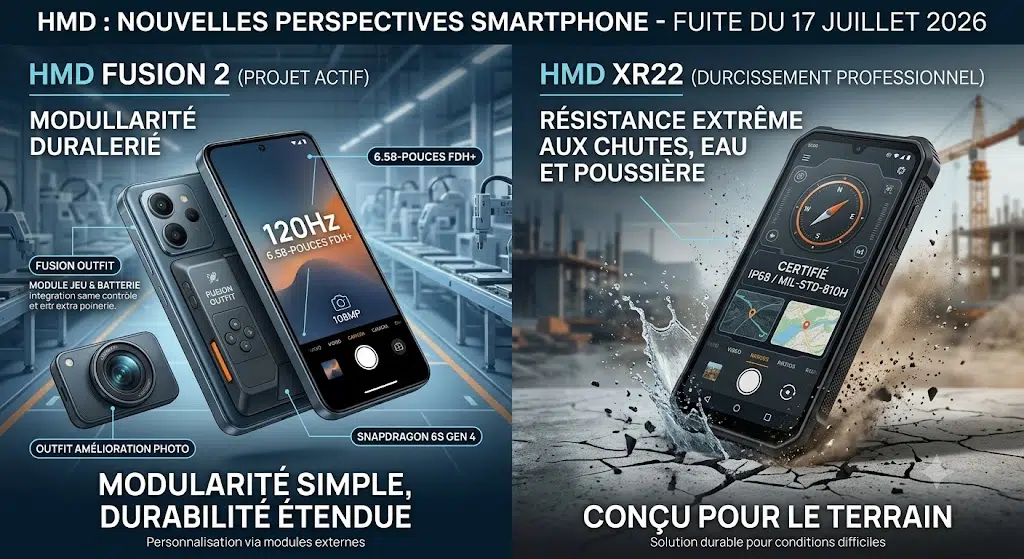
The original HMD Fusion already stands apart in HMD’s lineup thanks to a modular concept centered on a swappable back cover—often framed as an accessory system. Earlier leaks described “Fusion Outfits,” add-on backs that could bring extra functions such as improved protection, wireless charging, or gaming-oriented accessories.
If the Fusion 2 follows that approach, it would keep a modular identity that’s easier to explain than fully block-by-block modular phones, which have often been criticized as too complex and expensive.
A rumored 6.58-inch 120Hz screen and Snapdragon 6s Gen 4
The most detailed spec leak cited in the French report comes from YugaTech, which describes a 6.58-inch FHD+ display with a 120Hz refresh rate. That combination has become a familiar midrange formula, promising smoother scrolling and better motion in some games without the cost of higher-end panels.
YugaTech also points to a Snapdragon 6s Gen 4 processor. A Snapdragon chip choice is typically associated with expectations around network compatibility, power efficiency, and software stability. For a modular phone, performance can matter for another reason: it may need to offset potential tradeoffs from accessories, such as thicker cases or add-ons that draw extra power.
On cameras, the leak highlights a 108-megapixel main sensor paired with an 8-megapixel ultrawide. In real-world use, the value of a 108MP sensor often depends on image processing, pixel-binning, and lens quality. An 8MP ultrawide is a more budget-leaning choice, but it can still cover common needs like group shots and architecture.
The leaks don’t mention a telephoto camera, which could suggest a cost-conscious, practical setup aimed at broad usability rather than specialization.
“Fusion Outfits” aim for simpler modularity without complex repairs
If the reporting holds up, the Fusion line’s defining feature is modularity designed as a compromise. Instead of internal blocks that users would disassemble, HMD’s approach would rely on interchangeable backs—summed up in the “Fusion Outfits” label.
The advantage is straightforward: it reduces the risk of breakage during installation and lowers manufacturing complexity. For users, it’s closer to swapping a case than attempting a repair.
Notebookcheck’s roundup of leaks says these accessories could add tangible features such as wireless charging, a ring light, a game controller, or reinforced protection. The pitch is to turn a general-purpose phone into something more specialized depending on the moment—work, travel, or downtime.
But the model depends heavily on availability. A modular ecosystem with only a handful of accessories can lose its appeal quickly.
Some coverage around the Fusion 2 also emphasizes durability in the broader sense—suggesting the goal is to avoid replacing an entire phone because of a worn battery or aging camera module. That’s a common promise, but it’s hard to evaluate without a public policy on parts, pricing, and long-term support. Buyers also weigh resale value and software update longevity, since extendable hardware matters less if software support ends early.
XR22 leak continues to shadow the XR21 as HMD’s next rugged phone
Notebookcheck’s report also keeps the HMD XR22 in view, describing it as a rugged smartphone still in development. The logic is to serve a steady—if narrower—market tied to professional and outdoor use, where drops, weather exposure, and downtime translate into real costs.
An older source referenced in the French article suggested a tentative launch window without guarantees and pointed to a midrange configuration with 8GB of RAM and 256GB of storage. On rugged devices, that kind of memory and storage can be especially useful for field apps, offline maps, and on-site photos without relying on constant connectivity.
The leaks cited don’t provide specific durability certifications. Still, phones in this category typically emphasize water and dust protection and drop testing. If the XR22 follows the product-line logic, it would likely focus on incremental improvements in toughness and sealing rather than chasing top-tier camera or gaming performance—accepting the usual tradeoffs of thicker, heavier hardware in exchange for reliability.
For HMD, launching the Fusion 2 and XR22 in parallel would also draw a clear line in its catalog: a customizable phone built around accessories on one side, and a worksite-ready tool on the other. For business buyers in particular, software support and security can matter as much as the hardware—especially when devices are used for sensitive operations.
For now, both devices remain unannounced, with no official images or pricing. But the fact that the Fusion 2 and XR22 continue to be cited together strengthens the case that HMD is keeping multiple development tracks alive—potentially tied to a broader push around durability and specialized use cases.
https://www.europe-infos.fr/actualites/9023/des-millions-dentreprises-devront-modifier-leurs-habitudes-des-septembre-2026-etes-vous-pret/
Key Takeaways
- A leak claims the <strong>HMD Fusion 2</strong> hasn’t been canceled and is still in development
- Recurring specs cite <strong>6.58 inches</strong>, <strong>120 Hz</strong>, and the <strong>Snapdragon 6s Gen 4</strong>
- The camera setup is said to include <strong>108 MP</strong> and an <strong>8 MP</strong> ultrawide
- The <strong>Fusion Outfits</strong> accessory system would remain central to differentiating the device
- The rugged <strong>HMD XR22</strong> continues to be mentioned, with no official launch date
https://www.europe-infos.fr/actualites/9867/correze-moins-dacheteurs-locaux-visites-en-baisse-delais-de-vente-plus-longs-pourquoi-les-investisseurs-relancent-en-2026/
Sources
- le HMD Fusion 2 est toujours en cours de développement …
- HMD Fusion 2 specs leaked » YugaTech | Philippines Tech News & Reviews
- Leak says the HMD Fusion 2 has been cancelled – Notebookcheck News
- HMD Fusion 2 Sequel Arrives, but Users Don't Need Modular Phones
- HMD tipped to launch successor to XR21 in 2025, first …