

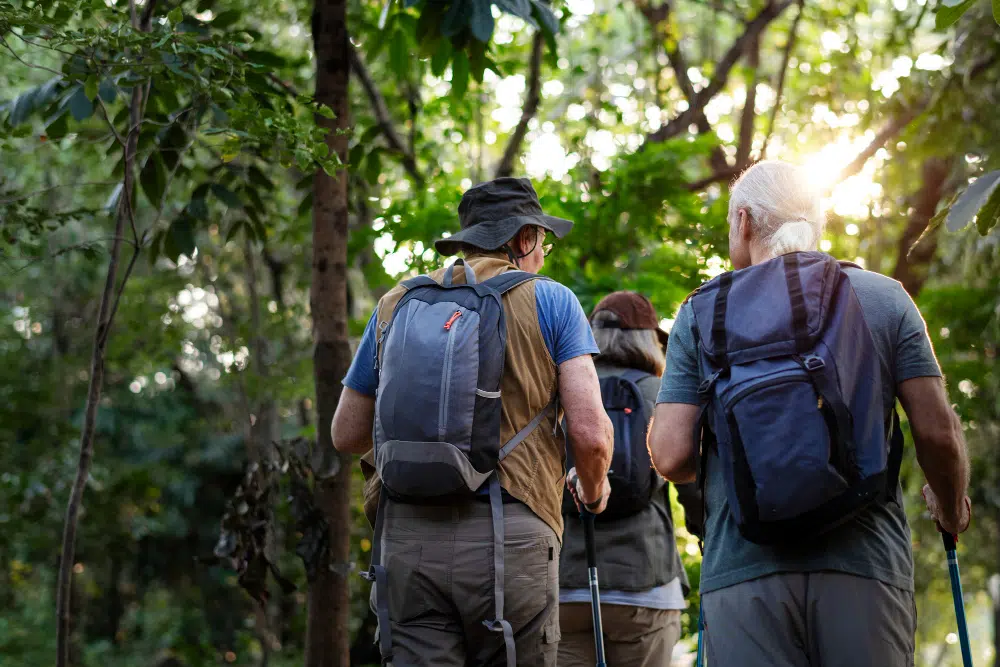
In France’s Rhône department—home to Lyon and its surrounding countryside—local hiking leaders are pushing a simple idea: walking routes that double as a guide to the area’s history. The French Hiking Federation (Fédération Française de la Randonnée Pédestre) is highlighting “Sentiers Mémoire,” or “Memory Trails,” which use the department’s marked trail network to steer walkers toward heritage sites and local points of interest.
In 2026, that approach is also showing up in organized events such as Rando Patrimoine, run by FFRandonnée Rhône – Métropole de Lyon. The concept blends guided hikes with narrated visits, aiming to spotlight lesser-known sites while offering a structured, clearly signposted outdoor activity designed for a broad public.
“Memory Trails” in Rhône: marked routes designed to read the landscape
The premise of the Sentiers Mémoire is straightforward: turn a hike into a way of “reading” the landscape. Instead of focusing only on a sporty route, the trails weave in local history—old paths, buildings, rural structures, places of remembrance, and traces of past economic activity.
In Rhône, the effort is led by FFRandonnée at the department level, with work focused on identifying routes, marking them, and aligning them with the existing trail network.
The strategy rests on a practical foundation. Rhône promotes a large network of marked trails and publications meant to make it easier for people to get out on the ground. Local communications point to a set called Les Sentiers du Rhône, described as “several thousand kilometers” of marked trails, with some materials priced up to €5 (about $5).
Behind the numbers is a clear goal: give occasional hikers an easy entry point while making outings safer through verified routes.
Waymarking and signage are central to the system. Local committees rely on trained volunteers to maintain consistent markings and keep routes coherent. For the “memory” concept, that continuity is what helps guide walkers to specific targets—a chapel, an old mill, a viewpoint tied to an event, or a hamlet shaped by a craft tradition. The hike becomes a narrative route, not just a recreational loop.
The structure also responds to real-world crowding. In a department that mixes suburban edges, vineyard hillsides, valleys, and nearby mountain areas, some sectors can get busy. Promoting heritage-focused routes is intended to spread visitors out by offering attractive, documented alternatives that are easy to understand.
On the ground, success depends on the quality of information available: maps, route descriptions, difficulty levels, walking times, and access by transit or car. The Sentiers Mémoire approach also requires reliable content about the places along the way—dated, sourced, and verifiable—so local heritage doesn’t get reduced to a throwaway tourist anecdote.
Rando Patrimoine 2026 in Sainte-Consorce: hiking paired with guided visits
As an event format, Rando Patrimoine 2026 shows the model FFRandonnée is trying to establish: a day where walking serves as the backbone for visits and interpretive stops. The event is listed as organized by FFRandonnée Rhône – Métropole de Lyon, with an explicit goal of pairing hikes with heritage discovery.
That combination is designed to draw a wider audience than regular hikers alone—especially families and local residents curious about their own area.
In Sainte-Consorce, several local publications described the 2026 edition as a success, including through relays tied to cultural organizations. That kind of public feedback is treated as a field indicator: it suggests demand for turnkey outings where the route is supervised and the cultural component doesn’t require participants to do homework in advance.
For towns, the payoff is visibility for features that can be overlooked—small-scale heritage, viewpoints, or buildings that are usually closed.
But the “hike + visit” formula is more complex than a standard walk. Organizers have to manage staggered starts, group flow, timing that matches site opening hours, and coordination among leaders, volunteers, and heritage speakers. Stops become storytelling sequences, which requires an ability to explain without oversimplifying—an expectation seen as essential to keeping the program credible and preventing heritage from becoming mere scenery.
For participants, the experience changes how people walk. The pace follows the stages, the landscape reading is guided, and attention shifts to details that might be missed on a purely athletic loop. That raises expectations for precise information—dates, how buildings were used, how landscapes evolved, and how all of it connects to local life.
The event also fits into a broader calendar of hikes promoted in Rhône. A visible 2026 schedule with identifiable meetups is meant to build loyalty. For FFRandonnée groups, these days often serve as a showcase—making the behind-the-scenes work of trail marking, supervision, and education more visible, while refreshing the image of hiking as something beyond performance.
“Les Sentiers du Rhône”: 4,000 km promoted, with low-cost materials
Local communications also highlight a network of 4,000 km of marked trails in Rhône—about 2,485 miles. The scale is presented as proof the department isn’t just a handful of headline routes, but a dense web offering variety, from rural paths near towns to more demanding loops.
For a Sentiers Mémoire-style program, that density matters: it makes it possible to choose routes that “tell” something without inventing artificial itineraries.
The cited price point—materials up to €5 (about $5)—signals an accessibility strategy. With leisure spending under scrutiny, low-cost documentation lowers the barrier to entry. It doesn’t make the whole activity free—transportation, gear, and food still cost money—but it can make the first step, finding a reliable outing idea, easier. Organizers also see it as a way to reach people who are less digitally equipped.
Clarity remains the core challenge. Between apps, GPX files, paper maps, trailhead panels, and painted waymarks, hikers need to navigate without ambiguity. Volunteer networks have long emphasized maintenance because incomplete markings or outdated information can turn a family outing into a stressful situation.
In a heritage-focused approach, precision matters even more: missing a site of interest, finding a viewpoint inaccessible, or encountering an unmarked detour weakens the cultural value of the walk.
The network also supports a close-to-home logic. Many people look for half-day routes reachable from the Lyon metro area and compatible with time constraints. Marked itineraries become weekend resources, and Sentiers Mémoire offers a way to revisit familiar paths with an added layer of interpretation—encouraging people to return to a trail to better understand a place.
Organizers also argue the heritage angle can encourage more attentive use. When a route highlights a dry-stone wall, an old roadway alignment, or a site tied to a local episode, walking shifts from exercise to observation. For on-the-ground groups, that can be a lever for awareness: knowing a place better may strengthen respect for the landscapes people pass through and limit some damage linked to unmanaged visitation.
Rando Glières in June 2026: a mountain example of the same heritage-hiking trend
The walk-and-heritage model isn’t limited to Rhône. In June 2026, Rando Glières was presented as an event combining mountain hiking with heritage discovery, marking its 28th edition. While it doesn’t take place in Rhône, it’s used as an example of a broader trend: organizers using walking as a vehicle for transmission—whether local history, memory, or natural and built heritage.
The comparison helps explain what participants are seeking. In the mountains, “heritage” might mean a plateau associated with historical events, historic routes, alpine pastures, or infrastructure tied to older practices. In Rhône, the sites differ, but the mechanism is the same: people walk to reach places, and that access gives meaning to the story. The physical movement makes the visit less passive because it unfolds as a progression.
These events also raise questions about difficulty and safety. Mountain terrain brings weather and trail constraints, while Rhône’s suburban or rural routes face different risks—sharing space with roads, crossing agricultural areas, summer heat, or heavy use. In both settings, supervision and information are decisive. The success of a heritage hike is rarely measured by athletic performance, but by the quality of the experience and the feeling of having understood something about a territory.
Reaching a 28th edition also signals the format’s staying power: decades of repetition suggest a well-run organization, steady demand, and deep local roots. For FFRandonnée and its committees, those examples serve as reference points, showing heritage can drive participation as much as scenery or athletic challenge—and that volunteer networks and local partnerships build hiking culture over time.
For Rhône’s Sentiers Mémoire, the implication is clear: place these routes within a wider push toward close-to-home tourism and low-impact cultural discovery. If participation continues to grow, the next question becomes resources—maintaining waymarks, producing content, coordinating with towns, and handling 2026 participation spikes without damaging sites or losing the quality of interpretation participants expect.
Key takeaways
- In Rhône, “Sentiers Mémoire” link marked hiking routes with discovery of local heritage sites.
- Rando Patrimoine 2026, led by FFRandonnée Rhône – Métropole de Lyon, showcases the hike-plus-guided-visit format.
- Communications promote 4,000 km (about 2,485 miles) of marked trails, with some materials priced up to €5 (about $5).
- Events like Rando Glières in June 2026 point to broader interest in heritage-focused hiking.
- Organizers say the quality of waymarking and reliable, verifiable content will shape the experience and site visitation.
Sources
Key Takeaways
- In the Rhône, the Memory Trails connect marked routes with opportunities to discover local heritage.
- Rando Patrimoine 2026, led by FFRandonnée Rhône – Lyon Metropolis, showcases this format.
- The Rhône Trails network is announced at 4,000 km, with materials priced up to €5.
- Events like Rando Glières in June 2026 confirm the appeal of heritage hikes.
- The quality of the trail markings and the content determines the experience and how often sites are visited.